
Magnesiumbromid
Magnesium Bromide
Daten werden ergänzt – lade die Seite später neu, um den aktuellen Stand zu sehen
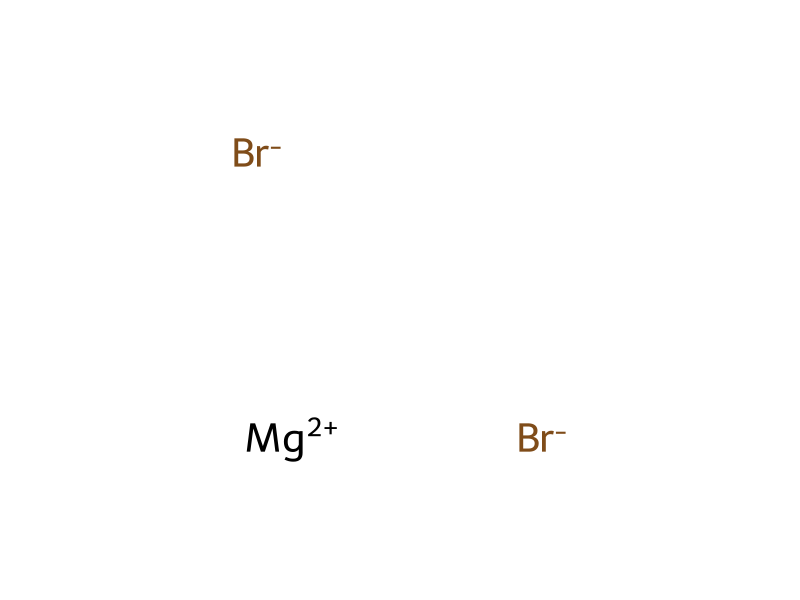
Grundinformationen
- CAS
7789-48-2- Standard-SMILES
[Br-].[Br-].[Mg+2]- InChIKey
OTCKOJUMXQWKQG-UHFFFAOYSA-L- Summenformel
- Br2Mg
- Durchschnittliche Molmasse
- 184,11 g/mol
Überblick
Magnesium bromide is a chemical compound of magnesium and bromine. It is often used as a mild sedative and as an anticonvulsant for treatment of nervous disorders. Bromine is a halogen element with the symbol Br and atomic number 35. Diatomic bromine does not occur naturally, but bromine salts can be found in crustal rock. (L625, L657)
Namen und Bezeichner
- Bevorzugter Name
- Magnesium Bromide
- IUPAC
- magnesium dibromide
- Lokaler Name
- Magnesiumbromid
- Englischer Name
- Magnesium bromide
- Summenformel
- Br2Mg
- Molmasse
- 184.11
Namen und Synonyme
Magnesium bromide7789-48-2MgBr2RefChem:155178DTXCID9048069232-170-92VC6P60SLNDTXSID7064865Magnesium bromide (MgBr2)Magnesium bromide, anhydrousmagnesiumbromideMagnesium Dibromide;
Weitere Namen anzeigen
finechemicalMagnesium dibromideMagnesium bromide 98 %magnesiumbromide(mgbr2)Magnesium bromide 7789-48-2Magnesiumbromide,anhydrous,98%
Br2MgMagnesiumbromidmagnesium-bromidemagnesium bromide saltmagnesium(II) bromidestarbld0009615magnesium bromide 6-hydrateSCHEMBL19000
Datenbank-Bezeichner
- CAS
7789-48-2- PubChem CID
- 82241
- UNII
- 2VC6P60SLN
- EC Number
- 232-170-9
- Nikkaji
- J43.879K
Eigenschaften
Berechnete StruktureigenschaftenWird ergänzt
- Polarare Oberfläche (TPSA)
- 0 Ų
- H-Brücken-Donoren
- 0
- H-Brücken-Akzeptoren
- 2
- Frei drehbare Bindungen
- 0
- Schwere Atome
- 3
- Formalladung
- 0
- Komplexität
- 0
Experimentelle und physikochemische Eigenschaften
Chemical ClassesMetals -> Metals, Inorganic Compounds
CosmeticsViscosity controlling
Physical DescriptionHexahydrate: Colorless or white solid; Highly deliquescent; [Merck Index] Hygroscopic solid; [Sigma-Aldrich MSDS]
Physikochemische Eigenschaften
- Schmelzpunkt
- 711 °C · 711 °C (lit.)
- Siedepunkt
- 1248.47 °C · 1248.47°C (estimate)
- Dichte
- 3.72 g/mL · 3.72 g/mL at 25 °C (lit.)
- Löslichkeit
- DMSO (Slightly, Heated), Methanol (Slightly), Water (Slightly)
- Aggregatzustand
- Powder
- Farbe
- off-white
- Wichte
- 3.72 · 3.72
- Wasserlöslichkeit
- 100 g · g/100g H2O: 100.6 (25°C), 125.4 (100°C); solid phase, MgBr2 ·6H2O [KRU93]
- Merck
- 13 · 13,5681
Sicherheit und Regulatorisches
Sicherheitsangaben dienen nur zur Orientierung und ersetzen weder das Sicherheitsdatenblatt (SDB) des Lieferanten noch geltende Vorschriften oder eine fachliche Bewertung.
GHS-Klassifizierung
GHS Classification
This chemical does not meet GHS hazard criteria for 8.2% (4 of 49) of reports.
Warning
H315 (91.8%): Causes skin irritation [Warning Skin corrosion/irritation]
P261, P264, P264+P265, P271, P280, P302+P352, P304+P340, P305+P351+P338, P319, P321, P332+P317, P337+P317, P362+P364, P403+P233, P405, and P501 (click each P-code to see the statement)
Aggregated GHS information provided per 49 reports by companies from 9 notifications to the ECHA C&L Inventory. Each notification may be associated with multiple companies.
Warning
Gefahrenhinweise
Regulatory Information
Chemical: Magnesium bromide (MgBr2)
Magnesium bromide (MgBr2): Does not have an individual approval but may be used as a component in a product covered by a group standard. It is not approved for use as a chemical in its own right.
Hazards SummaryA moderate irritant; Targets the CNS and kidney; [Sigma-Aldrich MSDS] See Magnesium chloride. See Bromine.
Hazard Classes and Categories
Skin Irrit. 2 (100%)
Skin Irrit. 2 (91.8%)
Toxikologische Informationen
Treatment
EYES: irrigate opened eyes for several minutes under running water. INGESTION: do not induce vomiting. Rinse mouth with water (never give anything by mouth to an unconscious person). Seek immediate medical advice. SKIN: should be treated immediately by rinsing the affected parts in cold running water for at least 15 minutes, followed by thorough washing with soap and water. If necessary, the person should shower and change contaminated clothing and shoes, and then must seek medical attention. INHALATION: supply fresh air. If required provide artificial respiration.
Chemie und Industrie
Pharmakologische Informationen
Metabolism/Metabolites
Bromine is mainly absorbed via inhalation, but may also enter the body through dermal contact. Bromine salts can be ingested. Due to its reactivity, bromine quickly forms bromide and may be deposited in the tissues, displacing other halogens. (L626)
Verwendung und Herstellung
UsesUsed in organic syntheses; Has been used as a therapeutic sedative and anticonvulsant; [Merck Index]
Use ClassificationCosmetics -> Viscosity controlling
General Manufacturing InformationMagnesium bromide (MgBr2): ACTIVE
Anwendungen
OccurrenceMagnesium bromide occurs in seawater, some mineral springs, natural brines, inland seas and lakes such as the Dead Sea and the Great Salt Lake, and salt deposits such as the Stassfurt deposits. In seawater, it is the primary source of bromine. By the action of chlorine gas upon seawater or seawater bitterns, bromine is formed. It is an electrolyte component in certain dry cells. In medicine, it is a sedative and anticonvulsant for treatment of nervous disorder. It also is used in organic synthesis forming several addition compounds.
Darstellung
synthetischeMagnesium bromide is prepared by treating MgO with hydrobromic acid and then crystallization above 0.0°C in solution. The product is the hexahydrate salt: MgO+2HBr→MgBr2+H2O→MgBr2·6H2O The anhydrous form may also be prepared by heating the hexahydrate with dry HBr gas. This compound can also be formed directly from the elements: Mg+Br2→MgBr2
Zugehörige Reaktionen
208


Notizen zur Verbindung
Wird geladen…