
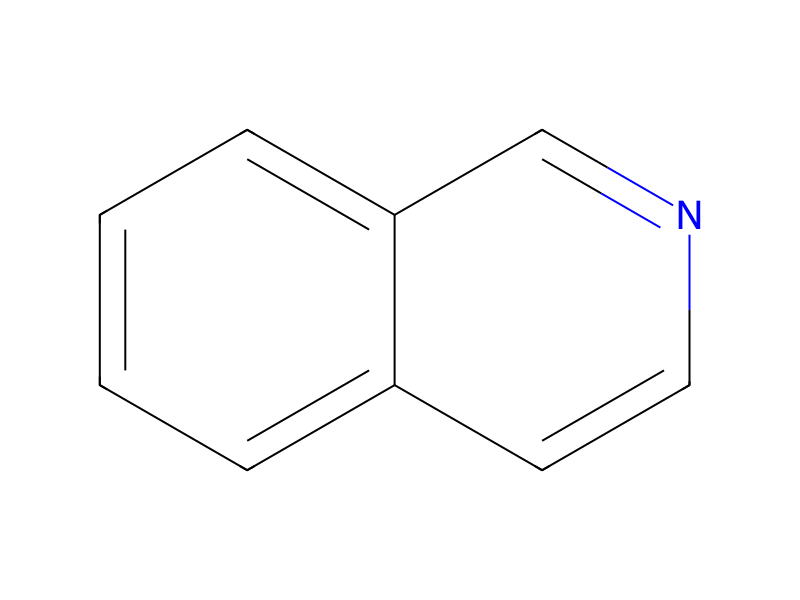
Grundinformationen
- Standard-SMILES
c1ccc2cnccc2c1- InChIKey
AWJUIBRHMBBTKR-UHFFFAOYSA-N- Summenformel
- C9H7N
- Durchschnittliche Molmasse
- 129,16 g/mol
- Monoisotopische Masse
- 129,05784923
Namen und Bezeichner
- Bevorzugter Name
- Isoquinoline
- IUPAC
- isoquinoline
- Lokaler Name
- Isochinolin
- Englischer Name
- Isoquinoline
- Summenformel
- C9H7N
- Molmasse
- 129.16
Namen und Synonyme
ISOQUINOLINE119-65-32-Benzazine2-AzanaphthaleneLeucolinebeta-QuinolineIsochinolinBenzo[c]pyridine3,4-BenzopyridineBenzo(c)pyridineFEMA No. 2978DTXSID2047644
Weitere Namen anzeigen
ISOQUINOLINBenzopyridineFEMA 2978ISOQINOLINEIsoquinoL
JGX76Y85M6NSC-3395DTXCID0027644CHEBI:16092RefChem:792283204-341-87-methoxy-1,6-dimethylisoquinoline-5,8-dione2-Benzanine
Datenbank-Bezeichner
- CAS
119-65-3- PubChem CID
- 8405
- DTXSID
DTXSID2047644- ChEMBL
CHEMBL12315- ChEBI
CHEBI:16092- UNII
- JGX76Y85M6
- EC Number
- 204-341-8
- Nikkaji
- J43.394B
Eigenschaften
Berechnete Struktureigenschaften
- XLogP
- 2,1
- Polarare Oberfläche (TPSA)
- 12,9 Ų
- H-Brücken-Donoren
- 0
- H-Brücken-Akzeptoren
- 1
- Frei drehbare Bindungen
- 0
- Schwere Atome
- 10
- Formalladung
- 0
- Komplexität
- 111
Experimentelle und physikochemische Eigenschaften
LogP
2.08
2.08
LogS-1.45
Density1.097-1.103
Solubility
4520
4.52 mg/mL at 25 °C
Slightly soluble in water
Soluble (in ethanol)
Boiling Point
243.2
242.00 to 243.00 °C. @ 760.00 mm Hg
242-243 °C
Melting Point
26.47
25.5 - 26 °C
Refractive Index1.621-1.627
Physical Description
Liquid
Liquid or hygroscopic solid with a pungent odor like anise oil mixed with benzaldehyde; mp = 26.48 deg C; [Merck Index] Light brown; mp = 24-28 deg C; [Acros Organics MSDS]
Solid
Colourless liquid, hygroscopic platelets when solid; Heavy-sweet balsamic, herbaceous aroma
Dissociation Constants5.42 (at 20 °C)
Kovats Retention Index
1225.2;1251;1269;1251;1269;1248;1272.9;1250.7;1240;1241.6;213.19
1255;1261;1225;1268;1261;1265;1275.5;1261.2;214;212.1;214.14;214.68;214.41;214.09;214.14;215.61
1934;1958;1934;1958;1934;1958;1955;1980
Collision Cross Section122.3 Ų [M+H]+ [CCS Type: DT; Buffer gas: N2; Ionization: APCI+; Dataset: TOXCAST; Source Identifier: DTXSID2047644]
Physikochemische Eigenschaften
- Schmelzpunkt
- 26 · 26-28 °C (lit.)
- Siedepunkt
- 242 · 242-243 °C (lit.)
- Dichte
- 1.099 g/mL · 1.099 g/mL at 25 °C (lit.)
- Dampfdruck
- 5 Pa · 5Pa at 20℃
- FEMA
- 2978 · 2978 | ISOQUINOLINE
- Brechungsindex
- 20 · n20/D 1.623(lit.)
- Flammpunkt
- 225 °F · 225 °F
- storage temp.
- 2 · 2-8°C
- Löslichkeit
- 5 g/l · 5g/l
- pka
- 5.42 · 5.42(at 20℃)
- Aggregatzustand
- Low Melting Solid
- Farbe
- Light brown
- PH
- 7.5 · 7.5 (5g/l, H2O, 20℃)
- Geruch (Odor)
- 0.1 % · at 0.10 % in triacetin. sweet balsam herbal benzaldehyde anise
- Geruchsart
- balsamic
- Wasserlöslichkeit
- practically insoluble
- Spezifische Wärmekapazität
- 1.52 J/ · Cp(liquid): 1.52 J/(g·K), at 25℃
- JECFA Number
- 1303 · 1303
- Merck
- 14 · 14,5222
- BRN
- 107549 · 107549
- Henry's Law Constant
- 5.2 · 5.2×10-2 mol/(m3Pa) at 25℃, Mackay et al. (2006)
- Dielectric constant
- 10.7 · 10.7(20℃)
- InChI
- 1S/C9H7N/c1-2-4-9-7-10-6-5-8(9)3-1/h1-7H
- InChIKey
- AWJUIBRHMBBTKR-UHFFFAOYSA-N
- SMILES
- c1ccc2cnccc2c1
- LogP
- 2.08 · 2.08
- CAS Datenbank
- 119 · 119-65-3(CAS DataBase Reference)
- NIST chemische Informationen
- Isoquinoline(119-65-3)
- EPA chemische Informationen
- Isoquinoline (119-65-3)
Sicherheit und Regulatorisches
GHS-Klassifizierung
GHS Classification
This chemical does not meet GHS hazard criteria for < 0.1% (1 of 1677) of reports.
Danger
H302 (> 99.9%): Harmful if swallowed [Warning Acute toxicity, oral];H311 (99.6%): Toxic in contact with skin [Danger Acute toxicity, dermal];H315 (93.4%): Causes skin irritation [Warning Skin corrosion/irritation];H319 (93.4%): Causes serious eye irritation [Warning Serious eye damage/eye irritation]
P262, P264, P264+P265, P270, P280, P301+P317, P302+P352, P305+P351+P338, P316, P321, P330, P332+P317, P337+P317, P361+P364, P362+P364, P405, and P501 (click each P-code to see the statement)
Aggregated GHS information provided per 1677 reports by companies from 8 notifications to the ECHA C&L Inventory. Each notification may be associated with multiple companies.;Reported as not meeting GHS hazard criteria per 1 of 1677 reports by companies.;There are 7 notifications provided by 1676 of 1677 reports by companies with hazard statement code(s).;Information may vary between notifications depending on impurities, additives, and other factors. The percentage value in parenthesis indicates the notified classification ratio from companies that provide hazard codes. Only hazard codes with percentage values above 10% are shown. For more detailed information, please visit ECHA C&L website.
Gefahrenhinweise
Regulatory Information
Chemical: Isoquinoline
Commission Regulation (EC) No 1565/2000 (Repealed by Com. Implementing Reg. (EU) No 872/2012)
Isoquinoline is listed on the EPA's Chemical Data Reporting (CDR) system. Manufacturers and importers of Isoquinoline are required to report information about their production and use of this chemical to the EPA under the Toxic Substances Control Act (TSCA). (40 eCFR Part 711)
Status: Active Update: 07-01-2011 https://echa.europa.eu/registration-dossier/-/registered-dossier/5236;Status: No longer Valid Update: 30-09-2010 https://echa.europa.eu/registration-dossier/-/registered-dossier/1356
Isoquinoline: Does not have an individual approval but may be used under an appropriate group standard
Hazards SummaryA moderate skin irritant; [RTECS] Safe when used as a flavoring agent in food; [JECFA] An irritant; Highly toxic by skin absorption; Harmful by ingestion; [Acros Organics MSDS] See Quinoline.
Hazard Classes and Categories
Acute Tox. 4 (> 99.9%);Acute Tox. 3 (99.6%);Skin Irrit. 2 (93.4%);Eye Irrit. 2 (93.4%)
Acute toxicity (Oral) - Category 4;Hazardous to the aquatic environment (Acute) - Category 3;Hazardous to the aquatic environment (Long-term) - Category 3
Toxikologische Informationen
USGS Health-Based Screening Levels for Evaluating Water-Quality
Isoquinoline
Waste-water effluent contaminant
Smith, C.D. and Nowell, L.H., 2024. Health-Based Screening Levels for evaluating water-quality data (3rd ed.). DOI:10.5066/F71C1TWP
Regulatorische Informationen
Regulatory Information
Chemical: Isoquinoline
Commission Regulation (EC) No 1565/2000 (Repealed by Com. Implementing Reg. (EU) No 872/2012)
Isoquinoline is listed on the EPA's Chemical Data Reporting (CDR) system. Manufacturers and importers of Isoquinoline are required to report information about their production and use of this chemical to the EPA under the Toxic Substances Control Act (TSCA). (40 eCFR Part 711)
Status: Active Update: 07-01-2011 https://echa.europa.eu/registration-dossier/-/registered-dossier/5236;Status: No longer Valid Update: 30-09-2010 https://echa.europa.eu/registration-dossier/-/registered-dossier/1356
Isoquinoline: Does not have an individual approval but may be used under an appropriate group standard
Sicherheitsdaten
- wgk
- 2
- tsca
- TSCA listed
- ridadr
- UN 2811 6.1/PG 3
- hs_code
- 29334900
- RTECS-Nr.
- NW6825000
- risk_code
- 22-24-38-52/53-36/38-21/22-45
- Toxizität
- LD50 orally in rats: 360 mg/kg (Smyth)
- hazard_code
- T
- safety_code
- 36/37-45-36/37/39-61-53
- hazard_class
- 6.1
- packing_group
- II
- Speicherklasse
- 6.1C - Combustible acute toxic Cat.3toxic compounds or compounds which causing chronic effects
- Hazard Classifications
- Acute Tox. 3 DermalAcute Tox. 4 OralAquatic Chronic 3Eye Irrit. 2Skin Irrit. 2
Chemie und Industrie
Pharmakologische Informationen
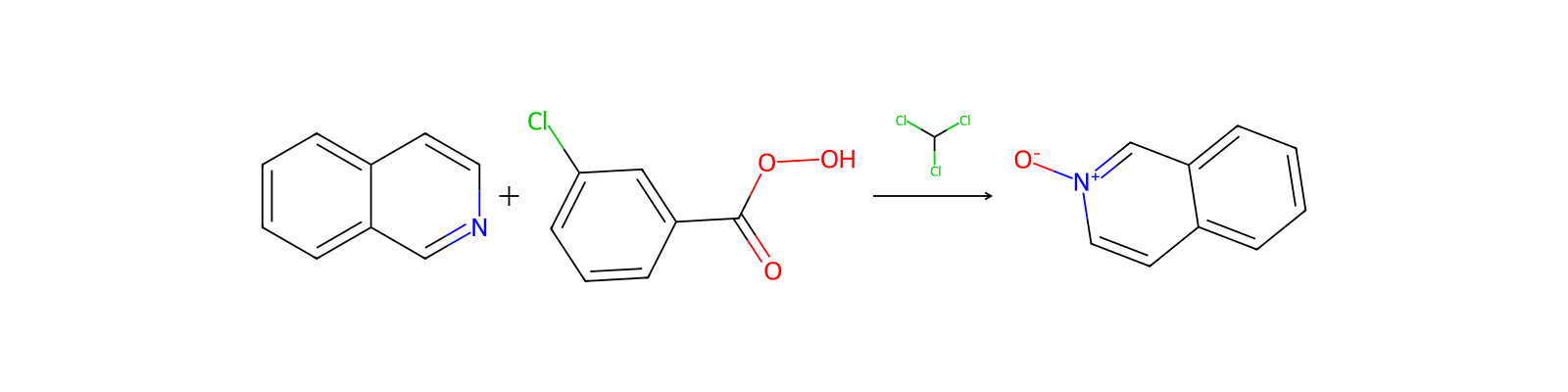
Metabolism/MetabolitesIsoquinoline has known human metabolites that include isoquinoline N-oxide.
Cellular LocationsCytoplasm;Extracellular
Verwendung und Herstellung
UsesPresent in coal tar; Used to make dyes, insecticides, antimalarials, and rubber accelerators; [Merck Index] Used as flavoring agent or adjuvant; [FDA]
U.S. Production2023: 25,000,000 - <75,000,000 lb;2022: 75,000,000 - <150,000,000 lb;2021: 150,000,000 - <500,000,000 lb;2020: 25,000,000 - <75,000,000 lb
Industry UsesCatalyst
Use Classification
Flavouring Agent -> FLAVOURING_AGENT -> JECFA Functional Classes
Flavoring Agents -> JECFA Flavorings Index
Flavouring Agent -> FLAVOURING_AGENT -> JECFA Functional Classes
Flavouring Agent -> FLAVOURING_AGENT -> JECFA Functional Classes
Flavouring Agent -> FLAVOURING_AGENT -> JECFA Functional Classes
General Manufacturing Information
Plastics Material and Resin Manufacturing
Isoquinoline: ACTIVE
Anwendungen
BeschreibungIsoquinoline, also known as 2-azanaphthalene, benzo[c]pyridine, or 2-benzanine, is a structural isomer of quinoline. It has structural and spectroscopic properties similar to quinoline. Isoquinoline was first isolated in 1885 by Hoogewerf and van Dorp from the quinoline fraction of coal tar by fractional crystallization. It is used to prepare dyes, insecticides, and antimalarial compounds, among other things.
VerwendenIsoquinolines are used in the manufacture of dyes, paints, insecticides and antifungals. It is also used as a solvent for the extraction of resins and terpenes, and as a corrosion inhibitor.Isoquinoline (isq) has been used:in the preparation of cis-[(dcbH2)2Ru(isq)2](ClO4)2 [dcbH2 = 4,4′-(CO2H)2-2,2′-bipyridine].to investigate the toxicity of three two-ring and five three-ring azaarenes to the green alga Scenedesmus acuminatus and its relationship with molecular structure.
Darstellung
synthetischeBischler-Napieralski synthesis is used to synthesize isoquinolines. β-phenylethylamine is acylated, and then cyclodehydrated using phosphoryl chloride, phosphorus pentoxide or other Lewis acids to yield dihydroisoquinoline, which can be aromatized by dehydrogenation with palladium, for example in the synthesis of papaverine, a pharmacologically active isoquinoline alkaloid.Pictet-Spengler synthesis is another method of preparing isoquinolines. β-phenylethylamine reacts with an aldehyde to produce an imine, which undergoes acid-catalysed cyclization, resulting in the synthesis of the tetrahydroisoquinoline system. Again, tetrahydroisoquinoline can be aromatized by palladium dehydrogenation to produce an isoquinoline system.
Vor- und nachgelagerte Produkte
Vorgelagerte Rohstoffe
Nachgelagerte Produkte
Ergänzende Hinweise
DefinitionChEBI: Isoquinoline is an ortho-fused heteroarene that is a benzopyridine in which the N atom not directly attached to the benzene ring. It is a mancude organic heterobicyclic parent, an azaarene, an ortho-fused heteroarene and a member of isoquinolines.
Zugehörige Reaktionen
279




Verknüpfte Notizen
Wird geladen…