
HRID 7011als Edukt
2-Bromo-3-methylthiophene
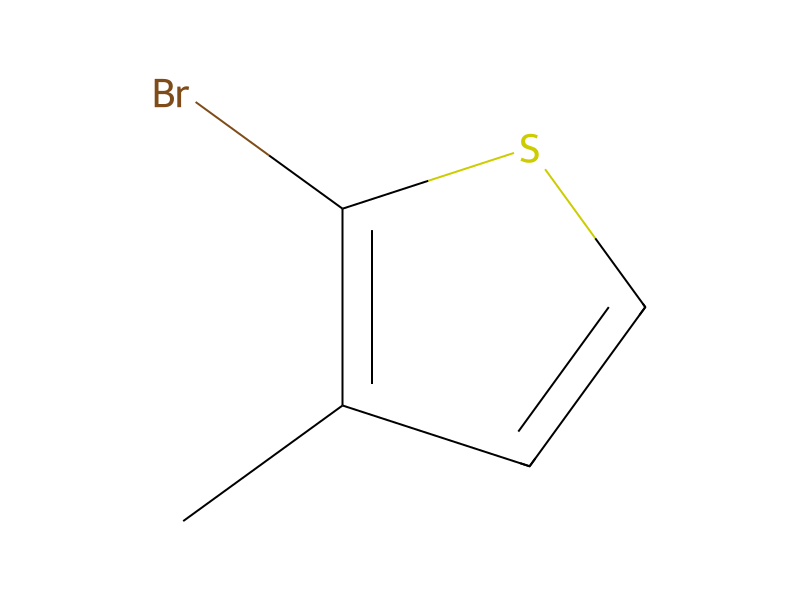
14282-76-9Cc1ccsc1BrYYJBWYBULYUKMR-UHFFFAOYSA-N14282-76-9DTXSID20162194Sicherheitsangaben dienen nur zur Orientierung und ersetzen weder das Sicherheitsdatenblatt (SDB) des Lieferanten noch geltende Vorschriften oder eine fachliche Bewertung.
Danger
H302 (97.8%): Harmful if swallowed [Warning Acute toxicity, oral]
P261, P264, P264+P265, P270, P271, P280, P301+P317, P302+P352, P304+P340, P305+P354+P338, P317, P319, P321, P330, P332+P317, P362+P364, P403+P233, P405, and P501 (click each P-code to see the statement)
Aggregated GHS information provided per 46 reports by companies from 4 notifications to the ECHA C&L Inventory. Each notification may be associated with multiple companies.
Verwenden2-Bromo-3-methylthiophene was used in the preparation of poly(3,3′′′-dimethyl-(2,2′:5′,2′:5′,2′′′)tetrathiophene)). It was also used in the preparation of 2-bromo-3-(bromomethyl)thiophene, lachrymatory compound.
synthetische2-Bromo-3-methylthiophene synthesis: To a solution of glacial AcOH (100 mL), acetic anhydride (4.0 g, 0.039 mol), and 3-methylthiophene (9.82 g, 0.100 mol) as a stirred mixture was added NBS (19.6 g, 0.11 mol) in one portion with a slight exotherm to 44 oC. After 20 min the reaction mixture was poured onto ice, neutralized with sodium bisulfite and extracted with ether. The ether layer was washed with water and concentrated to give 11.3 g (64%) of 2-bromo-3-methylthiophene as a tan colored liquid in 88% purity by GC area % analysis: 1H NMR (CDCl3) d 7.1 (d, 1H, J=5.7 Hz), 6.7 (d, 1H, J=5.9 Hz), 2.2 (s, 3H).


