2,8,9-Trioxa-5-aza-1-borabicyclo[3.3.3]undecan
Triethanolamine borate
HCID 84862
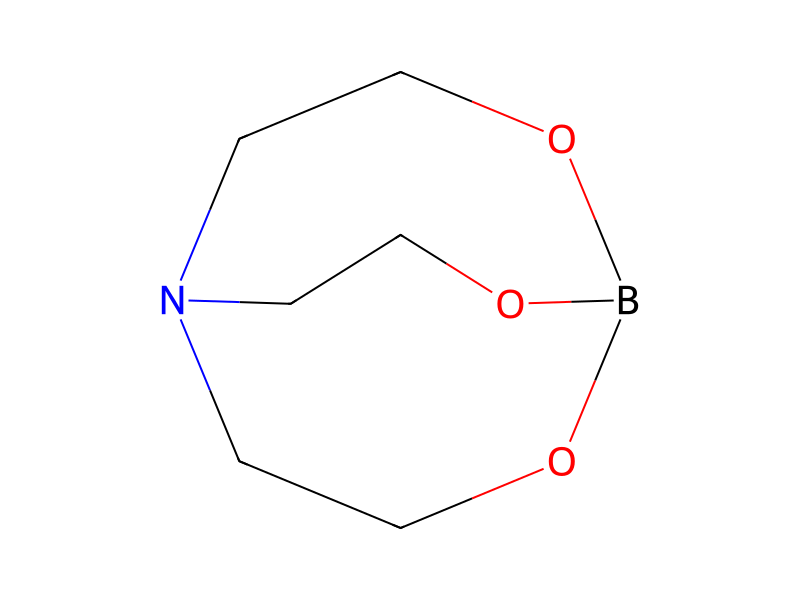
Grundinformationen
- CAS
15277-97-1- Standard-SMILES
C1CN2CCOB(O1)OCC2- InChIKey
NKPKVNRBHXOADG-UHFFFAOYSA-N- Summenformel
- C6H12BNO3
- Durchschnittliche Molmasse
- 156,98 g/mol
- Monoisotopische Masse
- 157,0910234
Namen und Bezeichner
- Bevorzugter Name
- Triethanolamine borate
- IUPAC
- 2,8,9-trioxa-5-aza-1-borabicyclo[3.3.3]undecane
- Lokaler Name
- 2,8,9-Trioxa-5-aza-1-borabicyclo[3.3.3]undecan
- Englischer Name
- Triethanolamine borate
- Summenformel
- C6H12BNO3
- Molmasse
- 156.98
Namen und Synonyme
283-56-72,8,9-Trioxa-5-aza-1-borabicyclo[3.3.3]undecaneBoratraneBoratranAtracor TBORIC ACID, TRIS(2-AMINOETHYL) ESTERNSC 52202,2',2''-Nitrilotriethanol cyclic borateEINECS 206-003-52N1AHN0X56Boron, ((2,2',2''-nitrilotris(ethanolato))(3-))-BRN 0774536
Weitere Namen anzeigen
C6H12BNO3atracortTRIETHANOLAMINE BORATETriethanolaMine borate 97%TRIS(HYDROXYETHYL)AMINE BORATETRIHYDROXYTRIETHYLAMINE BORATE2,2',2''-Nitrilotriethyl borate
ARBORITE BINDER 75NSC-5220Ethanol, 2,2',2''-nitrilotri-, cyclic borate4-04-00-01529 (Beilstein Handbook Reference)2,8,9-Trioxa-5-aza-1-borabicyclo(3.3.3)undecaneEthanol, 2,2',2''-nitrilotri-, cyclic ester with boric acid (H3BO3) (1:1)TRIETHANOLAMINE BORATE (ESTER)Ethanol, 2,2',2''-nitrilotri-, cyclic borate (7CI)
Datenbank-Bezeichner
- CAS
15277-97-1、283-56-7- PubChem CID
- 84862
- DTXSID
DTXSID701355429- UNII
- 2N1AHN0X56
- EC Number
- 206-003-5、239-317-6
- Nikkaji
- J25F
Eigenschaften
Berechnete Struktureigenschaften
- Polarare Oberfläche (TPSA)
- 30,9 Ų
- H-Brücken-Donoren
- 0
- H-Brücken-Akzeptoren
- 4
- Frei drehbare Bindungen
- 0
- Schwere Atome
- 11
- Formalladung
- 0
- Komplexität
- 111
Physikochemische Eigenschaften
- Schmelzpunkt
- 235 · 235-237 °C(lit.)
- Siedepunkt
- 149.6 · 149.6±39.0 °C(Predicted)
- Dichte
- 1.13 · 1.13±0.1 g/cm3(Predicted)
- storage temp.
- Room Temperature, under inert atmosphere
- Löslichkeit
- slightly soluble in acetone, benzene
- pka
- 6.4 · 6.40±0.20(Predicted)
- Aggregatzustand
- Powder
- Farbe
- white
- Geruch (Odor)
- odorless
- BRN
- 774536 · 774536
- InChI
- InChI=1S/C6H12BNO3/c1-4-9-7-10-5-2-8(1)3-6-11-7/h1-6H2
- InChIKey
- NKPKVNRBHXOADG-UHFFFAOYSA-N
- SMILES
- B12OCCN(CCO1)CCO2
- CAS Datenbank
- 283 · 283-56-7
Sicherheit und Regulatorisches
Sicherheitsangaben dienen nur zur Orientierung und ersetzen weder das Sicherheitsdatenblatt (SDB) des Lieferanten noch geltende Vorschriften oder eine fachliche Bewertung.
GHS-Klassifizierung
GHS Classification
This chemical does not meet GHS hazard criteria for 26.1% (23 of 88) of reports.
Danger
H315 (29.5%): Causes skin irritation [Warning Skin corrosion/irritation]
P261, P264, P264+P265, P271, P280, P302+P352, P304+P340, P305+P351+P338, P305+P354+P338, P317, P319, P321, P332+P317, P337+P317, P362+P364, P403+P233, P405, and P501 (click each P-code to see the statement)
Aggregated GHS information provided per 88 reports by companies from 4 notifications to the ECHA C&L Inventory. Each notification may be associated with multiple companies.
Warning
Gefahrenhinweise
Regulatory Information2,8,9-Trioxa-5-aza-1-borabicyclo[3.3.3]undecane: Does not have an individual approval but may be used as a component in a product covered by a group standard. It is not approved for use as a chemical in its own right.
Hazard Classes and Categories
Skin Irrit. 2 (29.5%)
Skin Irrit. 2 (100%)
Sicherheitsdaten
- F
- 10-21
- wgk
- 3
- hs_code
- 2916399090
- RTECS-Nr.
- YJ8968050
- risk_code
- 36/37/38
- Toxizität
- LD ivn-mus: >100 mg/kg EJMCA5 13,207,78
- hazard_code
- Xi
- safety_code
- 26-36/37
- Speicherklasse
- 11 - Combustible Solids
- Hazard Classifications
- Eye Irrit. 2Skin Irrit. 2STOT SE 3
Chemie und Industrie
Verwendung und Herstellung
General Manufacturing InformationBoron, [[2,2',2''-(nitrilo-.kappa.N)tris[ethanolato-.kappa.O]](3-)]-, (T-4)-: ACTIVE
Anwendungen
VerwendenTriethanolamine Borate is an intermediate in the synthesis of Silatrane (S433000) which can be used as a reversible cholinesterase inhibitor. Silatrane and its derivatives can also be used as antitumor agents.
Darstellung
synthetischetriethanolamine borate synthesis: Adding trimethyl borate into the reaction bottle62.7g (0.6mol), 74.6g (0.5mol) of triethanolamine and 300g of toluene are slowly heated to reflux for 1 hour at room temperature, then distillate is distilled out under normal pressure (65-100°C) while reaction is carried out, sampling is carried out by GC detection, after the reaction is finished, reduced pressure concentration is carried out until no liquid distillation is carried out, acetonitrile is added for recrystallization, filtration and drying are carried out, 68g of white solid is obtained, HPLC (high performance liquid chromatography) is 98.8%, and the yield is 86.6%.
Vor- und nachgelagerte Produkte
Vorgelagerte Rohstoffe
Nachgelagerte Produkte
Zugehörige Reaktionen
0
Noch keine zugehörigen Reaktionen