4,4,7,7-Tetraethoxy-3,8-dioxa-4,7-disiladecan
Bis(triethoxysilyl)ethane
Daten werden ergänzt – lade die Seite später neu, um den aktuellen Stand zu sehen

Grundinformationen
- CAS
16068-37-4- Standard-SMILES
CCO[Si](CC[Si](OCC)(OCC)OCC)(OCC)OCC- InChIKey
IZRJPHXTEXTLHY-UHFFFAOYSA-N- Summenformel
- C14H34O6Si2
- Durchschnittliche Molmasse
- 354,59 g/mol
- Monoisotopische Masse
- 354,18939187
Überblick
structure in first source
Namen und Bezeichner
- Bevorzugter Name
- Bis(triethoxysilyl)ethane
- IUPAC
- triethoxy(2-triethoxysilylethyl)silane
- Lokaler Name
- 4,4,7,7-Tetraethoxy-3,8-dioxa-4,7-disiladecan
- Englischer Name
- 1,2-Bis(triethoxysilyl)ethane
- Summenformel
- C14H34O6Si2
- Molmasse
- 354.59
Namen und Synonyme
1,2-Bis(triethoxysilyl)ethane16068-37-43,8-Dioxa-4,7-disiladecane, 4,4,7,7-tetraethoxy-F57B935G98DTXSID7051763RefChem:71744DTXCID6030318240-212-2Bis(triethoxysilyl)ethane4,4,7,7-Tetraethoxy-3,8-dioxa-4,7-disiladecanetriethoxy(2-triethoxysilylethyl)silaneC14H34O6Si2
Weitere Namen anzeigen
KH-526CFS-374Silquest Y 9805Co-Formula CFS-3741,2-Bis(triethoxysiLHEXAETHOXYDISILETHYLENE2-Bis(triethoxysilyl)ethane
MFCD00239362S02108Ethylenebis(triethoxysilane)EINECS 240-212-21,2-Bis(triethoxysilyl)ethane,UNII-F57B935G98Ethylenebis(triethoxysilane);triethoxy(2-triethoxysilylethyl)silane;4,4,7,7-Tetraethoxy-3,8-dioxa-4,7-disiladecane;SCHEMBL35088
Datenbank-Bezeichner
- CAS
16068-37-4
Eigenschaften
Berechnete StruktureigenschaftenWird ergänzt
- Polarare Oberfläche (TPSA)
- 55,4 Ų
- H-Brücken-Donoren
- 0
- H-Brücken-Akzeptoren
- 6
- Frei drehbare Bindungen
- 15
- Schwere Atome
- 22
- Formalladung
- 0
- Komplexität
- 208
Experimentelle und physikochemische Eigenschaften
Food Contact SubstancesFCS -> FDA Cumulative Estimated Daily Intake (CEDI)
Physical DescriptionLiquid
Physikochemische Eigenschaften
- Schmelzpunkt
- -20 · -20-10°C
- Siedepunkt
- 119 °C · 119 °C(lit.)
- Dichte
- 0.958 g/mL · 0.958 g/mL at 25 °C(lit.)
- Dampfdruck
- 0 · 0-7910Pa at 20-25℃
- Brechungsindex
- 20 · n20/D 1.411(lit.)
- Flammpunkt
- 230 °F · >230 °F
- storage temp.
- Keep in dark place,Sealed in dry,Room Temperature
- Aggregatzustand
- clear liquid
- Farbe
- Colorless to Almost colorless
- Wichte
- 0.957 · 0.957
- Wasserlöslichkeit
- Soluble in alcohol, aromatic and aliphatic hydrocarbons. Hydrolyzes with water.
Sicherheit und Regulatorisches
Sicherheitsangaben dienen nur zur Orientierung und ersetzen weder das Sicherheitsdatenblatt (SDB) des Lieferanten noch geltende Vorschriften oder eine fachliche Bewertung.
GHS-Klassifizierung
GHS Classification
Danger
H301 (65.7%): Toxic if swallowed [Danger Acute toxicity, oral]
P260, P261, P264, P264+P265, P270, P271, P273, P280, P301+P316, P302+P352, P304+P340, P305+P354+P338, P317, P319, P321, P330, P332+P317, P362+P364, P403+P233, P405, and P501 (click each P-code to see the statement)
Aggregated GHS information provided per 230 reports by companies from 11 notifications to the ECHA C&L Inventory. Each notification may be associated with multiple companies.
Gefahrenhinweise
Regulatory Information
Chemical: 3,8-Dioxa-4,7-disiladecane, 4,4,7,7-tetraethoxy-
Regulation (EC) No 1935/2004 (amended)
3,8-Dioxa-4,7-disiladecane, 4,4,7,7-tetraethoxy- is listed on the EPA's Chemical Data Reporting (CDR) system. Manufacturers and importers of 3,8-Dioxa-4,7-disiladecane, 4,4,7,7-tetraethoxy- are required to report information about their production and use of this chemical to the EPA under the Toxic Substances Control Act (TSCA). (40 eCFR Part 711)
PMN - indicates a commenced PMN (Pre-Manufacture Notices) substance.
Status: Active Update: 01-07-2022 https://echa.europa.eu/registration-dossier/-/registered-dossier/23679
3,8-Dioxa-4,7-disiladecane, 4,4,7,7-tetraethoxy-: Does not have an individual approval but may be used as a component in a product covered by a group standard. It is not approved for use as a chemical in its own right.
Hazard Classes and CategoriesAcute Tox. 3 (65.7%)
Sicherheitsdaten
- wgk
- 3
- tsca
- TSCA listed
- ridadr
- 2810
- hs_code
- 29319090
Chemie und Industrie
Verwendung und Herstellung
U.S. Production2023: 25,000 - <50,000 lb
Consumer UsesMonomers
Industry UsesMonomers
General Manufacturing Information
Paint and Coating Manufacturing
3,8-Dioxa-4,7-disiladecane, 4,4,7,7-tetraethoxy-: ACTIVE
Anwendungen
Verwenden1,2-Bis(triethoxysilyl)ethane is used as coating auxiliary agents, leather auxiliary agents, plastic auxiliary agents, surfactants and textile auxiliary agents. It is used to prepare mesoporous organosilica materials.
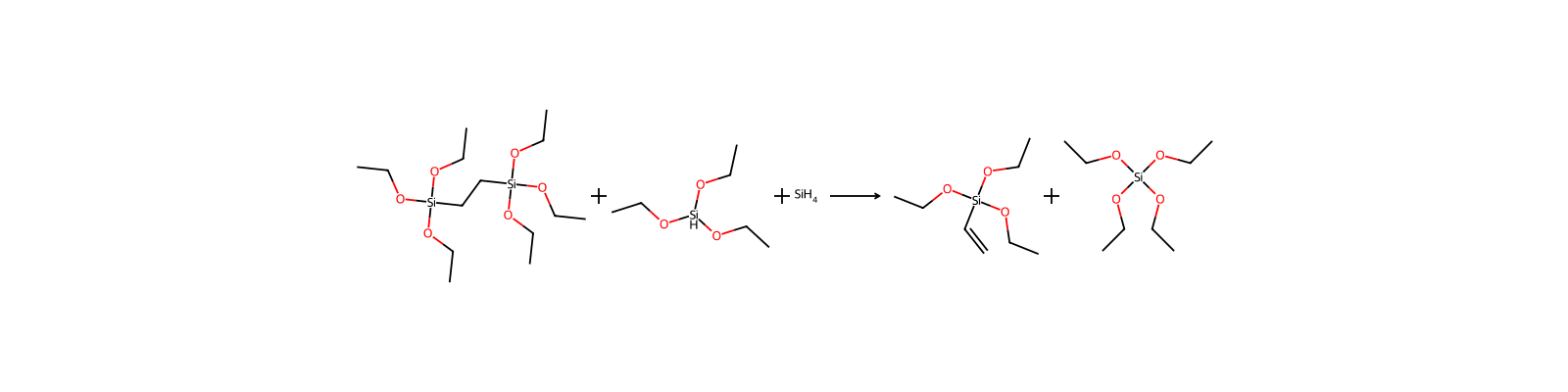
Zugehörige Reaktionen
3


Notizen zur Verbindung
Wird geladen…