
O-(2,4-Dinitrophenyl)hydroxylamin
O-(2,4-dinitrophenyl)hydroxylamine
Daten werden ergänzt – lade die Seite später neu, um den aktuellen Stand zu sehen
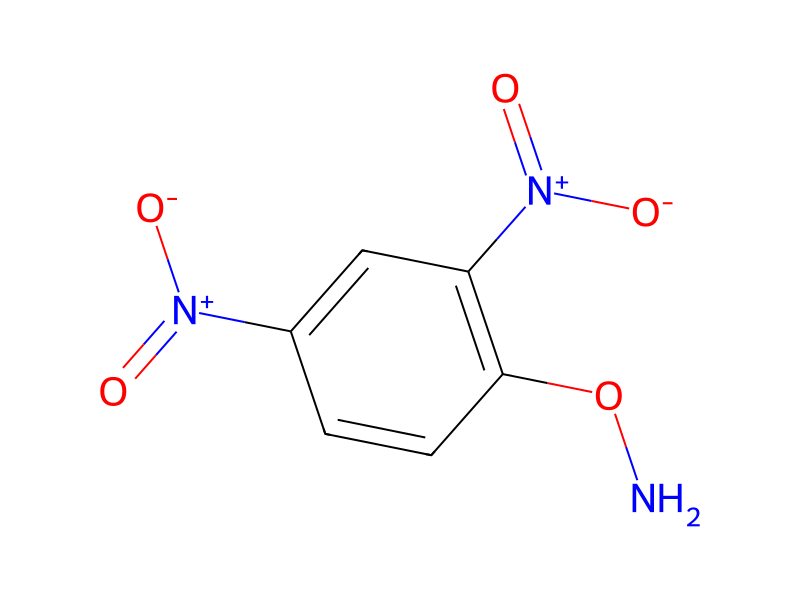
Grundinformationen
- CAS
17508-17-7- Standard-SMILES
NOc1ccc([N+](=O)[O-])cc1[N+](=O)[O-]- InChIKey
YLACRFYIUQZNIV-UHFFFAOYSA-N- Summenformel
- C6H5N3O5
- Durchschnittliche Molmasse
- 199,12 g/mol
- Monoisotopische Masse
- 199,02292026
Überblick
structure given in first source
Namen und Bezeichner
- Bevorzugter Name
- O-(2,4-dinitrophenyl)hydroxylamine
- IUPAC
- O-(2,4-dinitrophenyl)hydroxylamine
- Lokaler Name
- O-(2,4-Dinitrophenyl)hydroxylamin
- Englischer Name
- O-(2,4-dinitrophenyl)hydroxylamine
- Summenformel
- C6H5N3O5
- Molmasse
- 199.12
Namen und Synonyme
O-(2,4-Dinitrophenyl)hydroxylamine17508-17-72,4-Dinitrophenoxyamine2,4-Nitrophenoxyamine1-Aminooxy-2,4-dinitrobenzeneI1308NOV00NSC-148499DTXSID20169926RefChem:855089DTXCID4092417241-512-6Hydroxylamine, O-(2,4-dinitrophenyl)-
Weitere Namen anzeigen
2,4-DinitrophenylhydroxylamineNSC 1484994-dinitrophenyl)hydroxylamine1-aMinooxy-2,4-dinitro-benzeneHydroxylaMine,O-(2,4-dinitrophenyl)-O-(2,4-Dinitrophenyl)hydroxylamine,98%TIANFUCHEM--17508-17-7---O-(2,4-dinitrophenyl)hydroxylamine
DNPAC6H5N3O5MFCD00075001O-(2,4-dinitro-phenyl)-hydroxylamineUNII-I1308NOV001-(aminooxy)-2,4-dinitrobenzene1-Aminooxy-2,4-dinitrobenzene; 2,4-Dinitrophenoxyamine; 2,4-Nitrophenoxyamine; DNPA; NSC 148499;EINECS 241-512-6
Datenbank-Bezeichner
- CAS
Eigenschaften
Berechnete StruktureigenschaftenWird ergänzt
- XLogP
- 0,7
- Polarare Oberfläche (TPSA)
- 127 Ų
- H-Brücken-Donoren
- 1
- H-Brücken-Akzeptoren
- 6
- Frei drehbare Bindungen
- 1
- Schwere Atome
- 14
- Formalladung
- 0
- Komplexität
- 235
Physikochemische Eigenschaften
- Schmelzpunkt
- 112.5 °C · 112.5°C
- Siedepunkt
- 336.62 °C · 336.62°C (rough estimate)
- Dichte
- 1.6937 · 1.6937 (rough estimate)
- Brechungsindex
- 1.691 · 1.6910 (estimate)
- storage temp.
- 2 · 2-8°C(protect from light)
- Löslichkeit
- DMSO (Sparingly), Methanol (Slightly)
- Aggregatzustand
- solid
- pka
- -1.07 · -1.07±0.70(Predicted)
- Farbe
- yellow
- InChI
- InChI=1S/C6H5N3O5/c7-14-6-2-1-4(8(10)11)3-5(6)9(12)13/h1-3H,7H2
- InChIKey
- YLACRFYIUQZNIV-UHFFFAOYSA-N
- SMILES
- NOC1=CC=C([N+]([O-])=O)C=C1[N+]([O-])=O
Sicherheit und Regulatorisches
Sicherheitsangaben dienen nur zur Orientierung und ersetzen weder das Sicherheitsdatenblatt (SDB) des Lieferanten noch geltende Vorschriften oder eine fachliche Bewertung.
GHS-Klassifizierung
GHS Classification
Warning
H302 (95.6%): Harmful if swallowed [Warning Acute toxicity, oral]
P261, P264, P270, P272, P280, P301+P317, P302+P352, P321, P330, P333+P317, P362+P364, and P501 (click each P-code to see the statement)
Aggregated GHS information provided per 45 reports by companies from 6 notifications to the ECHA C&L Inventory. Each notification may be associated with multiple companies.
Gefahrenhinweise
Hazard Classes and CategoriesAcute Tox. 4 (95.6%)
Sicherheitsdaten
- tsca
- No
- hs_code
- 29221990
- risk_code
- 22-36/37/38
- safety_code
- 26
Chemie und Industrie
Anwendungen
VerwendenO-(2,4-Dinitrophenyl)hydroxylamine is a rapid active-site-directed inhibitor of D-amino acid oxidase; modification results in specific incorporation of an amine group into an accessible nucleophilic r esidue with concomitant release of 2,4-dinitrophenol.
Darstellung
synthetischeTo a stirred solution of 13.3 gm (0.1 mole) of t-butyl JV-hydroxycar-bamate and 5.6 gm (0.1 mole) of potassium hydroxide in 200 ml of absolute ethanol is added 20.2 gm (0.1 mole) of 2,4-dinitrochlorobenzene. The resultant deep red solution is stirred at room temperature for 1 hr; then enough glacial acetic acid is added dropwise to produce a light yellow solution. The solution is poured into 1.5 liters of cold water. The yellow oil which separates is gradually converted to crystals. The solid -butyl JV-(2,4-dinitrophenoxy)carbamate is separated, dried, and recrystallized from an ethyl acetate-hexane mixture to afford 16.4 gm (53%), m.p. 74-75°C. To 15 ml of trifluoroacetic acid is added 4 gm (0.0133 mole) of the i-butyl J/V-(2,4-dinitrophenoxy)carbamate. After the evolution of carbon dioxide has subsided, the solution is poured into 100 ml of ice water. The resultant oily layer crystallizes on standing to afford 2.5 gm (95%), m.p. 112°C (from ethanol). Recently it was discovered that the alkylation of ethyl JV-hydroxy-carbamate under alkaline conditions, particularly in a DMF medium at 60°C in the presence of sodium bicarbonate, leads to the ultimate formation of O-alkylated hydroxylamines. On the other hand, at 80-85°C, the direct alkylation without the presence of a base ultimately leads to N-alkylhydrox-ylamines (see Table I) [59]. The reaction of ethylazidoformate with an alcohol, while perhaps hazardous, may have some merit (Eqs. 31-33). The overall yield, based on ethyl chloroformate, is said to be on the order of 60%.
Vor- und nachgelagerte Produkte
Vorgelagerte Rohstoffe
Zugehörige Reaktionen
86


Notizen zur Verbindung
Wird geladen…