
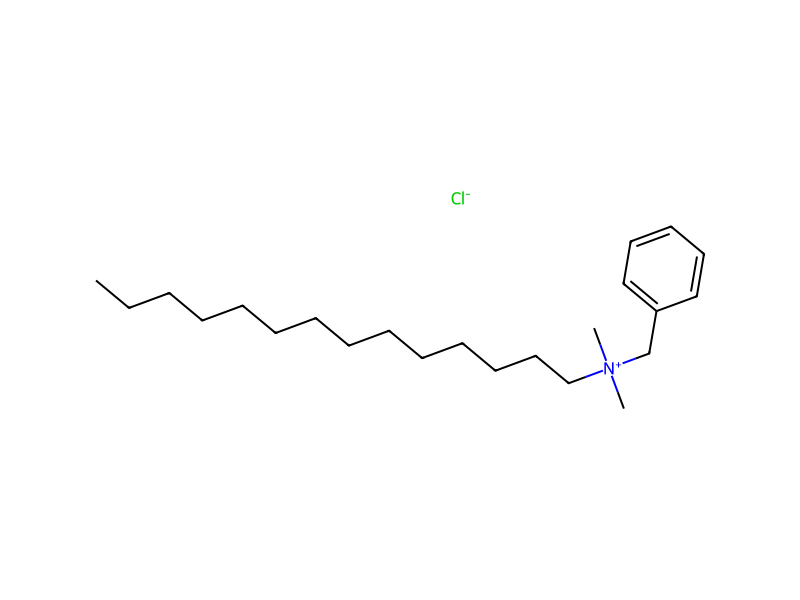
Grundinformationen
- Standard-SMILES
CCCCCCCCCCCCCC[N+](C)(C)Cc1ccccc1.[Cl-]- InChIKey
OCBHHZMJRVXXQK-UHFFFAOYSA-M- Summenformel
- C23H42ClN
- Durchschnittliche Molmasse
- 368 g/mol
- Monoisotopische Masse
- 367,300578
Namen und Bezeichner
- Bevorzugter Name
- Benzyldimethyltetradecylammonium chloride
- IUPAC
- benzyl-dimethyl-tetradecylazanium chloride
- Lokaler Name
- Quaternre Ammoniumverbindungen, Benzyl-C12-16-alkyldimethyl-, Chloride
- Englischer Name
- BENZALKONIUM CHLORIDE
- Summenformel
- C17H30ClN
- Molmasse
- 283.88
Namen und Synonyme
139-08-2Benzyldimethyltetradecylammonium chlorideMyristalkonium chlorideMiristalkonium chlorideDibactolFaringetsQuaternario 14BSanibond 200lgBarquat MB 50Quarton 14 BCLBarquat MS 100Cloruro de miristalkonio
Weitere Namen anzeigen
BACBKCADBACBAKZEPHIRAN CHLORIDEAlkyl dimethyl benzyl ammonium chloride 80%BAK1CDN1btc835BCL2L7
Chlorur de miristalkoniumMyristyldimethylbenzylammonium chlorideMiristalkonii chloridumBenzyldimethylmyristylammonium chlorideDimethylbenzylmyristylammonium chlorideDimethylbenzyltetradecylammonium chlorideMyristyl dimethyl benzyl ammonium chlorideTetradecyl dimethyl benzyl ammonium chloride
Datenbank-Bezeichner
- CAS
139-08-2、68391-01-5、68424-85-1- PubChem CID
- 8755
- ChEMBL
CHEMBL421049- ChEBI
CHEBI:234578- UNII
- 0W255OL75T
- EC Number
- 205-352-0
Eigenschaften
Berechnete Struktureigenschaften
- Polarare Oberfläche (TPSA)
- 0 Ų
- H-Brücken-Donoren
- 0
- H-Brücken-Akzeptoren
- 1
- Frei drehbare Bindungen
- 15
- Schwere Atome
- 25
- Formalladung
- 0
- Komplexität
- 265
Experimentelle und physikochemische Eigenschaften
Color/Form
Free-flowing powder
White crystalline powder
SolubilitySolubility in water: >1,000 mg/L /Alkyl(C=10-14) benzyldimethylammonium chloride/
DecompositionWhen heated to decomposition it emits very toxic fumes of /nitrogen oxides and hydrogen chloride/.
Melting Point60-61 °C
Physical Description
Liquid
White solid; [HSDB] White powder; [MSDSonline]
Stability/Shelf LifeStable under recommended storage conditions.
Physikochemische Eigenschaften
- Siedepunkt
- 100 °C · 100 °C
- Dichte
- 0.98 · 0.98
- Dampfdruck
- 0.001 · 0.001-0.006Pa at 20-25℃
- Flammpunkt
- 41 °C · 41 °C
- storage temp.
- 2 · 2-8°C
- Löslichkeit
- Chloroform (Sparingly), Methanol (Slightly)
- Aggregatzustand
- Solid:crystalline
- Biologische Quelle
- rabbit
- Kosmetik-Inhaltsstoffe Funktionen
- ANTIMICROBIALANTISTATICPRESERVATIVEDEODORANTSURFACTANT - DISPERSING
- InChI
- 1S/C23H42N.ClH/c1-4-5-6-7-8-9-10-11-12-13-14-18-21-24(2,3)22-23-19-16-15-17-20-23;/h15-17,19-20H,4-14,18,21-22H2,1-3H3;1H/q+1;/p-1
- InChIKey
- OCBHHZMJRVXXQK-UHFFFAOYSA-M
- LogP
- 0.004 · 0.004-2.75 at 20℃
- Oberflächenspannung
- 28.27 mN/m · 28.27mN/m at 1g/L and 19.7℃
- CAS Datenbank
- 68424 · 68424-85-1
- EPA chemische Informationen
- 12 · Quaternary ammonium compounds, benzyl-C12-16-alkyldimethyl, chlorides (68424-85-1)
Sicherheit und Regulatorisches
GHS-Klassifizierung
GHS Classification
This chemical does not meet GHS hazard criteria for 0.3% (1 of 364) of reports.
Danger
H302 (98.9%): Harmful if swallowed [Warning Acute toxicity, oral];H312 (82.1%): Harmful in contact with skin [Warning Acute toxicity, dermal];H314 (94%): Causes severe skin burns and eye damage [Danger Skin corrosion/irritation];H318 (43.1%): Causes serious eye damage [Danger Serious eye damage/eye irritation];H400 (88.2%): Very toxic to aquatic life [Warning Hazardous to the aquatic environment, acute hazard];H410 (32.4%): Very toxic to aquatic life with long lasting effects [Warning Hazardous to the aquatic environment, long-term hazard]
P260, P264, P264+P265, P270, P273, P280, P301+P317, P301+P330+P331, P302+P352, P302+P361+P354, P304+P340, P305+P354+P338, P316, P317, P321, P330, P362+P364, P363, P391, P405, and P501 (click each P-code to see the statement)
Aggregated GHS information provided per 364 reports by companies from 21 notifications to the ECHA C&L Inventory. Each notification may be associated with multiple companies.;Reported as not meeting GHS hazard criteria per 1 of 364 reports by companies.;There are 20 notifications provided by 363 of 364 reports by companies with hazard statement code(s).;Information may vary between notifications depending on impurities, additives, and other factors. The percentage value in parenthesis indicates the notified classification ratio from companies that provide hazard codes. Only hazard codes with percentage values above 10% are shown. For more detailed information, please visit ECHA C&L website.
Gefahrenhinweise
Regulatory Information
Chemical: Benzenemethanaminium, N,N-dimethyl-N-tetradecyl-, chloride
Benzenemethanaminium, N,N-dimethyl-N-tetradecyl-, chloride (1:1) is listed on the EPA's Chemical Data Reporting (CDR) system. Manufacturers and importers of Benzenemethanaminium, N,N-dimethyl-N-tetradecyl-, chloride (1:1) are required to report information about their production and use of this chemical to the EPA under the Toxic Substances Control Act (TSCA). (40 eCFR Part 711)
Status: Active Update: 21-10-2022 https://echa.europa.eu/registration-dossier/-/registered-dossier/22044
Benzyldimethyltetradecylammonium chloride dihydrate: Does not have an individual approval but may be used under an appropriate group standard
Other Safety InformationEvaluation - Benzalkonium halides
Hazards SummaryIrritating to skin and eyes; [HSDB] A skin and eye irritant; [eChemPortal: ERMA] Severe skin irritant--causes burns; [MSDSonline]
FDA Requirements
The food additive, quaternary ammonium chloride combination, may be safely used in food in accordance with the following conditions: (a) The additive contains the following compounds: ... n-tetradecyl dimethyl benzyl ammonium chloride ... (b) The additive meets the following specifications: pH (5% active solution) 7.0-8.0; total amines, maximum 1% as combined free amines and amine hydrochlorides. (c) The additive is used as an antimicrobial agent, as defined in section 170.3(o)(2) of this chapter, in raw sugar cane juice. It is added prior to clarification when further processing of the sugar cane must be delayed. (d) The additive is applied to the sugar juice in the following quantities, based on the weight of the raw sugar: Component: n-tetradecyl dimethyl benzyl ammonium chloride, 3.0-12.0 ppm.
Special Reports
USEPA; Office of Prevention, Pesticides and Toxic Substances; Reregistration Eligibility Decision (RED) for Alkyl Dimethyl Benzyl Ammonium Chloride (ADBAC) EPA739-R-06-009 (August 2006). The RED summarizes the risk assessment conclusions and outlines any risk reduction measures necessary for the pesticide to continue to be registered in the U.S.[Available from, as of November 4, 2014: http://www.epa.gov/oppsrrd1/reregistration/status.htm]
FIFRA Requirements
The Agency has determined that ADBAC /alkyl dimethyl benzyl ammonium chloride/-containing products are eligible for reregistration provided that: (i) current data gaps and confirmatory data needs are addressed; (ii) the risk mitigation measure outlined in this document is adopted; and (iii) label amendments are made to reflect this measure. ... Based on its evaluation of ADBAC, the Agency has determined that ADBAC products, unless labeled and used as specified in this document, would present risks inconsistent with FIFRA. Accordingly, should a registrant fail to implement the risk mitigation measure identified in this document, the Agency may take regulatory action to address the risk concerns from the use of ADBAC. If all changes outlined in this document are incorporated into the product labels, then all current risks for ADBAC will be substantially mitigated for the purposes of this determination. Once an Endangered Species assessment is completed, further changes to these registrations may be necessary as explained in Section III of this document.
As the federal pesticide law FIFRA directs, EPA is conducting a comprehensive review of older pesticides to consider their health and environmental effects and make decisions about their continued use. Under this pesticide reregistration program, EPA examines newer health and safety data for pesticide active ingredients initially registered before November 1, 1984, and determines whether the use of the pesticide does not pose unreasonable risk in accordance to newer safety standards, such as those described in the Food Quality Protection Act of 1996. Alkyl dimethyl benzyl ammonium chloride is found on List A, which contains most pesticides that are used on foods and, hence, have a high potential for human exposure. List A consists of the 194 chemical cases (or 350 individual active ingredients) for which EPA issued registration standards prior to FIFRA '88. Case No: 0350; Pesticide type: antimicrobial; Registration Standard Date: 09/30/85; Case Status: OPP is reviewing data from the pesticide's producers regarding its human health and/or environmental effects, or OPP is determining the pesticide's eligibility for reregistration and developing the RED document.; Active ingredient (AI): Alkyl dimethyl benzyl ammonium chloride; AI Status: The producers of the pesticide have made commitments to conduct the studies and pay the fees required for reregistration, and are meeting those commitments in a timely manner.
Hazard Classes and Categories
Acute Tox. 4 (98.9%);Acute Tox. 4 (82.1%);Skin Corr. 1B (94%);Eye Dam. 1 (43.1%);Aquatic Acute 1 (88.2%);Aquatic Chronic 1 (32.4%)
Acute toxicity (ingestion) - category 4;Acute toxicity (dermal) - category 4;Acute toxicity (inhalation) - category 2;Skin corrosion - category 1B
Hazardous to the aquatic environment (Acute) - Category 1;Hazardous to the aquatic environment (Long-term) - Category 1
Skin corrosion/irritation - Category 1;Serious eye damage/eye irritation - Category 1
Hazardous to the aquatic environment (Acute) - Category 1;Hazardous to the aquatic environment (Long-term) - Category 1
Skin, Eye, and Respiratory Irritations
Primary Dermal Irritation, rabbit: Corrosive /ADBAC/
A skin and eye irritant.
Hazardous Reactivities and IncompatibilitiesIncompatible materials: Strong oxidizing agents.
Sicherheit und Schutzausrüstung
Firefighting HazardsSpecial hazards arising from the substance or mixture: Carbon oxides, nitrogen oxides (NOx), hydrogen chloride gas.
Fire Fighting Procedures
Suitable extinguishing media: Use water spray, alcohol-resistant foam, dry chemical or carbon dioxide.
Advice for firefighters: Wear self contained breathing apparatus for fire fighting if necessary.
Storage ConditionsConditions for safe storage, including any incompatibilities: Keep container tightly closed in a dry and well-ventilated place. Keep in a dry place.
Cleanup Methods
Accidental Release Measures. Personal precautions, protective equipment and emergency procedures: Use personal protective equipment. Avoid dust formation. Avoid breathing vapours, mist or gas. Ensure adequate ventilation. Evacuate personnel to safe areas. Avoid breathing dust. Environmental precautions: Prevent further leakage or spillage if safe to do so. Do not let product enter drains. Discharge into the environment must be avoided. Methods and materials for containment and cleaning up: Pick up and arrange disposal without creating dust. Sweep up and shovel. Keep in suitable, closed containers for disposal.
Disposal Methods
SRP: The most favorable course of action is to use an alternative chemical product with less inherent propensity for occupational harm/injury/toxicity or environmental contamination. Recycle any unused portion of the material for its approved use or return it to the manufacturer or supplier. Ultimate disposal of the chemical must consider: the material's impact on air quality; potential migration in soil or water; effects on animal and plant life; and conformance with environmental and public health regulations.
Waste treatment methods. Product: Offer surplus and non-recyclable solutions to a licensed disposal company. Contact a licensed professional waste disposal service to dispose of this material. Dissolve or mix the material with a combustible solvent and burn in a chemical incinerator equipped with an afterburner and scrubber. Contaminated packaging: Dispose of as unused product.
Preventive Measures
SRP: The scientific literature for the use of contact lenses by industrial workers is inconsistent. The benefits or detrimental effects of wearing contact lenses depend not only upon the substance, but also on factors including the form of the substance, characteristics and duration of the exposure, the uses of other eye protection equipment, and the hygiene of the lenses. However, there may be individual substances whose irritating or corrosive properties are such that the wearing of contact lenses would be harmful to the eye. In those specific cases, contact lenses should not be worn. In any event, the usual eye protection equipment should be worn even when contact lenses are in place.
Precautions for safe handling: Avoid contact with skin and eyes. Avoid formation of dust and aerosols. Provide appropriate exhaust ventilation at places where dust is formed.Normal measures for preventive fire protection.
Appropriate engineering controls. Handle in accordance with good industrial hygiene and safety practice. Wash hands before breaks and at the end of workday.
Gloves must be inspected prior to use. Use proper glove removal technique (without touching glove's outer surface) to avoid skin contact with this product. Dispose of contaminated gloves after use in accordance with applicable laws and good laboratory practices. Wash and dry hands.
SRP: Local exhaust ventilation should be applied wherever there is an incidence of point source emissions or dispersion of regulated contaminants in the work area. Ventilation control of the contaminant as close to its point of generation is both the most economical and safest method to minimize personnel exposure to airborne contaminants. Ensure that the local ventilation moves the contaminant away from the worker.
Personal Protective Equipment (PPE)
Eye/face protection: Face shield and safety glasses Use equipment for eye protection tested and approved under appropriate government standards such as NIOSH (US) or EN 166(EU).
Skin protection: Handle with gloves.
Body Protection: Complete suit protecting against chemicals, The type of protective equipment must be selected according to the concentration and amount of the dangerous substance at the specific workplace.
Respiratory protection: Where risk assessment shows air-purifying respirators are appropriate use a full-face particle respirator type N100 (US) or type P3 (EN 143) respirator cartridges as a backup to engineering controls. If the respirator is the sole means of protection, use a full-face supplied air respirator. Use respirators and components tested and approved under appropriate government standards such as NIOSH (US) or CEN (EU).
Toxikologische Informationen
Environmental Fate
TERRESTRIAL FATE: Based on a classification scheme(1), an estimated Koc value of 9X10+5(SRC), determined from a structure estimation method(2), indicates that tetradecylbenzyldimethylammonium chloride is expected to be immobile in soil(SRC). Volatilization of tetradecylbenzyldimethylammonium chloride from moist soil surfaces is not expected to be an important fate process(SRC) given an estimated Henry's Law constant of 1.3X10⁻¹¹ atm-cu m/mole(SRC), using a fragment constant estimation method(2). Tetradecylbenzyldimethylammonium chloride is not expected to volatilize from dry soil surfaces(SRC) based upon an estimated vapor pressure of 3.6X10⁻¹⁰ mm Hg(SRC), determined from a fragment constant method(2). Biodegradation is the ultimate fate of quaternary ammonium compounds (QACs) released to wastewater treatment and the environment(3). Reported biodegradation measurements of QACs have varied from 0-100%, but some reported values may not distinguish between actual biodegradation, sorption and complexation mechanisms(3). Utilizing the Japanese MITI test and a mixture of decyl-, dodecyl- and tetradecylbenzyldimethylammonium chloride, 0% of the Theoretical BOD was reached in 4 weeks(4) indicating that biodegradation can be slow. Another MITI study reported a degradation of 83% in 10 days(5). Acclimation may be a major factor that influences biodegradation of QACs(3). Greater than 70% removal of 20 mg/L tetradecylbenzyldimethylammonium chloride was observed using a continuous-flow activated sludge system in a wastewater treatment plant(3).
AQUATIC FATE: Based on a classification scheme(1), an estimated Koc value of 9X10+5(SRC), determined from a structure estimation method(2), indicates that tetradecylbenzyldimethylammonium chloride is expected to adsorb to suspended solids and sediment in water(SRC). Volatilization from water surfaces is not expected(3) based upon an estimated Henry's Law constant of 1.3X10⁻¹¹ atm-cu m/mole(SRC), developed using a fragment constant estimation method(2). According to a classification scheme(4), a BCF range of <0.2-8.6 measured in carp (Cyprinus carpio)(5), suggests the potential for bioconcentration in aquatic organisms is low. Biodegradation is the ultimate fate of quaternary ammonium compounds (QACs) released to wastewater treatment and the environment(6). Reported biodegradation measurements of QACs have varied from 0-100%, but some reported values may not distinguish between actual biodegradation, sorption and complexation mechanisms(6). Utilizing the Japanese MITI test and a mixture of decyl-, dodecyl- and tetradecylbenzyldimethylammonium chloride, 0% of the Theoretical BOD was reached in 4 weeks(5) indicating that biodegradation can be slow. Another MITI study reported a degradation of 83% in 10 days(7). Acclimation may be a major factor that influences biodegradation of QACs(6). Greater than 70% removal of 20 mg/L tetradecylbenzyldimethylammonium chloride was observed using a continuous-flow activated sludge system in a wastewater treatment plant(6). Tetradecylbenzyldimethylammonium chloride is not expected to undergo hydrolysis in the environment due to the lack of hydrolyzable functional groups(3).
ATMOSPHERIC FATE: According to a model of gas/particle partitioning of semivolatile organic compounds in the atmosphere(1), tetradecylbenzyldimethylammonium chloride, which has an estimated vapor pressure of 3.6X10⁻¹⁰ mm Hg at 25 °C(SRC), using a fragment constant estimation method(2), is expected to exist solely in the particulate phase in the ambient atmosphere. Particulate-phase tetradecylbenzyldimethylammonium chloride may be removed from the air by wet and dry deposition(SRC).
Adverse EffectsDermatotoxin - Skin burns.
Toxicity Summary
IDENTIFICATION AND USE: Tetradecyldimethylbenzylammonium chloride is a white crystalline powder. It is used as a surfactant and detergent. It is a registered US pesticide used as an algicide, bacteriocide, bacteriostat, wood preservative, fungicide, fungistat, virucide, tuberculocide, insecticide, microbiocide, microbiostat, molluscide, deodorant, disinfectant, and sanitizer. HUMAN EXPOSURE AND TOXICITY: Human data could not be located. ANIMAL STUDIES: Tetradecyldimethylbenzylammonium chloride was corrosive in a rabbit dermal test, but it was not sensitizing in guinea pigs. It was not is not carcinogenic based on studies in rats and mice. It is not mutagenic or genotoxic. It was highly active in causing hemolysis of rabbit erythrocytes.
Soil Adsorption/Mobility
Using a structure estimation method based on molecular connectivity indices(1), the Koc for tetradecylbenzyldimethylammonium chloride can be estimated to be 9X10+5(SRC). According to a classification scheme(2), this estimated Koc value suggests that tetradecylbenzyldimethylammonium chloride is expected to be immobile in soil.
Artificial Pollution SourcesTetradecylbenzyldimethylammonium chloride's production and use as surfactant and detergent(1) may result in its release to the environment through various waste streams(SRC).
Environmental Biodegradation
AEROBIC: Biodegradation is the ultimate fate of quaternary ammonium compounds (QACs) released to wastewater treatment and the environment(1). Reported biodegradation measurements of QACs have varied from 0-100%, but some reported values may not distinguish between actual biodegradation, sorption and complexation mechanisms(1). One reported MITI test determined tetradecylbenzyldimethylammonium chloride degradation to be 83% after 10 days(2), but the same source reported only 0-5% degradation for the similar hexadecyl- and octadecyl-dimethylammonium chlorides(2). A decyl-, dodecyl- and tetradecylbenzyldimethylammonium chloride mixture, present at 100 mg/L, reached 0% of its theoretical BOD in 4 weeks using an activated sludge inoculum at 30 mg/L and the Japanese MITI test(3). Greater than 70% removal of 20 mg/L tetradecylbenzyldimethylammonium chloride was observed using a continuous-flow activated sludge system in a wastewater treatment plant(1). Acclimation may be a major factor that influences biodegradation of QACs(1).
Environmental Bioconcentration
BCF ranges of <0.2-5.9 at 0.5 mg/L and <1.8-8.6 at 0.05 mg/L were measured in fish for a decyl-, dodecyl- and tetradecylbenzyldimethylammonium chloride mixture(1) using carp (Cyprinus carpio) which were exposed over a 6-week period(1). According to a classification scheme(2), these BCF ranges suggest the potential for bioconcentration in aquatic organisms is low(SRC).
Volatilization from Water/Soil
The Henry's Law constant for tetradecylbenzyldimethylammonium chloride is estimated as 1.3X10⁻¹¹ atm-cu m/mole(SRC) using a fragment constant estimation method(1). This Henry's Law constant indicates that tetradecylbenzyldimethylammonium chloride is expected to be essentially nonvolatile from water surfaces(2). Tetradecylbenzyldimethylammonium chloride's estimated Henry's Law constant indicates that volatilization from moist soil surfaces is not expected to occur(SRC). Tetradecylbenzyldimethylammonium chloride is not expected to volatilize from dry soil surfaces(SRC) based upon an estimated vapor pressure of 3.6X10⁻¹⁰ mm Hg(SRC), determined from a fragment constant method(1).
Non-Human Toxicity Excerpts
/LABORATORY ANIMALS: Acute Exposure/ The degree of primary irritation of alkyldimethylbenzyl ammonium chlorides on rabbit eye mucosa was: dodecyl greater than tetradecyl, octadecyl greater than eicosanyl greater than octyl, and that on the skin was: tetradecyl, dodecyl greater than octodecyl greater than eicosanyl greater than octyl.
/LABORATORY ANIMALS: Chronic Exposure or Carcinogenicity/ ADBAC is not carcinogenic based on studies in rats and mice. /ADBAC/
/GENOTOXICITY/ ADBAC is not mutagenic or genotoxic. /ADBAC/
/ALTERNATIVE and IN VITRO TESTS/ Benzyldimethyltetradecylammonium chloride was highly active in causing hemolysis of rabbit erythrocytes. The activity incr with increasing alkyl chain length from C8-C18. With the exception of the tetradecyl homolog, hemolytic activity of quaternary ammonium salts having the same alkyl group increased with chlorine substitution of the benzyl group.
For more Non-Human Toxicity Excerpts (Complete) data for TETRADECYLBENZYLDIMETHYLAMMONIUM CHLORIDE (7 total), please visit the HSDB record page.
Environmental Abiotic Degradation
The rate constant for the vapor-phase reaction of tetradecylbenzyldimethylammonium chloride with photochemically-produced hydroxyl radicals has been estimated as 4.4X10⁻¹¹ cu cm/molecule-sec at 25 °C(SRC) using a structure estimation method(1). This corresponds to an atmospheric half-life of about 9 hours at an atmospheric concentration of 5X10+5 hydroxyl radicals per cu cm(1). Tetradecylbenzyldimethylammonium chloride is not expected to undergo hydrolysis in the environment due to the lack of hydrolyzable functional groups(2). Tetradecylbenzyldimethylammonium chloride does not contain chromophores that absorb at wavelengths >290 nm(2) and, therefore, is not expected to be susceptible to direct photolysis by sunlight(SRC).
Probable Routes of Human Exposure
According to the 2012 TSCA Inventory Update Reporting data, the number of persons reasonably likely to be exposed in the industrial manufacturing, processing, and use of tetradecylbenzyldimethylammonium chloride is 100-499; the data may be greatly underestimated(1).
NIOSH (NOES Survey 1981-1983) has statistically estimated that 26,968 workers (5,314 of these are female) are potentially exposed to tetradecylbenzyldimethylammonium chloride in the US(1). Occupational exposure to tetradecylbenzyldimethylammonium chloride may occur through inhalation and dermal contact with this compound at workplaces where tetradecylbenzyldimethylammonium chloride is produced or used(SRC). The general population may be exposed to tetradecylbenzyldimethylammonium chloride via the use of household consumer products containing tetradecylbenzyldimethylammonium chloride(SRC).
Environmental Fate/Exposure Summary
Tetradecylbenzyldimethylammonium chloride's production and use as a surfactant and detergent, and germicide may result in its release to the environment through various waste streams. If released to air, an estimated vapor pressure of 3.6X10⁻¹⁰ mm Hg at 25 °C indicates tetradecylbenzyldimethylammonium chloride will exist solely in the particulate phase in the ambient atmosphere. Particulate-phase tetradecylbenzyldimethylammonium chloride will be removed from the atmosphere by wet and dry deposition. If released to soil, tetradecylbenzyldimethylammonium chloride is expected to have no mobility based upon an estimated Koc of 9X10+5. Volatilization from moist soil surfaces is not expected to be an important fate process based upon an estimated Henry's Law constant of 1.3X10⁻¹¹ atm-cu m/mole. Tetradecylbenzyldimethylammonium chloride will not volatilize from dry soil surfaces based upon its vapor pressure. Biodegradation is the ultimate fate of quaternary ammonium compounds (QACs) released to wastewater treatment and the environment. If released into water, tetradecylbenzyldimethylammonium chloride is expected to adsorb to suspended solids and sediment in water based upon the estimated Koc. Utilizing the Japanese MITI test and a mixture of decyl-, dodecyl- and tetradecylbenzyldimethylammonium chloride, 0% of the Theoretical BOD was reached in 4 weeks indicating that biodegradation can be slow. Another MITI study reported a degradation of 83% in 10 days. Acclimation may be a major factor that influences biodegradation of QACs. Greater than 70% removal of 20 mg/L tetradecylbenzyldimethylammonium chloride was observed using a continuous-flow activated sludge system in a wastewater treatment plant. Volatilization from water surfaces is not expected to be an important fate process based upon this compound's estimated Henry's Law constant. A BCF range of <0.2-8.6 suggests bioconcentration in aquatic organisms is low. Tetradecylbenzyldimethylammonium chloride is not expected t
Regulatorische Informationen
Regulatory Information
Chemical: Benzenemethanaminium, N,N-dimethyl-N-tetradecyl-, chloride
Benzenemethanaminium, N,N-dimethyl-N-tetradecyl-, chloride (1:1) is listed on the EPA's Chemical Data Reporting (CDR) system. Manufacturers and importers of Benzenemethanaminium, N,N-dimethyl-N-tetradecyl-, chloride (1:1) are required to report information about their production and use of this chemical to the EPA under the Toxic Substances Control Act (TSCA). (40 eCFR Part 711)
Status: Active Update: 21-10-2022 https://echa.europa.eu/registration-dossier/-/registered-dossier/22044
Benzyldimethyltetradecylammonium chloride dihydrate: Does not have an individual approval but may be used under an appropriate group standard
FDA Requirements
The food additive, quaternary ammonium chloride combination, may be safely used in food in accordance with the following conditions: (a) The additive contains the following compounds: ... n-tetradecyl dimethyl benzyl ammonium chloride ... (b) The additive meets the following specifications: pH (5% active solution) 7.0-8.0; total amines, maximum 1% as combined free amines and amine hydrochlorides. (c) The additive is used as an antimicrobial agent, as defined in section 170.3(o)(2) of this chapter, in raw sugar cane juice. It is added prior to clarification when further processing of the sugar cane must be delayed. (d) The additive is applied to the sugar juice in the following quantities, based on the weight of the raw sugar: Component: n-tetradecyl dimethyl benzyl ammonium chloride, 3.0-12.0 ppm.
FIFRA Requirements
The Agency has determined that ADBAC /alkyl dimethyl benzyl ammonium chloride/-containing products are eligible for reregistration provided that: (i) current data gaps and confirmatory data needs are addressed; (ii) the risk mitigation measure outlined in this document is adopted; and (iii) label amendments are made to reflect this measure. ... Based on its evaluation of ADBAC, the Agency has determined that ADBAC products, unless labeled and used as specified in this document, would present risks inconsistent with FIFRA. Accordingly, should a registrant fail to implement the risk mitigation measure identified in this document, the Agency may take regulatory action to address the risk concerns from the use of ADBAC. If all changes outlined in this document are incorporated into the product labels, then all current risks for ADBAC will be substantially mitigated for the purposes of this determination. Once an Endangered Species assessment is completed, further changes to these registrations may be necessary as explained in Section III of this document.
As the federal pesticide law FIFRA directs, EPA is conducting a comprehensive review of older pesticides to consider their health and environmental effects and make decisions about their continued use. Under this pesticide reregistration program, EPA examines newer health and safety data for pesticide active ingredients initially registered before November 1, 1984, and determines whether the use of the pesticide does not pose unreasonable risk in accordance to newer safety standards, such as those described in the Food Quality Protection Act of 1996. Alkyl dimethyl benzyl ammonium chloride is found on List A, which contains most pesticides that are used on foods and, hence, have a high potential for human exposure. List A consists of the 194 chemical cases (or 350 individual active ingredients) for which EPA issued registration standards prior to FIFRA '88. Case No: 0350; Pesticide type: antimicrobial; Registration Standard Date: 09/30/85; Case Status: OPP is reviewing data from the pesticide's producers regarding its human health and/or environmental effects, or OPP is determining the pesticide's eligibility for reregistration and developing the RED document.; Active ingredient (AI): Alkyl dimethyl benzyl ammonium chloride; AI Status: The producers of the pesticide have made commitments to conduct the studies and pay the fees required for reregistration, and are meeting those commitments in a timely manner.
Sicherheitsdaten
- wgk
- 3
- tsca
- TSCA listed
- ridadr
- UN 1993 3/PG 3
- RTECS-Nr.
- UZ2995000
- risk_code
- 10-22-36/37/38-34
- hazard_code
- Xn,C
- safety_code
- 16-26-36-45-36/37/39
- Speicherklasse
- 3 - Flammable liquids
- Hazard Classifications
- Acute Tox. 4 OralAquatic Acute 1Aquatic Chronic 1Eye Dam. 1Flam. Liq. 3Skin Corr. 1B
Chemie und Industrie
Verwendung und Herstellung
Uses
Used as a surfactant, detergent, deodorizer, and germicide/biocide (food products and services, industrial plants, hospitals, farms, swimming pools, and cooling towers); Also used as a medication; [HSDB] Also used as a wood preservative; [EPA REDs]
Pulp and Paper Processing [Category: Industry];Applying Wood Preservatives [Category: Other];Using Disinfectants or Biocides [Category: Clean]
For tetradecyl dimethyl benzyl ammonium chloride (USEPA/OPP Pesticide Code: 069107) ACTIVE products with label matches. /SRP: Registered for use in the USA but approved pesticide uses may change periodically and so federal, state and local authorities must be consulted for currently approved uses./
Surfactant and detergent.
In the production of bacteriostatic and fungistatic paper. /Tetradecylbenzyldimethylammonium chloride monohydrate/
Used in hand cleaners as a sanitizer at a concentration of 2.5%
U.S. Production
2023: 590,940 lb;2022: 566,271 lb;2021: 458,730 lb;2020: 585,482 lb
(1979) PROBABLY GREATER THAN 4.54X10+6 GRAMS
(1981) PROBABLY GREATER THAN 2.27X10+6 GRAMS
(1993) Separate statistics for this item are not published to avoid disclosure of individual company operations.
Production volume for non-confidential chemicals reported under the 2006 Inventory Update Rule. Chemical: Benzenemethanaminium, N,N-dimethyl-N-tetradecyl-, chloride. Aggregated National Production Volume: 1 to < 10 million pounds.
Non-confidential 2012 Chemical Data Reporting (CDR) information on the production and use of chemicals manufactured or imported into the United States. Chemical: Benzenemethanaminium, N,N-dimethyl-N-tetradecyl-, chloride. National Production Volume: 3,485,000 lb/yr.
Consumer UsesCleaning agent
Industry UsesCleaning agent
Methods of Manufacturing
Dimethylmyristylamine + benzyl chloride (quaternisation)
Myristyl chloride + benzyldimethylamine (quaternisation)
Formulations/Preparations
The alkyl dimethyl benzyl ammonium chloride (ADBAC) chemical case is comprised of 24 compounds that are structurally similar quaternary ammonium compounds (quats) that are characterized by having a positively charged nitrogen covalently bonded to three alkyl group substituents and a benzyl substituent. In finished form, these quats are salts with the positively charged nitrogen (cation) balanced by a negatively charged molecule (anion). The most common anion for the quats in this cluster is chloride. However, other anions, such as saccharine and bromide are also used.
Pesticide Code 69107 CAS RN 139-08-2 ADBAC: Chain Lengths C12(1%); C14(98%); C16(1%)
Formulation intermediate, aerosol, soluble concentrate/tablet, impregnated wipes, ready-to-use solution, wettable powder, pressurized liquid, and water-soluble packaging.
Solution containing 50-80% active matter in water.
For more Formulations/Preparations (Complete) data for TETRADECYLBENZYLDIMETHYLAMMONIUM CHLORIDE (9 total), please visit the HSDB record page.
Household ProductsInformation on 9 consumer products that contain Myristyl dimethyl benzyl ammonium chloride in the following categories is provided:;• Commercial / Institutional;• Inside the Home
Use ClassificationCosmetics -> Preservative
General Manufacturing Information
All Other Chemical Product and Preparation Manufacturing
Benzenemethanaminium, N,N-dimethyl-N-tetradecyl-, chloride (1:1): ACTIVE
A quaternary ammonia compound.
Several bacteria resistant to the benzalkonium chloride tetradecyldimethylbenzylammonium chloride (i) were isolated. A representative strain, tentatively identified as enterobacter cloacae, grew even in the presence of about 10% (i).
Oil-adsorbing fibrous materials are produced from polyolefins containing anionic or cationic surfactants (0.1-2% of polyolefins). The product has a high oil-adsorbing capacity and yet is insol in oil, hence it has a high filtration capacity. Thus, a mixt of polypropylene and tetradecyldimethylbenzylammonium chloride (0.5% of polypropylene) was melt-spun to 5-denier filament.
Tetradecyldimethylbenzylammonium chloride is contained in a hygienic prepn for the prevention of growth of bacteria in footwear and clothing.
Anwendungen
VerwendenBarquat(R) 50-28 (also known as Benzalkonium Chloride) is a quaternary ammonium based antimicrobial used as a disinfectant, sanitizer, germicide, deodorant, fungicide and(or) algaecide.
Anbieter50 Anbieter
陕西缔都医药有限责任公司029-81124775 17791530730 · [email protected]
衢州润东化工有限公司0570-8789886 18892685668 · [email protected]
weifang runzhong fine chemical co., ltd536-7868377 +8618653686003 · [email protected]
Hebei Chuanghai Biotechnology Co., Ltd+86-17732866630 · [email protected]
广州纳珑化工有限公司13192879270; 13192879270 · [email protected]
上海麦克林生化科技股份有限公司021-50706066 15221275939 · [email protected]
杭州品高化工有限公司0571-87658025 · [email protected]
杭州埃肯新材料有限公司15258847994
Suzhou ARTK Medchem Co., Ltd.+86-18168183658 · [email protected]
河北创海生物科技有限公司+86-86-13131129325 · [email protected]
武汉科美沃化工有限公司+86-2785736489 +8618171418573 · [email protected]
Dayang Chem (Hangzhou) Co.,Ltd.+86-0571-88938639 17705817739 · [email protected]
广东百科试剂有限公司13532366769 13686183698 · [email protected]
广东云星生物技术有限公司0751-18902340975/189023400307 18902340307 · [email protected]
淄博容纳生物科技有限公司+86-86-13583358881 +8618560316533 · [email protected]
上海钰康生物科技有限公司+86-18930848214 +86-021-56762820 · [email protected]
Auschemicals Pty Ltd+86-13822340013 · [email protected]
广东元丰化学试剂有限公司0751-2829979 13376591640 · [email protected]
Shanghai Scibiotron Pharmaceutical Co., Ltd+86-16621589600 · [email protected]
成都麦卡希化工有限公司028-85632863 18108198598 · [email protected]
广东顺奥化学试剂有限公司19928586137 · [email protected]
PT CHEM GROUP LIMITED+86-85511178; +86-85511178 · [email protected]
上海创赛科技有限公司400-6087598 15021221957 · [email protected]
上海兴鲁化工科技有限公司02120970332 · [email protected]
池州凯隆进出口贸易有限公司[email protected]
Sigma-Aldrich西格玛奥德里奇(上海)贸易有限公司021-61415566 800-8193336 · [email protected]
南兴化工(江苏)有限公司0512-66387035 18662433356 · [email protected]
上海谱振生物科技有限公司4001650900 13817534909 · [email protected]
广东翁江化学试剂有限公司0751-2815987 13927875076 · [email protected]
广州和为医药科技有限公司17612033329 17612033329
上海玻尔化学试剂有限公司19102157732 · [email protected]
艾吉析科技(上海)有限公司17721401538;17717235263 17721401538 · [email protected]
启源(广东)医药化工有限公司18026564465 · [email protected]
上海源叶生物科技有限公司13636370518 · [email protected]
临沂康爱特化工科技有限公司0523-84506864 15152665088 · [email protected]
BOC Sciences[email protected]
广州市金华大化学试剂有限公司020-84383047 · [email protected]
金锦乐(湖南)化学有限公司18001959627(微信同号) 18001959627 · [email protected]
武汉普世达生物科技有限公司18163336578 · [email protected]
上海万千化工有限公司18796480002 18796480002 · [email protected]
Shanghai Acmec Biochemical Technology Co., Ltd.+86-18621343501 · [email protected]
杭州洁汉化工有限公司+86-571-86217390; +8618058761490 · [email protected]
江苏艾康生物医药研发有限公司025-58859352 13913916777 · [email protected]
河南天孚化工有限公司+86-0371-55170693 +86-19937530512 · [email protected]
杭州凡达化工有限公司008657128800458 · [email protected]
JingJiang Connect Chemical manufacturing Co., Ltd.0523-80501690 15252623102 · [email protected]
医恩医疗系统研发(上海)有限公司021-58958002 18930822973 · [email protected]
career henan chemical co+86-0371-86658258 · [email protected]
合肥天健化工有限公司+86-0551-65418679 +86-18949832763 · [email protected]
南京克罗托鲁宁医药科技有限公司13382066392
Zugehörige Reaktionen
3


Verknüpfte Notizen
Wird geladen…