StartseiteMCPWorkbenchSkills
StartseiteWorkbenchBenachrichtigungenMein Bereich
llms.txt · MCP-AnleitungDatenschutz · Nutzungsbedingungen · Supportv1.8.0
  1. Startseite
  2. /Verbindung

1,3-Dichlorpropan

1,3-Dichloropropane

HCID 8881
Neue NotizNeue ReaktionAnfrage stellen
Druckvorschau

Daten werden ergänzt – lade die Seite später neu, um den aktuellen Stand zu sehen

GrundinformationenÜberblickNamen und BezeichnerEigenschaftenSicherheit und RegulatorischesChemie und IndustrieZugehörige ReaktionenNotizen zur Verbindung
TeilstruktursucheÄhnliche Strukturen suchen

Grundinformationen

CAS
142-28-9
Standard-SMILES
ClCCCCl
InChIKey
YHRUOJUYPBUZOS-UHFFFAOYSA-N
Summenformel
C3H6Cl2
Durchschnittliche Molmasse
112,98 g/mol
Monoisotopische Masse
111,98465555

Überblick

1,3-dichloropropane is a colorless watery liquid with a sweet odor. Sinks in water. Produces irritating vapor. (USCG, 1999)

Namen und Bezeichner

Bevorzugter Name
1,3-Dichloropropane
IUPAC
1,3-dichloropropane
Lokaler Name
1,3-Dichlorpropan
Englischer Name
1,3-Dichloropropane
Summenformel
C3H6Cl2
Molmasse
112.99

Namen und Synonyme

1,3-DICHLOROPROPANE142-28-9Trimethylene dichloridePropane, 1,3-dichloro-R 270faAJ1HQ2GUCPDTXSID6022004NSC-6204DTXCID802004CHEBI:137978RefChem:72637205-531-3
Weitere Namen anzeigen
propylendichlorider270faNSC 62041.3-DichloroprAKOS BBS-000044061,3-Dichlorpropan1,3-dichloro-propan
1,3-Dichloro-propaneCH2ClCH2CH2ClCl(CH2)3ClMFCD00000999Trimethylene ChlorideCCRIS 9220HSDB 5482Dichloropropane, 1,3-

Datenbank-Bezeichner

CAS
142-28-9
PubChem CID
8881
DTXSID
DTXSID6022004
ChEMBL
CHEMBL157427
ChEBI
CHEBI:137978
UNII
AJ1HQ2GUCP
EC Number
205-531-3
Nikkaji
J2.543G

Eigenschaften

Berechnete StruktureigenschaftenWird ergänzt

XLogP
2
Polarare Oberfläche (TPSA)
0 Ų
H-Brücken-Donoren
0
H-Brücken-Akzeptoren
0
Frei drehbare Bindungen
2
Schwere Atome
5
Formalladung
0
Komplexität
12,4

Experimentelle und physikochemische Eigenschaften

SolventsSolvents -> Chlorinated Aliphatics
SpringerMaterials PropertiesSchoenflies notation
PesticidesVolatile Organic Compound (VOC) (Pesticide/Volatile Organic Compound (VOC))
LogP · 3 Einträge

log Kow = 2.00

2.0

2.0

OdorSweet
Density · 4 Einträge

1.1878 at 68 °F (USCG, 1999) - Denser than water; will sink

1.1876 @ 20 °C/4 °C

Relative density (water = 1): 1.19

1.1876 @25 °C

Color/FormColorless liquid
Solubility · 3 Einträge

Sol in benzene, chloroform, alcohol, ether

In water, 2.75X10+3 mg/l @ 25 °C

Solubility in water, g/100ml at 20 °C: 0.3

Flash Point · 3 Einträge

Sicherheit und Regulatorisches

Sicherheitsangaben dienen nur zur Orientierung und ersetzen weder das Sicherheitsdatenblatt (SDB) des Lieferanten noch geltende Vorschriften oder eine fachliche Bewertung.

GHS-Klassifizierung

GHS Classification · 6 Einträge

This chemical does not meet GHS hazard criteria for 0.7% (1 of 141) of reports.

Danger

H225 (20.6%): Highly Flammable liquid and vapor [Danger Flammable liquids]

P210, P233, P240, P241, P242, P243, P261, P264+P265, P272, P273, P280, P302+P352, P303+P361+P353, P305+P351+P338, P321, P333+P317, P337+P317, P362+P364, P370+P378, P403+P235, and P501 (click each P-code to see the statement)

Aggregated GHS information provided per 141 reports by companies from 13 notifications to the ECHA C&L Inventory. Each notification may be associated with multiple companies.

Danger

Gefahrenhinweise

Regulatory Information · 3 Einträge

Chemical: Propane, 1,3-dichloro-

Status: Active Update: 31-05-2018 https://echa.europa.eu/registration-dossier/-/registered-dossier/25727

1,3-Dichloropropane: Does not have an individual approval but may be used under an appropriate group standard

DOT LabelFlammable Liquid
Fire Hazards · 2 Einträge

Special Hazards of Combustion Products: Emits fumes of phosgene.

Highly flammable. Gives off irritating or toxic fumes (or gases) in a fire. Above 16 °C explosive vapour/air mixtures may be formed.

Fire Potential · 2 Einträge

Flammable

A very dangerous fire hazard when exposed to heat or flame.

Health HazardsINHALATION: May cause some central nervous system depression. EYES: May cause some pain and irritation. SKIN: Mild irritation. (USCG, 1999)
Hazards Summary

Chemie und Industrie

Verwendung und Herstellung

UsesNo known commercial production or sale in the US in 2000; [HSDB]
U.S. Production(1977) 4.5X10+8 G MIN-PROBABLY AS A BYPRODUCT
Consumption PatternsNo evidence of commercial prodn or sales of the isolated cmpd in USA in 2000.
Methods of ManufacturingMay be produced as a result of the photochlorination of isopropyl ether.
General Manufacturing Information · 3 Einträge

Propane, 1,3-dichloro-: ACTIVE

PART OF DICHLOROPROPENE-DICHLOROPROPANE MIXT (PROBABLE USE)

Photochlorination of isopropyl ether leads to 1,3-dichloropropane.

Anwendungen

Verwenden1,3-Dichloropropane is used as an intermediate in organic synthesis. It is also used as solvent, detergent and chromatographic analysis. Further, it is used to prepare 3,7-dithia-nonanedioic acid by reacting with mercaptoacetic acid.

Darstellung · 1 Eintrag

synthetische1,3-Dichloropropane is obtained by the action of propylene glycol with hydrochloric acid.1,3-Dichloropropane synthesis: A process for the preparation of 1,3-dichloropropane by reacting bis(3-hydroxypropyl)ether with hydrogen chloride, optionally in the presence of tertiary basic nitrogen compounds or other tertiary aliphatic bases as catalysts, distilling off the 1,3-dichloropropane and the water of reaction and working up the two phases. Process for the preparation of 1,3-dichloropropane

Vor- und nachgelagerte Produkte

Vorgelagerte Rohstoffe

Propan-1,3-diol

Zugehörige Reaktionen

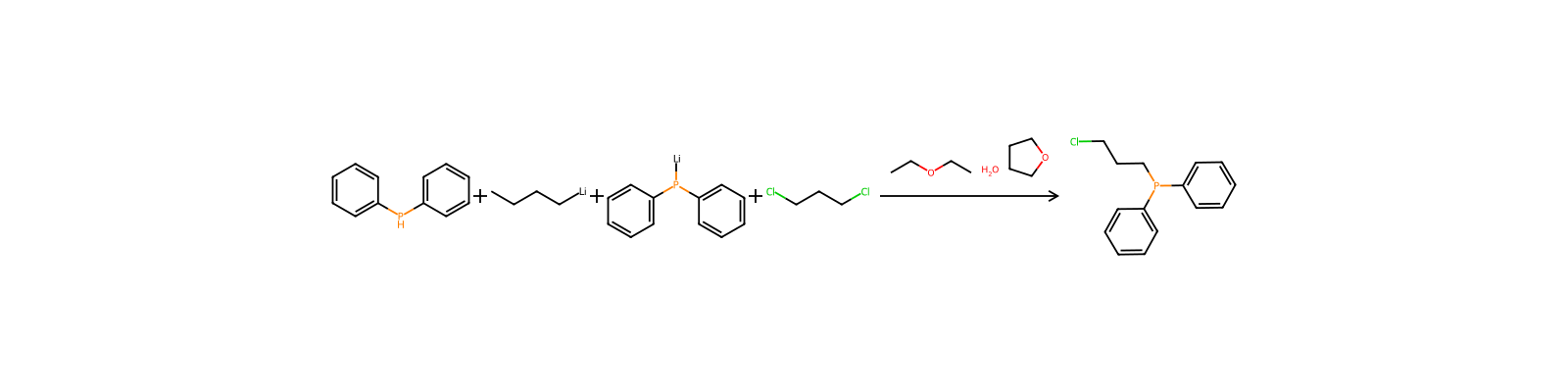
47
Reaktionsaufzeichnung erstellen
Reaktionsgleichung von HRID 4761
HRID 4761als Eduktuspto-grants-1988_02
Reaktionsgleichung von HRID 91522
HRID 91522als EduktTraining data from https://doi.org/10.1039/C8SC04228D (2/10)
Reaktionsgleichung von HRID 173480
HRID 173480als EduktTraining data from https://doi.org/10.1039/C8SC04228D (9/10)
Reaktionsgleichung von HRID 205034
HRID 205034als EduktTraining data from https://doi.org/10.1039/C8SC04228D (6/10)
Reaktionsgleichung von HRID 258786
HRID 258786als Eduktuspto-grants-1977_07
Reaktionsgleichung von HRID 355355
HRID 355355als Eduktuspto-grants-1998_11
Reaktionsgleichung von HRID 363302
HRID 363302als Eduktuspto-grants-1999_02
Reaktionsgleichung von HRID 400297
HRID 400297als Eduktuspto-grants-1998_10
Seite 1 von 6

Notizen zur Verbindung

Wird geladen…

Auf dieser SeiteGrundinformationenÜberblickNamen und BezeichnerEigenschaftenSicherheit und RegulatorischesChemie und IndustrieZugehörige ReaktionenNotizen zur Verbindung
Weitere Aktionen
Neue NotizNeue ReaktionAnfrage stellen

70 °F (est.) (USCG, 1999)

16 °C

16 °C o.c.

Boiling Point · 4 Einträge

248.7 °F at 760 mmHg (USCG, 1999)

120.4 °C @ 760 mm Hg

120 °C

120.9 °C @760 [mm Hg]

DecompositionWhen heated to decomposition it emits highly toxic fumes of /hydrogen chloride/ and phosgene.
Melting Point · 4 Einträge

-147.1 °F (USCG, 1999)

-99.5 °C

-99 °C

-99.5 °C

Physikochemische Eigenschaften

Schmelzpunkt
99 °C · −99 °C(lit.)
Siedepunkt
120 · 120-122 °C(lit.)
Dichte
1.19 g/mL · 1.19 g/mL at 25 °C(lit.)
Dampfdruck
24 · 24-24.265hPa at 20-25℃
Brechungsindex
20 · n20/D 1.448(lit.)
Flammpunkt
90 °F · 90 °F
storage temp.
Refrigerator
Löslichkeit
Chloroform (Slightly), Ethyl Acetate (Slightly)
Aggregatzustand
Liquid
Farbe
Clear colorless
Wasserlöslichkeit
0.8 g/L · 0.8 g/L (20 ºC)
BRN
505960 · 505960
Henry's Law Constant
1 · 1.0×10-2 mol/(m3Pa) at 25℃, Burkholder et al. (2019)
Dielectric constant
9.51 · 9.5099999999999998
InChI
1S/C3H6Cl2/c4-2-1-3-5/h1-3H2
InChIKey
YHRUOJUYPBUZOS-UHFFFAOYSA-N
SMILES
ClCCCCl
LogP
2 at · 2 at 25℃ and pH7
CAS Datenbank
142 · 142-28-9(CAS DataBase Reference)
NIST chemische Informationen
1 · Propane, 1,3-dichloro-(142-28-9)
EPA chemische Informationen
1 · 1,3-Dichloropropane (142-28-9)
A skin, eye, and respiratory tract irritant; [ICSC] Inhalation of high concentrations can cause CNS depression, kidney, and liver injury; [HSDB] An irritant; [MSDSonline]
Reactive GroupHalogenated Organic Compounds
UN ClassificationUN Hazard Class: 3; UN Subsidiary Risks: 6.1; UN Pack Group: II
Special ReportsTSCA CHIPs present a preliminary assessment of 1,3-dichloropropane's potential for injury to human health & the environment (available at EPA's TSCA Assistance Office: (202) 554-1404
TSCA Requirements · 2 Einträge

Pursuant to section 8(d) of TSCA, EPA promulgated a model Health and Safety Data Reporting Rule. The section 8(d) model rule requires manufacturers, importers, and processors of listed chemical substances and mixtures to submit to EPA copies and lists of unpublished health and safety studies. Propane, 1,3-dichloro- is included on this list.

Section 8(a) of TSCA requires manufacturers of this chemical substance to report preliminary assessment information concerned with production, use, and exposure to EPA as cited in the preamble of the 51 FR 41329.

Reactivity AlertsHighly Flammable
Reactivity Profile · 1 Eintrag

Halogenated aliphatic compounds, such as 1,3-DICHLOROPROPANE, are moderately or very reactive. Halogenated organics generally become less reactive as more of their hydrogen atoms are replaced with halogen atoms. Low molecular weight haloalkanes are highly flammable and can react with some metals to form dangerous products. Materials in this group are incompatible with strong oxidizing and reducing agents. Also, they are incompatible with many amines, nitrides, azo/diazo compounds, alkali metals, and epoxides.

Sicherheit und Schutzausrüstung

Fire Fighting · 2 Einträge

Fire Extinguishing Agents: Foam, carbon dioxide, dry chemical. (USCG, 1999)

Use water spray, powder, foam, carbon dioxide. In case of fire: keep drums, etc., cool by spraying with water.

First Aid Measures · 4 Einträge

Fresh air, rest.

First rinse with plenty of water for at least 15 minutes, then remove contaminated clothes and rinse again.

First rinse with plenty of water for several minutes (remove contact lenses if easily possible), then refer for medical attention.

Rinse mouth. Do NOT induce vomiting.

First AidCall a doctor.
Safe StorageSeparated from food and feedstuffs, oxidants, acids, bases and alumina. Cool. Well closed. Keep in a well-ventilated room.
Firefighting HazardsFlash back along vapor trail may occur.
Nonfire Spill ResponseExcerpt from ERG Guide 128 [Flammable Liquids (Water-Immiscible)]:
Disposal Methods · 1 Eintrag

SRP: At the time of review, criteria for land treatment or burial (sanitary landfill) disposal practices are subject to significant revision. Prior to implementing land disposal of waste residue (including waste sludge), consult with environmental regulatory agencies for guidance on acceptable disposal practices.

Spillage Disposal · 1 Eintrag

Evacuate danger area! Ventilation. Collect leaking and spilled liquid in sealable containers as far as possible. Absorb remaining liquid in sand or inert absorbent. Then store and dispose of according to local regulations. Do NOT wash away into sewer. Personal protection: filter respirator for organic gases and vapours adapted to the airborne concentration of the substance.

Preventive Measures · 2 Einträge

SRP: Contaminated protective clothing should be segregated in such a manner so that there is no direct personal contact by personnel who handle, dispose, or clean the clothing. Quality assurance to ascertain the completeness of the cleaning procedures should be implemented before the decontaminated protective clothing is returned for reuse by the workers. Contaminated clothing should not be taken home at end of shift, but should remain at employee's place of work for cleaning.

SRP: The scientific literature for the use of contact lenses in industry is conflicting. The benefit or detrimental effects of wearing contact lenses depend not only upon the substance, but also on factors including the form of the substance, characteristics and duration of the exposure, the uses of other eye protection equipment, and the hygiene of the lenses. However, there may be individual substances whose irritating or corrosive properties are such that the wearing of contact lenses would be harmful to the eye. In those specific cases, contact lenses should not be worn. In any event, the usual eye protection equipment should be worn even when contact lenses are in place.

Isolation and EvacuationExcerpt from ERG Guide 128 [Flammable Liquids (Water-Immiscible)]:
Eye PreventionWear safety spectacles.
Fire PreventionNO open flames, NO sparks and NO smoking. Above 16 °C use a closed system, ventilation and explosion-proof electrical equipment.

Toxikologische Informationen

Body Burden1,3-Dichloropropane was identified, not quantified, in human adipose tissue(1).
Ecotoxicity Values · 5 Einträge

LC50 Poecilia reticulata (guppy) 84 ppm/7 days

LC50 Cyprinodon variegatus (sheepshead minnow) 86,700 ug/l 96 hr

EC50 Selenastrum capricornutum 72,200 ug/l/96 hr Toxic Effect: Cell numbers

LC50 Daphnia magna (cladoceran) 282,000 ug/l 96 hr

For more Ecotoxicity Values (Complete) data for 1,3-DICHLOROPROPANE (7 total), please visit the HSDB record page.

Environmental Fate · 3 Einträge

TERRESTRIAL FATE: Based on a classification scheme(1), an estimated Koc value of 290(SRC), determined from a log Kow of 2.0(2) and a regression-derived equation(3), indicates that 1,3-dichloropropane is expected to have moderate mobility in soil(SRC). Volatilization of 1,3-dichloropropane from moist soil surfaces is expected to be an important fate process(SRC) given a Henry's Law constant of 9.76X10⁻⁴ atm-cu m/mole(4). The potential for volatilization of 1,3-dichloropropane from dry soil surfaces may exist (SRC) based upon a vapor pressure of 18.2 mm Hg(5). Using a standard dilution method and a sewage seed inoculum, 1,3-dichloropropane achieved 16% of the theoretical BOD during a 5 day incubation period(6), suggesting biodegradation may occur in soil(SRC). The hydrolysis half-life of 1,3-dichloropropane is 2.3 years at pH 7 and 25 °C(7), suggesting hydrolysis will occur slowly in moist soils(SRC).

AQUATIC FATE: Based on a classification scheme(1), an estimated Koc value of 290(SRC), determined from a log Kow of 2.0(2) and a regression-derived equation(3), indicates that 1,3-dichloropropane is not expected to adsorb to suspended solids and sediment(SRC). Volatilization from water surfaces is expected(3) based upon a Henry's Law constant of 9.76X10⁻⁴ atm-cu m/mole(4). Using this Henry's Law constant and an estimation method(3), volatilization half-lives for a model river and model lake are 2 hours and 4.5 days, respectively(SRC). According to a classification scheme(5), an estimated BCF of 7(SRC) from its log Kow(2) and a regression-derived equation(6), suggests the potential for bioconcentration in aquatic organisms is low. The hydrolysis half-life of 1,3-dichloropropane is 2.3 years at pH 7 and 25 °C(7). Using a standard dilution method and a sewage seed inoculum, 1,3-dichloropropane achieved 16% of the theoretical BOD during a 5 day incubation period(8), suggesting biodegradation may occur in water(SRC).

ATMOSPHERIC FATE: According to a model of gas/particle partitioning of semivolatile organic compounds in the atmosphere(1), 1,3-dichloropropane, which has a vapor pressure of 18.2 mm Hg at 25 °C(2), is expected to exist solely as a vapor in the ambient atmosphere. Vapor-phase 1,3-dichloropropane is degraded in the atmosphere by reaction with photochemically-produced hydroxyl radicals(SRC); the half-life for this reaction in air is estimated to be 21 days(SRC), calculated from its rate constant of 7.8X10⁻¹³ cu cm/molecule-sec at 25 °C(3).

Adverse EffectsNeurotoxin - Acute solvent syndrome
Exposure RoutesThe substance can be absorbed into the body by inhalation and by ingestion.
Signs and Symptoms · 3 Einträge

Dizziness.

Redness. Pain.

Redness. Pain.

Effluent Concentrations1,3-Dichloropropane was detected at levels of 18, 0.038, 0.008 and 0.012 ppm in leachate from four monitoring wells located at an abandoned organic chemical manufacturing facility near Salem, OH(1).
Medical SurveillanceEvaluate the skin, liver, and renal function on a periodic basis, as well as cardiac and respiratory status & general health.
Soil Adsorption/Mobility · 1 Eintrag

The Koc of 1,3-dichloropropane is estimated as 290(SRC), using a measured log Kow of 2.0(1) and a regression-derived equation(2). According to a classification scheme(3), this estimated Koc value suggests that 1,3-dichloropropane is expected to have moderate mobility in soil.

TSCA Test Submissions · 3 Einträge

Toxicity of 1,3-dichloropropane (DCP) with respect to testicular changes was evaluated in male albino Wistar rats (10/treated group, 20 in arachis oil vehicle control group) exposed orally to DCP by gavage at dosage levels of 0, 100 or 400 mg/kg/day for 14 days. On day 15, the animals were sent for pathological examination. No significant differences between treated and control animals were observed in the following: maternal mortality, clinical observations, body weights and weight gain, testes weights, morphology, or detailed macroscopic and microscopic examination of the kidneys, testes, epididymides, ductuli efferentes, and vasa deferentes.

The mutagenicity of 1,3-dichloropropane was evaluated in Salmonella tester strains TA1535, TA1537, TA1538, TA98 and TA100 (Ames Test), Escherichia coli test strains WP2 and WP2 uvrA and Saccharomyces cerevisiae strain JD1, both in the presence and absence of added metabolic activation by Aroclor-induced rat liver S9 fraction. Bacterial cultures were tested at concentrations up to 4000ug/plate using the plate incorporation technique. 1,3-Dichloropropane was tested at concentrations up to 5.0mg/ml in liquid suspension cultures of Saccharomyces cerevisiae. 1,3-Dichloropropane produced a dose-related increase in the reversion frequency in Salmonella tester strain TA1535 at concentrations at or above 500ug/plate in the presence of metabolic activation. 1,3-Dichloropropane did not cause a positive response in any of the remaining tester strains with or without metabolic activation.

The ability of 1,3-dichloropropane (DCP) to cause chromosome aberrations in cultures of rat liver (RL4) cells was evaluated in the absence of added metabolic activation. Monolayer slide cultures of RL4 cells were exposed to 0, 125, 250 or 500 ug/ml for 24 hrs and 100 cells/culture (200-300 cells/dose level) were scored for chromosome aberrations. None of the cultures produced frequencies of chromosome aberrations statistically greater than those produced by the controls (DMSO vehicle).

Atmospheric ConcentrationsSOURCE DOMINATED: 1,3-Dichloropropane was detected in the air near an unspecified industrial site at a concn of 2 ppb(1).
Human Toxicity Excerpts · 2 Einträge

Vapors cause a slight smarting of eyes & resp system if present in high concn. The effect is temporary. ... If spilled on clothing & allowed to remain, may cause smarting & reddening of skin. ... Alters pancreatic function /as late effect/.

Symptomatology: 1A) Inhalation, high vapor concn: gasping, refusal to breathe, coughing, substernal pain, & extreme respiratory distress at vapor concn over 1500 ppm. Irritation of eyes & upper respiratory mucosa appears promptly after exposure to concentrated vapors. Lacrimation & headache are prominent. Coma may occur rapidly. B) Inhalation, low vapor concn: central nervous depression & moderate irritation of respiratory system. Headache is frequent. 2) Dermal: severe skin irritation with marked inflammatory response of epidermis & underlying tissues. 3) Oral: acute gastrointestinal distress with pulmonary congestion & edema. Central nervous depression, perhaps even in the absence of impaired oxygen uptake. 4) By any route, possible late injuries to liver, kidneys & heart. 5) After inhalation exposures, malaise, headache, chest & abdominal discomfort & irritability have been reported to persist for several weeks & perhaps for several years.

Regulatorische Informationen

TSCA Requirements · 2 Einträge

Pursuant to section 8(d) of TSCA, EPA promulgated a model Health and Safety Data Reporting Rule. The section 8(d) model rule requires manufacturers, importers, and processors of listed chemical substances and mixtures to submit to EPA copies and lists of unpublished health and safety studies. Propane, 1,3-dichloro- is included on this list.

Section 8(a) of TSCA requires manufacturers of this chemical substance to report preliminary assessment information concerned with production, use, and exposure to EPA as cited in the preamble of the 51 FR 41329.

CERCLA Reportable Quantities · 1 Eintrag

Persons in charge of vessels or facilities are required to notify the National Response Center (NRC) immediately, when there is a release of this designated hazardous substance, in an amount equal to or greater than its reportable quantity of 1,000 lb or 454 kg. The toll free number of the NRC is (800) 424-8802; In the Washington D.C. metropolitan area (202) 426-2675. The rule for determining when notification is required is stated in 40 CFR 302.4 (section IV. D.3.b).

Clean Water Act Requirements · 1 Eintrag

1,3-Dichloropropane is designated as a hazardous substance under section 311(b)(2)(A) of the Federal Water Pollution Control Act and further regulated by the Clean Water Act Amendments of 1977 and 1978. These regulations apply to discharges of this substance. This designation includes any isomers and hydrates, as well as any solutions and mixtures containing this substance.

Sicherheitsdaten

wgk
2
tsca
TSCA listed
ridadr
UN 1993 3/PG 2
hs_code
29031990
RTECS-Nr.
TX9660000
risk_code
11-20-20/22-52/53-36/37/38-39/23/24/25-23/24/25-36-20/21/22
Toxizität
dog,LDLo,oral,3gm/kg (3000mg/kg),LIVER: OTHER CHANGESLUNGS, THORAX, OR RESPIRATION: CHRONIC PULMONARY EDEMABLOOD: HEMORRHAGE,American Journal of Hygiene. Vol. 16, Pg. 325, 1932.
hazard_code
F,Xn,T,Xi
safety_code
9-16-29-33-24-61-26-45-36/37-7
hazard_class
3
packing_group
II
Speicherklasse
3 - Flammable liquids
Giftige Stoffe Daten
142-28-9(Hazardous Substances Data)
Hazard Classifications
Eye Irrit. 2Flam. Liq. 3Skin Irrit. 2STOT SE 3
D-D Extender
Hydrogenchlorid
Propan-1,2-diol
Bis(2-chlor-1-methylethyl)ether
1-Chlorpropan-2-ol

Nachgelagerte Produkte

2-[2-(DIPHENYLPHOSPHINO)ETHYL]PYRIDINE[1,3-Bis(diphenylphosphino)propane]nickel(II) chloridePropan-1,3-diylbis(diphenylphosphin)Palladium(II)di(4-oxopent-2-en-2-oat)Bis(dibenzylideneacetone)palladiumCyclopropanBensultap(Methoxymethyl)oxiran1,3-Diamino-propan1,1,3-trichloropropaneDiethyl-1,1-cyclobutandicarboxylat1-(Allyloxy)butanDIETHYL (3-CHLOROPROPYL)MALONATEPropan-1,3-diylbis(4-aminobenzoat)pyrazolidine3-Chlorpropylamin
Ergänzende Hinweise · 1 Eintrag

DefinitionChEBI: 1,3-dichloropropane is a chloroalkane that is propane in which a hydrogen from each of the terminal methyl groups has been replaced by a chlorine. It has a role as an environmental contaminant and a nematicide. It is a chloroalkane and a chlorohydrocarbon.