
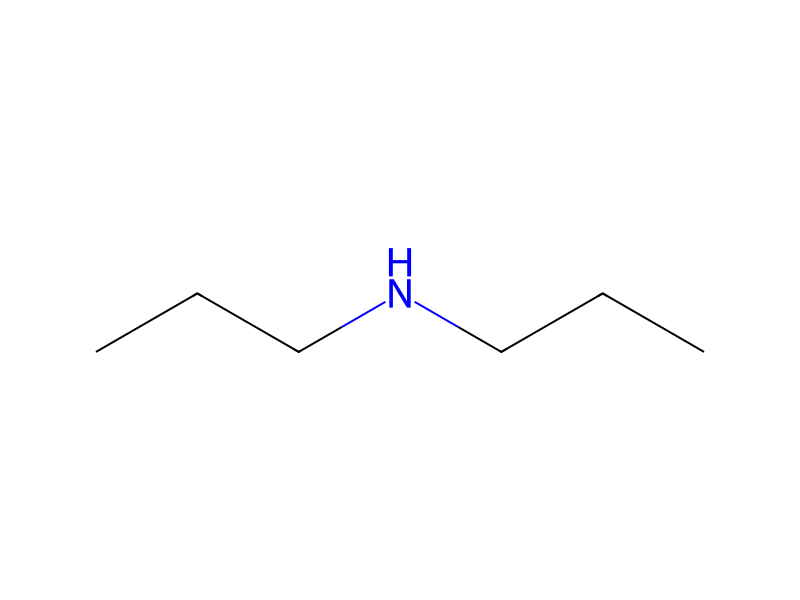
Grundinformationen
- Standard-SMILES
CCCNCCC- InChIKey
WEHWNAOGRSTTBQ-UHFFFAOYSA-N- Summenformel
- C6H15N
- Durchschnittliche Molmasse
- 101,19 g/mol
- Monoisotopische Masse
- 101,12044948
Überblick
Dipropylamine appears as a clear colorless liquid with an ammonia-like odor. Less dense than water. Vapors heavier than air. Toxic oxides of nitrogen produced during combustion.
Namen und Bezeichner
- Bevorzugter Name
- Dipropylamine
- IUPAC
- N-propylpropan-1-amine
- Lokaler Name
- Di-n-Propylamin
- Englischer Name
- Dipropylamine
- Summenformel
- C6H15N
- Molmasse
- 101.19
Namen und Synonyme
DIPROPYLAMINE142-84-7Di-n-propylaminen-Dipropylamine1-Propanamine, N-propyl-N-Propyl-1-propanamineRCRA waste number U110CCRIS 4805DTXSID2025185HSDB 2644EINECS 205-565-9N,N-Dipropylamine
Weitere Namen anzeigen
DPADNPAN-Propylpropan-1-amine(n-C3H7)2NHDi-n-propyLDipropanamine
UN2383BRN 050597460P318IIRYAI3-24037DIPROPYLAMINE [HSDB]N-DIPROPYLAMINE [MI]DTXCID105185EC 205-565-9
Datenbank-Bezeichner
- CAS
142-84-7- PubChem CID
- 8902
- DTXSID
DTXSID2025185- ChEMBL
CHEMBL3185961- UNII
- 60P318IIRY
- EC Number
- 205-565-9
- Nikkaji
- J2.547J
Eigenschaften
Berechnete Struktureigenschaften
- XLogP
- 1,7
- Polarare Oberfläche (TPSA)
- 12 Ų
- H-Brücken-Donoren
- 1
- H-Brücken-Akzeptoren
- 1
- Frei drehbare Bindungen
- 4
- Schwere Atome
- 7
- Formalladung
- 0
- Komplexität
- 23,4
Experimentelle und physikochemische Eigenschaften
Chemical Classes
Nitrogen Compounds -> Amines, Aliphatic
Flammable agents - 3rd degree
PFASPFAS -> Other/unspecified
SpringerMaterials PropertiesBoiling point
LogP
log Kow = 1.67
1.73
OdorAmmonia odor
Density
0.738 at 68 °F (USCG, 1999) - Less dense than water; will float
0.738 at 20 °C/4 °C
Bulk density = 6.1 lb/gal
Saturated liquid density= 46.010 lb/cu ft @ 70 °C
Saturated vapor density= 0.00771 lb/cu ft @ 70 °C
0.7400 @ 20°C
Viscosity0.517 mPa.s at 25 °C
Color/Form
Colorless liquid
Water-white liquid
Solubility
Soluble (>=10 mg/ml) (NTP, 1992)
Miscible in ether, very soluble in acetone, soluble in ethanol
In water, 3.51X10+4 mg/L at 25 °C
Flash Point
45 °F (USCG, 1999)
63 °F (17 °C) (open cup)
7 °C (closed cup)
Boiling Point
228.9 °F at 760 mmHg (NTP, 1992)
109.3 °C
109.3 °C @760 [mm Hg]
DecompositionWhen heated to decomposition it emits toxic fumes of nitroxides.
Physikochemische Eigenschaften
- Schmelzpunkt
- -63 °C · -63 °C
- Siedepunkt
- 105 · 105-110 °C(lit.)
- Dichte
- 0.738 g/mL · 0.738 g/mL at 25 °C(lit.)
- Dampfdruck
- 38 hPa · 38 hPa (20 °C)
- Brechungsindex
- 20 · n20/D 1.4049(lit.)
- Flammpunkt
- 39 °F · 39 °F
- storage temp.
- 30 °C · Store below +30°C.
- Löslichkeit
- 35 g/l · 35g/l (experimental)
- pka
- 1 · pK1:10.91(+1) (25°C)
- Aggregatzustand
- Liquid
- Farbe
- Clear
- Explosionsgrenze
- 1.8 · 1.8-9.3%(V)
- Wasserlöslichkeit
- soluble
- Merck
- 14 · 14,3343
- BRN
- 505974 · 505974
- Henry's Law Constant
- 2 · 2.0×10-1 mol/(m3Pa) at 25℃, Burkholder et al. (2019)
- Dielectric constant
- 2.9 · 2.9(21℃)
- Stabilität
- Stable. Highly flammable. Incompatible with strong oxidizing agents.
- InChI
- 1S/C6H15N/c1-3-5-7-6-4-2/h7H,3-6H2,1-2H3
- InChIKey
- WEHWNAOGRSTTBQ-UHFFFAOYSA-N
- SMILES
- CCCNCCC
- LogP
- 1.33 at · 1.33 at 23℃
- CAS Datenbank
- 142 · 142-84-7(CAS DataBase Reference)
- NIST chemische Informationen
- 1 · 1-Propanamine, n-propyl-(142-84-7)
- EPA chemische Informationen
- Dipropylamine (142-84-7)
Sicherheit und Regulatorisches
GHS-Klassifizierung
GHS Classification
Danger
H225: Highly Flammable liquid and vapor [Danger Flammable liquids]
P210, P233, P240, P241, P242, P243, P260, P261, P264, P270, P271, P280, P301+P317, P301+P330+P331, P302+P352, P302+P361+P354, P303+P361+P353, P304+P340, P305+P354+P338, P316, P317, P321, P330, P362+P364, P363, P370+P378, P403+P235, P405, and P501 (click each P-code to see the statement)
Danger
H225 (100%): Highly Flammable liquid and vapor [Danger Flammable liquids]
P210, P233, P240, P241, P242, P243, P260, P261, P262, P264, P264+P265, P270, P271, P280, P301+P316, P301+P317, P301+P330+P331, P302+P352, P302+P361+P354, P303+P361+P353, P304+P340, P305+P354+P338, P316, P317, P319, P321, P330, P361+P364, P362+P364, P363, P370+P378, P403+P233, P403+P235, P405, and P501 (click each P-code to see the statement)
Gefahrenhinweise
Regulatory Information
Chemical: 1-Propanamine, N-propyl-
1-Propanamine, N-propyl- is listed on the EPA's Chemical Data Reporting (CDR) system. Manufacturers and importers of 1-Propanamine, N-propyl- are required to report information about their production and use of this chemical to the EPA under the Toxic Substances Control Act (TSCA). (40 eCFR Part 711)
Status: Active Update: 05-10-2022 https://echa.europa.eu/registration-dossier/-/registered-dossier/13819
1-Propanamine, N-propyl-: HSNO Approval: HSR001143 Approved with controls
The New Jersey Worker and Community Right to Know Act requires public and private employers to provide information about hazardous substances at their workplaces. (N.J.S.A. 34:5A-1 et. seq.)
Other Safety InformationIMAP assessments - Short chain (C2-3) alkyl amines: Human health tier II assessment
DOT LabelFlammable Liquid Corrosive
Fire Hazards
Special Hazards of Combustion Products: Toxic oxides of nitrogen may form in fires. (USCG, 1999)
· Flammable/combustible material.
Fire Potential
Forms explosive mixture with air.
A very dangerous fire hazard when exposed to heat or flame.
Health Hazards
Inhalation causes severe coughing and chest pain due to irritation of air passages; can-cause lung edema; may also cause headache, nausea, faintness, and anxiety. Ingestion causes irritation and burning of mouth and stomach. Contact with eyes causes severe irritation and edema of the cornea. Contact with skin causes severe irritation. (USCG, 1999)
· May cause toxic effects if inhaled or ingested.
Hazards Summary
Highly corrosive to skin; [Quick CPC] Two of six rats died after exposure to 1000 ppm for four minutes. High inhalation exposure can cause pulmonary edema. [HSDB] Possesses pharmacologic activity as a dopamine agonist; [REPROTOX] A strong respiratory tract irritant that may cause pulmonary edema; A severe skin and eye irritant (may cause corneal edema); Degenerative changes to kidney and liver observed in chronic studies of rats and rabbits; [CHRIS]
DOT ID and Guide2383 132
Reactive GroupAmines, Phosphines, and Pyridines
Special ReportsEuropean Chemicals Bureau; IUCLID Dataset, Dipropylamine (142-84-7) (2000 CD-ROM edition). Provides information on usage patterns, ecotoxicity, and toxicity supplied to the European Union by industry.
RCRA Requirements
U110; As stipulated in 40 CFR 261.33, when dipropylamine, as a commercial chemical product or manufacturing chemical intermediate or an off-specification commercial chemical product or a manufacturing chemical intermediate, becomes a waste, it must be managed according to Federal and/or State hazardous waste regulations. Also defined as a hazardous waste is any residue, contaminated soil, water, or other debris resulting from the cleanup of a spill, into water or on dry land, of this waste. Generators of small quantities of this waste may qualify for partial exclusion from hazardous waste regulations (40 CFR 261.5).
TSCA Requirements
Pursuant to section 8(d) of TSCA, EPA promulgated a model Health and Safety Data Reporting Rule. The section 8(d) model rule requires manufacturers, importers, and processors of listed chemical substances and mixtures to submit to EPA copies and lists of unpublished health and safety studies. 1-Propanamine, N-propyl- is included on this list.
Sicherheit und Schutzausrüstung
Fire FightingExcerpt from ERG Guide 132 [Flammable Liquids - Corrosive]:
Accidental Release Measures
· CALL 911. Then call emergency response telephone number on shipping paper. If shipping paper not available or no answer, refer to appropriate telephone number listed on the inside back cover.
· ELIMINATE all ignition sources (no smoking, flares, sparks or flames) from immediate area.
First Aid
EYES: First check the victim for contact lenses and remove if present. Flush victim's eyes with water or normal saline solution for 20 to 30 minutes while simultaneously calling a hospital or poison control center. Do not put any ointments, oils, or medication in the victim's eyes without specific instructions from a physician. IMMEDIATELY transport the victim after flushing eyes to a hospital even if no symptoms (such as redness or irritation) develop.
General First Aid:
Exposure Control and Personal Protection· Wear positive pressure self-contained breathing apparatus (SCBA).
Fire Fighting Procedures
FOAM; DRY CHEMICAL; CARBON DIOXIDE. ... WATER MAY BE INEFFECTIVE.
If material on fire or involved in fire: Do not extinguish fire unless flow can be stopped. Use water in flooding quantities as fog. Solid streams of water may be ineffective. Cool all affected containers with flooding quantities of water. Apply water from as far a distance as possible. Use "alcohol" foam, dry chemical or carbon dioxide.
Storage Conditions
Before entering a confined space where this chemical may be present, check to make sure that an explosive concentration does not exist. Store in Tightly closed containers in a cool, well-ventilated area. Metal containers involving the transfer of this chemical should be grounded and bonded. Where possible, automatically pump liquid from drums or other storage containers to process containers. Drums must be equipped with self-closing valves, pressure vacuum bungs, and flame arresters. Use only non-sparking tools and equipment, especially when opening and closing containers of this chemical. Sources of ignition such as smoking and open flames are prohibited where this chemical is used, handled, or stored in a manner that could create a potential fire or explosion hazard. Wherever this chemical is used, handled, manufactured, or stored, use explosion-proof electrical equipment and fittings.
Storage temp: ambient
Cleanup Methods
Evacuate and restrict persons not wearing protective equipment from area of spill or leak until cleanup is complete. Remove all ignition sources. Ventilate area of spill or leak. Absorb liquids in vermiculite, dry sand, earth, peat, carbon, or a similar material and deposit in sealed containers. Keep this chemical out of confined spaces, such as a sewer, because of the possibility of an explosion, unless the sewer is designed to prevent the build up of explosive concentrations. It may be necessary to contain and dispose of this chemical as a hazardous waste. If material or contaminated runoff enters waterways, notify downstream users of potentially contaminated waters. Contact your Department of Environmental Protection or your regional office of the federal EPA for specific recommendations. If employees are required to clean-up spills, they must be properly trained and equipped. OSHA 1910.120(q) may be applicable.
1. REMOVE ALL IGNITION SOURCES; 2. VENTILATE AREA OF SPILL OR LEAK; 3. FOR SMALL QUANTITIES, ABSORB ON PAPER TOWELS. EVAPORATE IN SAFE PLACE (SUCH AS FUME HOOD). ALLOW SUFFICIENT TIME FOR EVAPORATING VAPORS TO COMPLETELY CLEAR THE HOOD DUCTWORK. BURN PAPER IN SUITABLE LOCATION AWAY FROM COMBUSTIBLE MATERIALS.
Environmental considerations-land spill: Dig a pit, pond, lagoon, holding area to contain liquid or solid material. /SRP: If time permits, pits, ponds, lagoons, soak holes, or holding areas should be sealed with an impermeable flexible membrane liner./ Dike surface flow using soil, sand bags, foamed polyurethane, or foamed concrete. Absorb bulk liquid with fly ash, cement powder, or commercial sorbents.
Environmental considerations-water spill: Use natural barriers or oil spill control booms to limit spill travel. Remove trapped material with suction hoses.
Environmental considerations-air spill: Apply water spray or mist to knock down vapors.
Nonfire Spill ResponseExcerpt from ERG Guide 132 [Flammable Liquids - Corrosive]:
Disposal Methods
[40 CFR 240-280, 300-306, 702-799 (7/1/2006)] Generators of waste (equal to or greater than 100 kg/mo) containing this contaminant, EPA hazardous waste number U110, must conform with USEPA regulations in storage, transportation, treatment and disposal of waste.
Generators of waste (equal to or greater than 100 kg/mo) containing this contaminant, EPA hazardous waste number U110, must conform with USEPA regulations in storage, transportation, treatment and disposal of waste.
A potential candidate for rotary kiln incineration at a temperature range of 820 to 1,600 °C and residence times of seconds for liquids and gases, and hours for solids. A potential candidate for fluidized bed incineration at a temperature range of 450 to 980 °C and residence times of seconds for liquids and gases, and longer for solids. A potential candidate for liquid injection incineration at a temperature range of 650 to 1,600 °C and a residence time of 0.1 to 2 seconds.
/Absorb small spills with paper and/ burn the paper in a suitable location away from combustible materials. Large quantities can be reclaimed or collected & atomized in suitable combustion chamber equipped with appropriate effluent gas cleaning device.
Preventive Measures
SRP: Local exhaust ventilation should be applied wherever there is an incidence of point source emissions or dispersion of regulated contaminants in the work area. Ventilation control of the contaminant as close to its point of generation is both the most economical and safest method to minimize personnel exposure to airborne contaminants.
SRP: The most favorable course of action is to use an alternative chemical product with less inherent propensity for occupational exposure or environmental contamination. Recycle any unused portion of the material for its approved use or return it to the manufacturer or supplier. Ultimate disposal of the chemical must consider: the material's impact on air quality; potential migration in soil or water; effects on animal, aquatic, and plant life; and conformance with environmental and public health regulations.
If material not on fire and not involved in fire: Keep sparks, flames, and other sources of ignition away. Keep material out of water sources and sewers. Build dikes to contain flow as necessary. Attempt to stop leak if without undue personnel hazard. Use water spray to disperse vapors and dilute standing pools of liquid.
Personnel protection: Avoid breathing vapors. Keep upwind. Avoid bodily contact with the material. ... Do not handle broken packages unless wearing appropriate personal protective equipment. Wash away any material which may have contacted the body with copious amounts of water or soap and water. ... If contact with the material anticipated, wear appropriate chemical protective clothing.
Isolation and Evacuation
Excerpt from ERG Guide 132 [Flammable Liquids - Corrosive]:
Immediate precautionary measure
Protective Action Criteria (PAC)
2.9 [mg/m3]
32 [mg/m3]
190 [mg/m3]
Toxikologische Informationen
Interactions
Nitrite ... is used as a food additive in meats and smoked fish. Some fish, vegetables, and fruit juices contain secondary amines. The acidic environment of the stomach facilitates a chemical reaction between nitrite and secondary amines, leading to the formation of carcinogenic nitrosamines. /Secondary amines/
Ecotoxicity Values
EC50 Daphnia magna straus /water flea/ 73 mg/L for 48 hr. /conditions of bioassay not specified/
EC50 Daphnia magna straus 76 mg/L for 24 hr. /conditions of bioassay not specified/
EC50 Scenedesmus subspicatus (Green algae) 5.4 mg/L/72 hr; Effect: cell multiplication inhibition /Conditions of bioassay not specified in source examined/
EC50 Scenedesmus subspicatus (Green algae) 2 mg/L/96 hr; Effect: cell multiplication inhibition /Conditions of bioassay not specified in source examined/
Environmental Fate
TERRESTRIAL FATE: Based on a classification scheme(1), an estimated Koc value of 190(SRC), determined from a log Kow of 1.67(2) and a regression-derived equation(3), indicates that dipropylamine is expected to have moderate mobility in soil(SRC). The pKa of dipropylamine is 11(4) indicating that this compound will exist almost entirely in the cation form in the environment and cations generally adsorb more strongly to soils containing organic carbon and clay than their neutral counterparts(5). Volatilization of dipropylamine from moist soil surfaces is not expected to be an important fate process given its cationic state(SRC). Dipropylamine is expected to volatilize from dry soil surfaces(SRC) based upon a vapor pressure of 20.1 mm Hg(6). Dipropylamine was determined to be biodegradable using the Japanese MITI test protocol(7), suggesting biodegradation may be an important fate process in soil(SRC).
AQUATIC FATE: Based on a classification scheme(1), an estimated Koc value of 190(SRC), determined from a log Kow of 1.67(2) and a regression-derived equation(3), indicates that dipropylamine is expected to adsorb to suspended solids and sediment(SRC). A pKa of 11(4) indicates dipropylamine will exist almost entirely in the cation form at pH values of 5 to 9 and therefore volatilization from water surfaces is not expected to be an important fate process(5). According to a classification scheme(6), an estimated BCF of 4(SRC), from its log Kow(2) and a regression-derived equation(7), suggests the potential for bioconcentration in aquatic organisms is low(SRC). Dipropylamine was determined to be biodegradable using the Japanese MITI test protocol(8), suggesting biodegradation may be an important fate process in water(SRC).
ATMOSPHERIC FATE: According to a model of gas/particle partitioning of semivolatile organic compounds in the atmosphere(1), dipropylamine, which has a vapor pressure of 20.1 mm Hg at 25 °C(2), is expected to exist solely as a vapor in the ambient atmosphere. Vapor-phase dipropylamine is degraded in the atmosphere by reaction with photochemically-produced hydroxyl radicals(SRC); the half-life for this reaction in air is estimated to be 4 hours(SRC), from its rate constant of 8.7X10⁻¹¹ cu cm/molecule-sec at 25 °C that was derived using a structure estimation method(3). Dipropylamine does not contain chromophores that absorb at wavelengths >290 nm(4) and therefore is not expected to be susceptible to direct photolysis by sunlight(SRC).
Food Survey Values
The following concns (in mg/kg) of dipropylamine were detected in various food products from W Germany: preserved broken beans, 1.0; preserved shelled peas, 0.1; preserved red cabbage, 0.1; paprika, 0.3; paprika brine, 2.0; cucumber, 0.1-1.4; pickled onions, 1.1; celery, 0.9; cheese, 8.4; brown bread, 0.4(1). Trace levels (<0.1 ppm) were detected in baked ham(2). Dipropylamine was identified, not quantified, in boiled beef(3). Dipropylamine was detected in baked ham at a concn of 0.007 ppm(4).
Adverse EffectsDermatotoxin - Skin burns.
Plant ConcentrationsLatakia tobacco leaf has been found to contain dipropylamine(1). Dipropylamine was identified as a naturally occurring compound (concn <0.1 ppm) in samples of American tobacco(2).
Soil Adsorption/Mobility
The Koc of dipropylamine was estimated as 190(SRC), using a log Kow of 1.67(1) and a regression-derived equation(2). According to a classification scheme(3), this estimated Koc value suggests that dipropylamine is expected to have moderate mobility in soil(SRC). The pKa of dipropylamine is 11(4) indicating that this compound will exist almost entirely in the cation form in the environment and cations generally adsorb more strongly to soils containing organic carbon and clay than their neutral counterparts(5).
TSCA Test Submissions
An acute inhalation toxicity study was conducted with 4 Sprague-Dawley rats (sex not reported) receiving whole body exposure to a saturated atmosphere of di-n-propylamine in a gas environment chamber for 15 minutes. The saturated atmosphere was generated by passing air at 1 liter/minute through a bubbler containing the test material, resulting in an average concentration of 110 mg/l. The exposure was run at room temperature. Ten to twelve minutes into the exposure, all rats were observed with labored breathing to the point of gasping, loss of equilibrium, and forced movements. After 15 minutes of exposure, some of the animals became prostrate and the exposure was terminated. All animals survived the exposure and subsequent 14 day observation period. Necropsy did not revealed any gross alterations.
An acute oral toxicity was conducted with groups of fasted female Sprague-Dawley rats (4/group) receiving di-n-propylamine (vehicle use not reported) once orally by gavage. Groups of animals were administered the test material at doses of 0.125, 0.25, 0.50, 1, or 2 g/kg, resulting in the following mortality data (no. animals dead/no. animals tested): 0/4, 0/4, 2/4, 4/4 and 4/4, respectively. Time of deaths were not reported. The acute oral LD50 of di-n-propylamine was calculated to be 0.5 g/kg (95% confidence limits of 0.335 - 0.746 g/kg).
An acute oral toxicity study was conducted with non-fasted male albino Carworth Farm-Nelson rats (5/group) receiving di-n-propylamine, undiluted and as a 5% dilution in corn oil, once orally by gavage. Animals were observed for 14 days post dosing. The administration of the undiluted test material was lethal to all rats at a dose level of 0.125 ml/kg. However, groups of animals receiving the test material, diluted in corn oil, at doses of 0.25, 0.5, 1 or 2 g/kg, resulted in the following mortality data (no. animals dead/no. animals treated): 0/5, 0/5, 3/5 and 5/5, respectively. Deaths occurred within 1 day of dosing. Necropsy of animals found dead revealed congestion in all internal organs. The oral LD50 was calculated by the moving average method to be 0.933 g/kg (0.669 - 1.30 g/kg).
An acute dermal toxicity study was conducted in 3 groups of male albino New Zealand strain rabbits (4/group) administered 24-hour occluded dermal exposure upon clipped skin of the trunk to undiluted di-n-propylamine (CAS # 142-84-7) at doses of 0.625, 1.25, and 2.50 ml/kg respectively. A dermal LD50 calculated by moving average method was 1.25 ml/kg. Following 14-day post-treatment observation necrosis characterized sites of application. Gross necropsy revealed pale or opaque internal organs which study reviewers attributed speculatively to corrosive action of the test material. Among the 6 decedent rabbits, one exhibited a single hemorrhagic lung.
For more TSCA Test Submissions (Complete) data for DIPROPYLAMINE (10 total), please visit the HSDB record page.
Natural Pollution Sources
... amines from decomposing fish ... /Amines/
Dipropylamine has been found in tobacco(1,2).
Human Toxicity Excerpts
/SIGNS AND SYMPTOMS/ Inhalation causes severe coughing and chest pain due to irritation of air passages; can cause lung edema; may also cause headache, nausea, faintness, and anxiety. Ingestion causes irritation and burning of mouth and stomach. Contact with eyes causes severe irritation and edema of the cornea. Contact with skin causes severe irritation.
/OTHER TOXICITY INFORMATION/ Moderately toxic by skin contact and inhalation.
/OTHER TOXICITY INFORMATION/ Since the amines are bases and may form strongly alkaline solutions, they can be damaging if splashed in the eye or if allowed to contaminate the skin. Otherwise they have no specific toxic properties, and the lower aliphatic amines are normal constituents of body tissues, so that they occur in a large number of foods, particularly fish, to which they impart a characteristic odor. One area of concern at present is the possibility that some aliphatic amines may react with nitrate or nitrite in vivo to form nitroso compounds, many of which are known to be potent carcinogens in animals ... . /Aliphatic amines/
Fish/Seafood ConcentrationsDipropylamine concns of 0.2-0.4 ppm have been detected in whole samples of spotted trout and small mouth bass(1).
Artificial Pollution SourcesDipropylamine's production and use as a chemical intermediate(1), principally in the production of certain herbicides(2), may result in its release to the environment through various waste streams(SRC).
Regulatorische Informationen
RCRA Requirements
U110; As stipulated in 40 CFR 261.33, when dipropylamine, as a commercial chemical product or manufacturing chemical intermediate or an off-specification commercial chemical product or a manufacturing chemical intermediate, becomes a waste, it must be managed according to Federal and/or State hazardous waste regulations. Also defined as a hazardous waste is any residue, contaminated soil, water, or other debris resulting from the cleanup of a spill, into water or on dry land, of this waste. Generators of small quantities of this waste may qualify for partial exclusion from hazardous waste regulations (40 CFR 261.5).
TSCA Requirements
Pursuant to section 8(d) of TSCA, EPA promulgated a model Health and Safety Data Reporting Rule. The section 8(d) model rule requires manufacturers, importers, and processors of listed chemical substances and mixtures to submit to EPA copies and lists of unpublished health and safety studies. 1-Propanamine, N-propyl- is included on this list.
CERCLA Reportable Quantities
Persons in charge of vessels or facilities are required to notify the National Response Center (NRC) immediately, when there is a release of this designated hazardous substance, in an amount equal to or greater than its reportable quantity of 5000 lb or 2270 kg. The toll free number of the NRC is (800) 424-8802. The rule for determining when notification is required is stated in 40 CFR 302.4 (section IV. D.3.b).
Sicherheitsdaten
- wgk
- 1
- tsca
- TSCA listed
- ridadr
- UN 2383
- hs_code
- 29211910
- RTECS-Nr.
- JL9200000
- risk_code
- 11-20/21/22-35
- Toxizität
- LD50 orally in rats: 0.93 g/kg, H. F. Smyth et al., Am. Ind. Hyg. Assoc. J. 23, 95 (1962)
- hazard_code
- F,C
- safety_code
- 16-26-36/37/39-45
- hazard_class
- 3
- packing_group
- II
- Speicherklasse
- 3 - Flammable liquids
- Giftige Stoffe Daten
- 142-84-7(Hazardous Substances Data)
- Hazard Classifications
- Acute Tox. 3 DermalAcute Tox. 3 InhalationAcute Tox. 4 OralEye Dam. 1Flam. Liq. 2Skin Corr. 1ASTOT SE 3
- Selbstentzündungstemperatur
- 260 °C
Chemie und Industrie
Pharmakologische Informationen
Mechanism of ActionWhen administered ip to rats, dipropylamine was a moderate inhibitor of liver monoamine oxidase activity. Possible relations between effects of alkylamines on MAO activity and changes in serotonin metabolism discussed.
Metabolism/MetabolitesDipropylimine is a known human metabolite of NDPA.
Verwendung und Herstellung
Uses
Used as a chemical intermediate; [HSDB]
...Required principally as a starting material for the synthesis of herbicides, e.g. trifluralin, oryzalin, EPTC, and vernolate
Intermediate
U.S. Imports
(1972) 3.70X10+8 GRAMS (& OTHER ALKYLAMINES)
(1975) 5.45X10+9 (INCL OTHER ALKYLAMINES)
U.S. Production
2023: 8,500,000 - <25,000,000 lb
(1972) 7.6X10+9 GRAMS
(1974) 1.11X10+10 GRAMS
(1981) 26,439X10+3 lb
(1984) 1.86X10+10 g
For more U.S. Production (Complete) data for DIPROPYLAMINE (6 total), please visit the HSDB record page.
Consumer UsesIntermediate
Industry UsesIntermediate
Methods of ManufacturingREACTION OF N-PROPANOL AND AMMONIA OVER A DEHYDRATING CATALYST SUCH AS ALUMINA AT HIGH TEMPS AND PRESSURES
Formulations/Preparations
97% min
Grades or purity: Technical, 98%; pure, 99+%
Technical
General Manufacturing Information
All Other Basic Organic Chemical Manufacturing
1-Propanamine, N-propyl-: ACTIVE
Vor- und nachgelagerte Produkte
Vorgelagerte Rohstoffe
Nachgelagerte Produkte
Zugehörige Reaktionen
538


Verknüpfte Notizen
Wird geladen…