
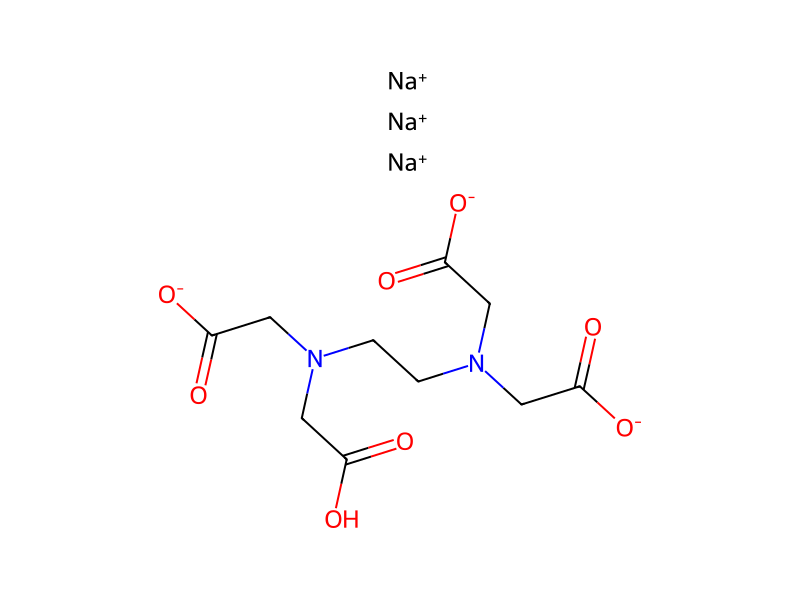
Grundinformationen
- Standard-SMILES
O=C([O-])CN(CCN(CC(=O)[O-])CC(=O)O)CC(=O)[O-].[Na+].[Na+].[Na+]- InChIKey
QZKRHPLGUJDVAR-UHFFFAOYSA-K- Summenformel
- C10H13N2Na3O8
- Durchschnittliche Molmasse
- 358,19 g/mol
- Monoisotopische Masse
- 358,03649822
Namen und Bezeichner
- Bevorzugter Name
- Edetate Trisodium
- IUPAC
- trisodium;2-[2-[bis(carboxylatomethyl)amino]ethyl-(carboxymethyl)amino]acetate
- Lokaler Name
- Trinatriumhydrogenethylendiamintetraacetat
- Englischer Name
- Ethylenediaminetetraacetic acid trisodium salt solution
- Summenformel
- C10H13N2Na3O8·2H2O
- Molmasse
- 394.22
Namen und Synonyme
Edetate trisodium150-38-9Trisodium EDTAEDTA trisodium saltTrisodium ethylenediaminetetraacetateVersene-9Edetate Trisodium [USAN]CCRIS 294UNII-420IP921MBEDTA trisodium salt (trihydrate)420IP921MBTrisodium hydrogen ethylenediaminetetraacetate
Weitere Namen anzeigen
ETHYLENEDIAMINETETRAACETIC ACID TRISODIUM SALTEdetateZonon Tabs9133EDTA 3NAEDTA.Na3Limclairtrilonaoversene9nci-c03974
EINECS 205-758-8Edetate trisodium (USAN)NSC-756746AI3-18050DTXSID7020556EDETATE TRISODIUM [VANDF]EDTA TRISODIUM SALT [MI]TRISODIUM EDETATE [MART.]
Datenbank-Bezeichner
- CAS
150-38-9、85715-60-2- PubChem CID
- 9008
- ChEMBL
CHEMBL2028177- ChEBI
CHEBI:63125- UNII
- 420IP921MB
- EC Number
- 205-758-8
- Nikkaji
- J10.138I
Eigenschaften
Berechnete Struktureigenschaften
- Polarare Oberfläche (TPSA)
- 164 Ų
- H-Brücken-Donoren
- 1
- H-Brücken-Akzeptoren
- 10
- Frei drehbare Bindungen
- 8
- Schwere Atome
- 23
- Formalladung
- 0
- Komplexität
- 351
Experimentelle und physikochemische Eigenschaften
Density0.7215 (NTP, 1992) - Less dense than water; will float
Solubility5 to 10 mg/mL at 70.7 °F (NTP, 1992)
Melting Pointgreater than 572 °F (NTP, 1992)
Physical Description
Ethylenediamine tetraacetic acid, trisodium salt is an odorless white crystalline powder. pH (1% aqueous solution) 9.3. pH (10% aqueous solution) about 8.3-8.7. (NTP, 1992)
Dry Powder; Liquid
White odorless solid; [CAMEO] Fine white crystals; [Sigma-Aldrich MSDS]
Physikochemische Eigenschaften
- Schmelzpunkt
- 237 °C · 237 °C
- Dichte
- 1.69 · 1.69[at 20℃]
- Dampfdruck
- 0.007 Pa · 0.007Pa at 50℃
- storage temp.
- Inert atmosphere,Room Temperature
- Löslichkeit
- 2 O: · H2O: clear, colorless to light yellow
- Aggregatzustand
- Liquid
- Farbe
- White to off-white
- PH
- 8 · 8
- Wasserlöslichkeit
- 212.9 g/L · 212.9g/L at 20℃
- Merck
- 13 · 13,3545
- Stabilität
- Stable. Incompatible with strong oxidizing agents, copper, aluminium.
- Kosmetik-Inhaltsstoffe Funktionen
- CHELATING
- InChI
- InChI=1S/C10H16N2O8.3Na.2H2O/c13-7(14)3-11(4-8(15)16)1-2-12(5-9(17)18)6-10(19)20;;;;;/h1-6H2,(H,13,14)(H,15,16)(H,17,18)(H,19,20);;;;2*1H2/q;3*+1;;/p-3
- InChIKey
- OABSPZRQQUFHRY-UHFFFAOYSA-K
- SMILES
- N(CC([O-])=O)(CC(=O)O)CCN(CC([O-])=O)CC([O-])=O.O.O.[Na+].[Na+].[Na+]
- LogP
- -3.8 at · -3.8 at 25℃
- CAS Datenbank
- 150 · 150-38-9(CAS DataBase Reference)
- EPA chemische Informationen
- Ethylenediaminetetraacetic acid trisodium salt (150-38-9)
Sicherheit und Regulatorisches
GHS-Klassifizierung
GHS Classification
This chemical does not meet GHS hazard criteria for 1% (2 of 197) of reports.
Danger
H302+H332 (53.3%): Harmful if swallowed or if inhaled [Warning Acute toxicity, oral; acute toxicity, inhalation];H302 (87.8%): Harmful if swallowed [Warning Acute toxicity, oral];H318 (66%): Causes serious eye damage [Danger Serious eye damage/eye irritation];H319 (25.9%): Causes serious eye irritation [Warning Serious eye damage/eye irritation];H332 (62.9%): Harmful if inhaled [Warning Acute toxicity, inhalation];H373 (66%): May causes damage to organs through prolonged or repeated exposure [Warning Specific target organ toxicity, repeated exposure]
P260, P261, P264, P264+P265, P270, P271, P280, P301+P317, P304+P340, P305+P351+P338, P305+P354+P338, P317, P319, P330, P337+P317, and P501 (click each P-code to see the statement)
Aggregated GHS information provided per 197 reports by companies from 13 notifications to the ECHA C&L Inventory. Each notification may be associated with multiple companies.;Reported as not meeting GHS hazard criteria per 2 of 197 reports by companies.;There are 12 notifications provided by 195 of 197 reports by companies with hazard statement code(s).;Information may vary between notifications depending on impurities, additives, and other factors. The percentage value in parenthesis indicates the notified classification ratio from companies that provide hazard codes. Only hazard codes with percentage values above 10% are shown. For more detailed information, please visit ECHA C&L website.
Gefahrenhinweise
Regulatory Information
Chemical: Glycine, N,Nâ²-1,2-ethanediylbis[N-(carboxymethyl)-, sodium salt (1:3)
Glycine, N,N'-1,2-ethanediylbis[N-(carboxymethyl)-, sodium salt (1:3) is listed on the EPA's Chemical Data Reporting (CDR) system. Manufacturers and importers of Glycine, N,N'-1,2-ethanediylbis[N-(carboxymethyl)-, sodium salt (1:3) are required to report information about their production and use of this chemical to the EPA under the Toxic Substances Control Act (TSCA). (40 eCFR Part 711)
Status: Active Update: 20-01-2023 https://echa.europa.eu/registration-dossier/-/registered-dossier/27615
Trisodium EDTA: Does not have an individual approval but may be used under an appropriate group standard
Other Safety InformationIMAP assessments - Glycine, N,N'-1,2-ethanediylbis[N-(carboxymethyl)-, trisodium salt: Human health tier I assessment
Fire HazardsLiterature sources indicate that this compound is noncombustible. (NTP, 1992)
Health Hazards
SYMPTOMS: Symptoms of exposure to this compound may include coughing, wheezing, respiratory distress and mucous membrane irritation upon inhalation. It is a strong chelating agent and ingestion of large amounts may cause hypocalcemic tetany with spontaneous recovery. This compound may cause skin irritation, an eye contact may cause pain and slight transient irritation.;ACUTE/CHRONIC HAZARDS: When heated to decomposition this chemical may emit toxic fumes of carbon monoxide, carbon dioxide, oxides of nitrogen and ammonia. It may also emit very toxic fumes of disodium oxide. This compound may present a dust explosion hazard. (NTP, 1992)
Hazards Summary
No evidence of carcinogenicity in mice or rats; [NTP] Causes changes in tubules (including acute renal failure and necrosis) in intraperitoneal lethal-dose studies of mice; [RTECS] May cause skin and eye irritation; Inhalation may cause coughing, wheezing, respiratory distress, and mucous membrane irritation; [NTP] An irritant; [Sigma-Aldrich MSDS] See Edetic acid.
Reactive GroupAmines, Phosphines, and Pyridines;Salts, Basic
Reactivity ProfileAqueous solutions of ETHYLENEDIAMINE TETRAACETIC ACID, TRISODIUM SALT react with aluminum to produce hydrogen. Oxidizers should be avoided. (NTP, 1992)
Air and Water ReactionsSlightly water soluble.
Hazard Classes and CategoriesAcute Tox. 4 (87.8%);Eye Dam. 1 (66%);Eye Irrit. 2 (25.9%);Acute Tox. 4 (62.9%);STOT RE 2 (66%)
Sicherheit und Schutzausrüstung
Fire FightingFires involving this material can be controlled with a dry chemical, carbon dioxide or Halon extinguisher. (NTP, 1992)
First Aid
EYES: First check the victim for contact lenses and remove if present. Flush victim's eyes with water or normal saline solution for 20 to 30 minutes while simultaneously calling a hospital or poison control center. Do not put any ointments, oils, or medication in the victim's eyes without specific instructions from a physician. IMMEDIATELY transport the victim after flushing eyes to a hospital even if no symptoms (such as redness or irritation) develop.;SKIN: IMMEDIATELY flood affected skin with water while removing and isolating all contaminated clothing. Gently wash all affected skin areas thoroughly with soap and water. If symptoms such as redness or irritation develop, IMMEDIATELY call a physician and be prepared to transport the victim to a hospital for treatment.;INHALATION: IMMEDIATELY leave the contaminated area; take deep breaths of fresh air. If symptoms (such as wheezing, coughing, shortness of breath, or burning in the mouth, throat, or chest) develop, call a physician and be prepared to transport the victim to a hospital. Provide proper respiratory protection to rescuers entering an unknown atmosphere. Whenever possible, Self-Contained Breathing Apparatus (SCBA) should be used; if not available, use a level of protection greater than or equal to that advised under Protective Clothing.;INGESTION: DO NOT INDUCE VOMITING. If the victim is conscious and not convulsing, give 1 or 2 glasses of water to dilute the chemical and IMMEDIATELY call a hospital or poison control center. Be prepared to transport the victim to a hospital if advised by a physician. If the victim is convulsing or unconscious, do not give anything by mouth, ensure that the victim's airway is open and lay the victim on his/her side with the head lower than the body. DO NOT INDUCE VOMITING. IMMEDIATELY transport the victim to a hospital. (NTP, 1992)
Nonfire Spill Response
SMALL SPILLS AND LEAKAGE: If you spill this chemical, you should dampen the solid spill material with water, then transfer the dampened material to a suitable container. Use absorbent paper dampened with water to pick up any remaining material. Seal your contaminated clothing and the absorbent paper in a vapor-tight plastic bag for eventual disposal. Wash all contaminated surfaces with a soap and water solution. Do not reenter the contaminated area until the Safety Officer (or other responsible person) has verified that the area has been properly cleaned.;STORAGE PRECAUTIONS: You should store this chemical under ambient temperatures, and keep it away from all oxidizing materials. (NTP, 1992)
Personal Protective Equipment (PPE)
RECOMMENDED RESPIRATOR: Where the neat test chemical is weighed and diluted, wear a NIOSH-approved half face respirator equipped with an organic vapor/acid gas cartridge (specific for organic vapors, HCl, acid gas and SO2) with a dust/mist filter. (NTP, 1992)
Toxikologische Informationen
Toxicity SummarySafe in the present practices of use and concentration. Ingredient, concentration, and use information are available in documents discoverable at https://cir-reports.cir-safety.org
Carcinogen Classification
Trisodium ethylenediaminetetra-acetate trihydrate (EDTA)
TR-011: Bioassay of Trisodium Ethylenediaminetetraacetate Trihydrate (EDTA) for Possible Carcinogenicity (CASRN 150-38-9) (1977 )
07/25/77
No Evidence
No Evidence
No Evidence
Regulatorische Informationen
Regulatory Information
Chemical: Glycine, N,Nâ²-1,2-ethanediylbis[N-(carboxymethyl)-, sodium salt (1:3)
Glycine, N,N'-1,2-ethanediylbis[N-(carboxymethyl)-, sodium salt (1:3) is listed on the EPA's Chemical Data Reporting (CDR) system. Manufacturers and importers of Glycine, N,N'-1,2-ethanediylbis[N-(carboxymethyl)-, sodium salt (1:3) are required to report information about their production and use of this chemical to the EPA under the Toxic Substances Control Act (TSCA). (40 eCFR Part 711)
Status: Active Update: 20-01-2023 https://echa.europa.eu/registration-dossier/-/registered-dossier/27615
Trisodium EDTA: Does not have an individual approval but may be used under an appropriate group standard
Sicherheitsdaten
- wgk
- 3
- tsca
- TSCA listed
- hs_code
- 29173990
- RTECS-Nr.
- AH5250000
- risk_code
- 36/37/38
- hazard_code
- Xi
- safety_code
- 26-36-24/25-22-36/37
- Speicherklasse
- 11 - Combustible Solids
- Hazard Classifications
- Acute Tox. 4 InhalationAcute Tox. 4 OralEye Dam. 1STOT RE 2 Inhalation
Chemie und Industrie
Verwendung und Herstellung
Uses
CIR ingredient: Trisodium EDTA
Formerly registered in the US for use as a disinfectant; [NPIRS] Used as a preservative, color retention agent, antioxidant, flavoring agent for foods, anticoagulant for blood collection, and chelating agent in personal care products; Also used in the pulp and paper industry, in laboratory titrimetric analysis of metals, and as a therapeutic chelating agent; [Merck Index] Used in detergents, agricultural chemical sprays, pharmaceutical products, oil emulsions, to improve dyeing in textiles, as a metal chelating agent, in metal cleaning and plating, to decontaminate radioactive surfaces, as a metal deactivator in vegetable oils, as an eluting agent in ion exchange, to remove insoluble deposits of calcium and magnesium soaps, as an antioxidant, in the clarification of liquids, and to help reduce blood cholesterol; [NTP] Permitted for use as an inert ingredient in non-food pesticide products; [EPA]
Acid and Alkali Cleaning of Metals [Category: Clean];Electroplating [Category: Plate];Pulp and Paper Processing [Category: Industry];Using Disinfectants or Biocides [Category: Clean];Textiles (Printing, Dyeing, or Finishing) [Category: Industry]
U.S. Production2023: 75,000 - <500,000 lb;2022: 75,000 - <500,000 lb;2021: <75,000 lb;2020: 75,000 - <500,000 lb
Consumer UsesIon exchange agent;Surfactant (surface active agent)
Industry UsesIon exchange agent;Surfactant (surface active agent)
Household ProductsInformation on 91 consumer products that contain Trisodium EDTA in the following categories is provided:;• Hobby/Craft;• Inside the Home;• Personal Care;• Pet Care
Use ClassificationCosmetics -> Chelating
General Manufacturing Information
All Other Basic Organic Chemical Manufacturing;Soap, Cleaning Compound, and Toilet Preparation Manufacturing
Glycine, N,N'-1,2-ethanediylbis[N-(carboxymethyl)-, sodium salt (1:3): ACTIVE
Anwendungen
Verwendenchelating agent, antioxidant
Anbieter50 Anbieter
国药集团化学试剂有限公司86-21-63210123 · [email protected]
北京华美互利生物化工010-56205725 · [email protected]
上海康朗生物科技有限公司021-61998208 18217752821 · [email protected]
上海麦克林生化科技股份有限公司021-50706066 15221275939 · [email protected]
河南赢创生物科技有限公司16650615803 · [email protected]
杭州品高化工有限公司0571-87658025 · [email protected]
Hebei Yanxi Chemical Co., Ltd.+86-17531190177 · [email protected]
浙江珲达生物科技有限公司0571-89903022 18679456698 · [email protected]
上海弘顺生物科技有限公司15901914505 · [email protected]
广东元丰化学试剂有限公司0751-2829979 13318593351 · [email protected]
United Life Science020-82099279 18988941402 · [email protected]
北京博奥森生物技术有限公司400-901-9800 18611424007 · [email protected]
MedChemexpress LLC021-58955995 · [email protected]
武汉丰泰威远科技有限公司027-87465837 19945049750 · [email protected]
ChemeGen 中国18818260767 · [email protected]
湖南汇百侍生物科技有限公司0731-85526065 13308475853 · [email protected]
斯百全化学(上海)有限公司021-021-021-67601398-809-809-809 15221380277 · [email protected]
上海将来实业股份有限公司021-61552785 · [email protected]
杭州杰恒化工有限公司0571-87396432 · [email protected]
池州凯隆进出口贸易有限公司[email protected]
上海谱科生物技术有限公司021-64705760 18027310741 · [email protected]
Sigma-Aldrich西格玛奥德里奇(上海)贸易有限公司021-61415566 800-8193336 · [email protected]
上海陶术生物科技股份有限公司+1-781-999-5354; +1-00000000000 · [email protected]
北京诺其雅盛生物科技有限公司4000-819-385 010-62329685 13718666987
Henan Alfa Chemical Co., Ltd+8618339805032 · [email protected]
郑州九亿时光新材料有限公司+86-15225627621 +86-13213167925 · [email protected]
湖南汇百益新材料有限公司400-0909710 13319523173 · [email protected]
安耐吉化学&3A(安徽泽升科技股份有限公司)400-0056266 · [email protected]
上海阿拉丁生化科技股份有限公司6206333 13167063860 · [email protected]
陕西缔都医药化工有限公司029-029-81120477 17792793610 · [email protected]
上海珞珐生化科技有限公司021-51111890 15317326293 · [email protected]
上海源叶生物科技有限公司13636370518 · [email protected]
上海陶术生物科技股份有限公司13564774135 · [email protected]
爱必信(上海)生物科技有限公司13761418683 · [email protected]
阿勒山(广州)生物科技有限公司18636736628 · [email protected]
Shanghai Acmec Biochemical Technology Co., Ltd.+86-18621343501 · [email protected]
上海泰坦科技股份有限公司18616708014 · [email protected]
Musechem+1-800-259-7612 · [email protected]
广州市乐试生物科技有限公司13672434928;13672434928 · [email protected]
江苏艾康生物医药研发有限公司025-58851090 13913916777 · [email protected]
常州北山化工有限公司+86-021-61559630 +86-13761092941 · [email protected]
厦门盈融达化工有限公司+86-0592-6210733 · [email protected]
郑州艾克姆化工有限公司0371-63315541 13323832564 · [email protected]
上海吉至生化科技有限公司021-4009004166/18616739031 18616739031 · [email protected]
北京沃凯生物科技有限公司010-62971590 18548936886 · [email protected]
广东翁江化学试剂有限公司0751-2815688 13927872512 · [email protected]
广州糖姆氏生命科学有限公司020-31155029 18902330969 · [email protected]
Aladdin Scientific[email protected]
湖北信康医药化工有限公司027-027-59308705 18871579363 · [email protected]
山东创赢化工有限公司0531-155-8990-1131 15589901131
Zugehörige Reaktionen
1
Verknüpfte Notizen
Wird geladen…