Quinestrol
HCID 9046
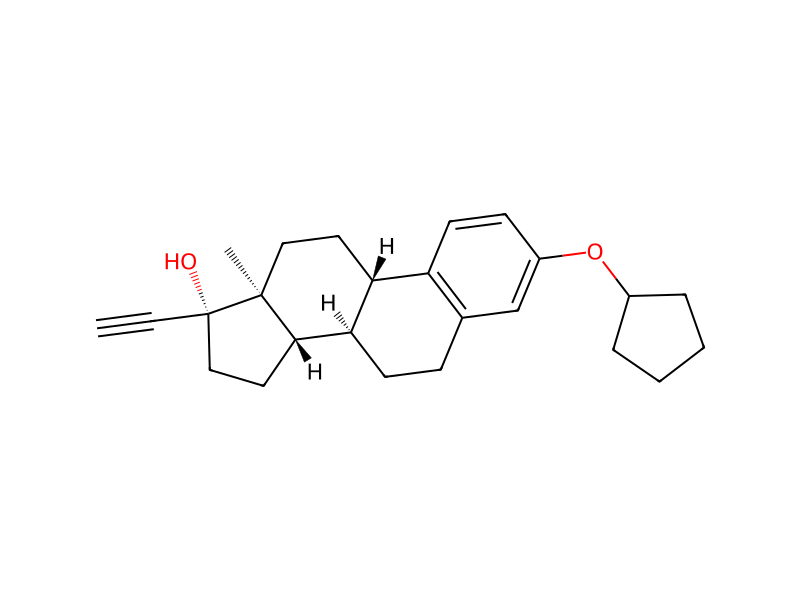
Grundinformationen
- CAS
152-43-2- Standard-SMILES
C#C[C@]1(O)CC[C@H]2[C@@H]3CCc4cc(OC5CCCC5)ccc4[C@H]3CC[C@@]21C- InChIKey
PWZUUYSISTUNDW-VAFBSOEGSA-N- Summenformel
- C25H32O2
- Durchschnittliche Molmasse
- 364,5 g/mol
- Monoisotopische Masse
- 364,24023026
Überblick
Quinestrol is a 17-hydroxy steroid and a terminal acetylenic compound. It has a role as a xenoestrogen. It is functionally related to a 17beta-estradiol.
Namen und Bezeichner
- Bevorzugter Name
- Quinestrol
- IUPAC
- (8R,9S,13S,14S,17R)-3-cyclopentyloxy-17-ethynyl-13-methyl-7,8,9,11,12,14,15,16-octahydro-6H-cyclopenta[a]phenanthren-17-ol
- Lokaler Name
- Quinestrol
- Englischer Name
- Quinestrol
- Summenformel
- C25H32O2
- Molmasse
- 364.52
Namen und Synonyme
QUINESTROL152-43-2EstrovisEstrovisterPlestrovisEstonEstradiol-17-beta 3-cyclopentyl etherQuinestrolumEstrovis 4000Quinestrolo17-alpha-Ethinylestradiol 3-cyclopentyl etherQuilea
Weitere Namen anzeigen
eecpew3566EE2CPEqui-leaestrovis4000
W 356617alpha-Ethynylestradiol 3-cyclopentyl etherW-3566DTXSID6046553JR0N7XD5GZ(8R,9S,13S,14S,17R)-3-cyclopentyloxy-17-ethynyl-13-methyl-7,8,9,11,12,14,15,16-octahydro-6H-cyclopenta[a]phenanthren-17-olNSC-759637CHEBI:8716
Datenbank-Bezeichner
- CAS
152-43-2- PubChem CID
- 9046
- DTXSID
DTXSID6046553- ChEMBL
CHEMBL1201165- ChEBI
CHEBI:8716- UNII
- JR0N7XD5GZ
- EC Number
- 205-803-1
- Nikkaji
- J5.865C
Eigenschaften
Berechnete Struktureigenschaften
- XLogP
- 5,3
- Polarare Oberfläche (TPSA)
- 29,5 Ų
- H-Brücken-Donoren
- 1
- H-Brücken-Akzeptoren
- 2
- Frei drehbare Bindungen
- 3
- Schwere Atome
- 27
- Formalladung
- 0
- Komplexität
- 613
Experimentelle und physikochemische Eigenschaften
DrugsPharmaceuticals -> Listed in ZINC15
LipidsLipids -> Sterol Lipids [ST] -> Steroids [ST02] -> C18 steroids (estrogens) and derivatives [ST0201]
Solubility1.57e-03 g/L
Human Drugs
FDA approved drugs -> Active ingredient
FDA approved drugs -> Active ingredient
Endocrine DisruptorsPotential endocrine disrupting compound
Melting Point107.5 °C
Physical DescriptionSolid
Physikochemische Eigenschaften
- Schmelzpunkt
- 107 · 107-108°
- Siedepunkt
- 435.69 °C · 435.69°C (rough estimate)
- Dichte
- 1.0693 · 1.0693 (rough estimate)
- Brechungsindex
- 1.448 · 1.4480 (estimate)
- storage temp.
- 2 · 2-8°C
- Löslichkeit
- Chloroform (Slightly), Dioxane (Slightly), DMSO (Slightly), Methanol (Slightly)
- pka
- 13.1 · 13.10±0.40(Predicted)
- Aggregatzustand
- Solid
- Farbe
- White to Off-White
- Merck
- 14 · 14,8055
- CAS Datenbank
- 152 · 152-43-2(CAS DataBase Reference)
Sicherheit und Regulatorisches
Sicherheitsangaben dienen nur zur Orientierung und ersetzen weder das Sicherheitsdatenblatt (SDB) des Lieferanten noch geltende Vorschriften oder eine fachliche Bewertung.
GHS-Klassifizierung
GHS Classification
Danger
H302 (60.9%): Harmful if swallowed [Warning Acute toxicity, oral]
P203, P260, P261, P263, P264, P270, P271, P280, P301+P317, P302+P352, P304+P340, P317, P318, P321, P330, P362+P364, P405, and P501 (click each P-code to see the statement)
Aggregated GHS information provided per 64 reports by companies from 4 notifications to the ECHA C&L Inventory. Each notification may be associated with multiple companies.
Gefahrenhinweise
Hazard Classes and CategoriesAcute Tox. 4 (60.9%)
Toxikologische Informationen
Health EffectsSide effects include liver and kidney dysfunction, high blood pressure, heart disease, degeneration of the testicles, premature baldness, and acne.
Exposure RoutesAbsorbed following oral administration.
Toxicity Summary
Estrogens diffuse into their target cells and interact with a protein receptor (the estrogen receptor). Estrogen interacts with a target cell receptor. When the estrogen receptor has bound its ligand it can enter the nucleus of the target cell, and regulate gene transcription which leads to formation of messenger RNA. The mRNA interacts with ribosomes to produce specific proteins that express the effect of estradiol upon the target cell. Estrogens increase the hepatic synthesis of sex hormone binding globulin (SHBG), thyroid-binding globulin (TBG), and other serum proteins and suppress follicle-stimulating hormone (FSH) from the anterior pituitary. Target cells include the female reproductive tract, the mammary gland, the hypothalamus, and the pituitary. Estrogens increase the hepatic synthesis of sex hormone binding globulin (SHBG), thyroid-binding globulin (TBG), and other serum proteins and suppress follicle-stimulating hormone (FSH) from the anterior pituitary. The combination of an estrogen with a progestin suppresses the hypothalamic-pituitary system, decreasing the secretion of gonadotropin-releasing hormone (GnRH).
Signs and SymptomsSymptoms of overdose include nausea and vomiting, and withdrawal bleeding may occur in females.
Carcinogen ClassificationNo indication of carcinogenicity to humans (not listed by IARC).
Sicherheitsdaten
- wgk
- 3
- RTECS-Nr.
- RC8948000
- risk_code
- 45-61-20/21/22-46
- hazard_code
- T
- safety_code
- 53-22-36/37/39-45
Chemie und Industrie
Pharmakologische Informationen
Pharmacodynamics
Quinestrol is the 3-cyclopentyl ether of ethinyl estradiol (the active metabolite). After gastrointestinal absorption, it is stored in adipose tissue where it is slowly released and metabolized principally to the parent compound, ethinyl estradiol. Ethinyl estradiol is a synthetic derivative of the natural estrogen estradiol.
Mechanism of Action
Estrogens diffuse into their target cells and interact with a protein receptor (the estrogen receptor). Estrogen interacts with a target cell receptor. When the estrogen receptor has bound its ligand it can enter the nucleus of the target cell, and regulate gene transcription which leads to formation of messenger RNA. The mRNA interacts with ribosomes to produce specific proteins that express the effect of estradiol upon the target cell. Estrogens increase the hepatic synthesis of sex hormone binding globulin (SHBG), thyroid-binding globulin (TBG), and other serum proteins and suppress follicle-stimulating hormone (FSH) from the anterior pituitary. Target cells include the female reproductive tract, the mammary gland, the hypothalamus, and the pituitary. Estrogens increase the hepatic synthesis of sex hormone binding globulin (SHBG), thyroid-binding globulin (TBG), and other serum proteins and suppress follicle-stimulating hormone (FSH) from the anterior pituitary. The combination of an estrogen with a progestin suppresses the hypothalamic-pituitary system, decreasing the secretion of gonadotropin-releasing hormone (GnRH).
Metabolism/Metabolites
Metabolized principally to the parent compound, ethinyl estradiol. Ethinyl estradiol is metabolized in the liver. Quantitatively, the major metabolic pathway for ethinyl estradiol, both in rats and in humans, is aromatic hydroxylation, as it is for the natural estrogens.
Metabolized principally to the parent compound, ethinyl estradiol. Ethinyl estradiol is metabolized in the liver. Quantitatively, the major metabolic pathway for ethinyl estradiol, both in rats and in humans, is aromatic hydroxylation, as it is for the natural estrogens.
MeSH Pharmacological Classification
Compounds that interact with ESTROGEN RECEPTORS in target tissues to bring about the effects similar to those of ESTRADIOL. Estrogens stimulate the female reproductive organs, and the development of secondary female SEX CHARACTERISTICS. Estrogenic chemicals include natural, synthetic, steroidal, or non-steroidal compounds.
Absorption, Distribution and ExcretionAbsorbed following oral administration.
Cellular LocationsCytoplasm
Verwendung und Herstellung
UsesUsed in hormone replacement therapy, treating symptoms of menopause such as hot flashes. Also used to treat breast and prostate cancer.
Anwendungen
BeschreibungQuinestrol is a synthetic estrogen that is effective in hormone replacement therapy. It is a 3-cyclopentyl ether of ethynyl estradiol. After gastrointestinal absorption, it is stored in adipose tissue, where it is slowly released and metabolized in the liver to its active form, ethinyl estradiol. Quinestrol has found limited use in suppressing lactation in postpartum women and, in combination with synthetic progestogens, as contraceptive therapy, although additional studies are needed for both applications.
VerwendenQuinestrol is an estrogen-like compound.
Vor- und nachgelagerte Produkte
Vorgelagerte Rohstoffe
Zugehörige Reaktionen
0
Noch keine zugehörigen Reaktionen