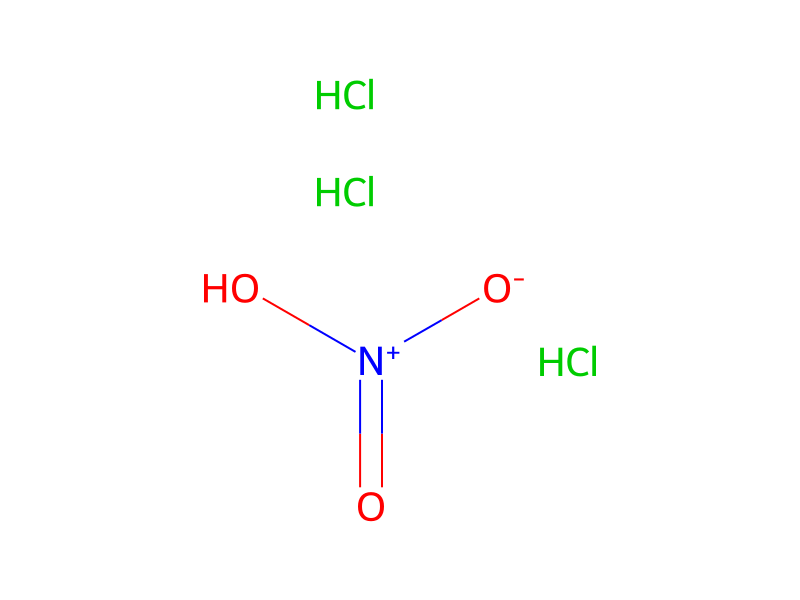
Grundinformationen
- Standard-SMILES
Cl.Cl.Cl.O=[N+]([O-])O- InChIKey
NICDRCVJGXLKSF-UHFFFAOYSA-N- Summenformel
- Cl3H4NO3
- Durchschnittliche Molmasse
- 172,39 g/mol
- Monoisotopische Masse
- 170,92567603
Überblick
Aqua regia appears as a yellow liquid with a pungent odor prepared by mixing nitric acid and hydrochloric acid, usually in a ratio of one part of nitric acid to three or four parts of hydrochloric acid. Fumes are irritating to the eyes and mucous membranes. Corrosive to metals and to tissue.
Namen und Bezeichner
- Bevorzugter Name
- Aqua regia
- IUPAC
- nitric acid;trihydrochloride
- Englischer Name
- Nitrohydrochloric acid
- Summenformel
- ClHNO2
- Molmasse
- 82.46644
Namen und Synonyme
Weitere Namen anzeigen
Datenbank-Bezeichner
- CAS
8007-56-5- PubChem CID
- 90477010
- DTXSID
DTXSID50893666- UNII
- X3TT5X989E
- EC Number
- 690-364-2
Eigenschaften
Berechnete Struktureigenschaften
- Polarare Oberfläche (TPSA)
- 66,1 Ų
- H-Brücken-Donoren
- 4
- H-Brücken-Akzeptoren
- 3
- Frei drehbare Bindungen
- 0
- Schwere Atome
- 7
- Formalladung
- 0
- Komplexität
- 24,8
Experimentelle und physikochemische Eigenschaften
Chemical Classes
Toxic Gases & Vapors -> Acids, Inorganic
Corrosives
Physical Description
Aqua regia appears as a yellow liquid with a pungent odor prepared by mixing nitric acid and hydrochloric acid, usually in a ratio of one part of nitric acid to three or four parts of hydrochloric acid. Fumes are irritating to the eyes and mucous membranes. Corrosive to metals and to tissue.
Yellow fuming liquid with a suffocating odor; [Merck Index] Red, yellow, or gold fuming liquid; [University of Oxford MSDS]
Physikochemische Eigenschaften
- Stabilität
- Pressure will develop in sealed bottles. Incompatible with (and may react violently with) a wide variety of materials, including metals, oxidising agents, reducing agents, combustible materials.
- CAS Datenbank
- 8007 · 8007-56-5
- EPA chemische Informationen
- Aqua regia (8007-56-5)
Sicherheit und Regulatorisches
GHS-Klassifizierung
GHS Classification
This chemical does not meet GHS hazard criteria for 100% (3 of 3) of all reports.
Not Classified
Aggregated GHS information provided per 3 reports by companies from 1 notifications to the ECHA C&L Inventory.
Gefahrenhinweise
Fire Hazards
Excerpt from ERG Guide 157 [Substances - Toxic and/or Corrosive (Non-Combustible / Water-Sensitive)]:
· Non-combustible, substance itself does not burn but may decompose upon heating to produce corrosive and/or toxic fumes.
· Non-combustible, substance itself does not burn but may decompose upon heating to produce corrosive and/or toxic fumes.
Health Hazards
Excerpt from ERG Guide 157 [Substances - Toxic and/or Corrosive (Non-Combustible / Water-Sensitive)]:
· TOXIC and/or CORROSIVE; inhalation, ingestion or contact (skin, eyes) with vapors, dusts or substance may cause severe injury, burns or death.
· TOXIC and/or CORROSIVE; inhalation, ingestion or contact (skin, eyes) with vapors, dusts or substance may cause severe injury, burns or death.
Hazards Summary
Contains nitrosyl chloride and free chlorine; Corrosive; [Merck Index] A strong oxidizing agent with known catalytic activity; Reacts with air; Causes burns; [CAMEO] Causes burns and severe respiratory tract irritation; Highly toxic by ingestion and inhalation; [University of Oxford MSDS] See Nitric acid and Hydrogen chloride.
DOT ID and Guide
1798 157
1798 157
Reactivity Profile
AQUA REGIA is a powerful oxidizing agent and a strong acid. Reacts exothermically with chemical bases (for example: amines and inorganic hydroxides) to form salts and water. Reacts with most metals, including gold and platinum, to dissolve them with generation of toxic and/or flammable gases. Can initiate polymerization in polymerizable organic compounds. Reacts with cyanide salts to generate toxic hydrogen cyanide gas. Generates flammable and/or toxic gases with dithiocarbamates, isocyanates, mercaptans, nitrides, nitriles, sulfides, and weak or strong reducing agents. Additional exothermic gas-generating reactions occur with sulfites, nitrites, thiosulfates (to give H2S and SO3), dithionites (SO2), and carbonates (CO2).
DOT Hazard Classification
Nitrohydrochloric acid
UN1798
Class 8 Corrosive material (49 eCFR § 173.136)
PG I: the degree of danger presented by the material is great
Hazard Classes and Categories
Not Classified
Corrosives
Sicherheit und Schutzausrüstung
Accidental Release Measures
· CALL 911. Then call emergency response telephone number on shipping paper. If shipping paper not available or no answer, refer to appropriate telephone number listed on the inside back cover.
· ELIMINATE all ignition sources (no smoking, flares, sparks or flames) from immediate area.
· CALL 911. Then call emergency response telephone number on shipping paper. If shipping paper not available or no answer, refer to appropriate telephone number listed on the inside back cover.
· ELIMINATE all ignition sources (no smoking, flares, sparks or flames) from immediate area.
First Aid
Excerpt from ERG Guide 157 [Substances - Toxic and/or Corrosive (Non-Combustible / Water-Sensitive)]:
General First Aid:
General First Aid:
Exposure Control and Personal Protection
· Wear positive pressure self-contained breathing apparatus (SCBA).
· Wear positive pressure self-contained breathing apparatus (SCBA).
Isolation and Evacuation
Excerpt from ERG Guide 157 [Substances - Toxic and/or Corrosive (Non-Combustible / Water-Sensitive)]:
Immediate precautionary measure
Immediate precautionary measure
Protective Action Criteria (PAC)
1.8 [ppm]
22 [ppm]
100 [ppm]
Emergency Response Planning Guidelines
· Note: Some foams will react with the material and release corrosive/toxic gases.
· Note: Some foams will react with the material and release corrosive/toxic gases.
Toxikologische Informationen
Sicherheitsdaten
- ridadr
- UN 1798
- hazard_class
- 8
- packing_group
- I
Chemie und Industrie
Verwendung und Herstellung
Anwendungen
VerwendenMetallurgy, testing metals, dissolving metals.
Vor- und nachgelagerte Produkte
Nachgelagerte Produkte
Anbieter3 Anbieter
Ergänzende Hinweise
DefinitionA mixture of concentrated nitric acid and three to four parts of hydrochloric acid. It dissolves all metals including gold, hence the name. The mixture contains chlorine and NOCl (nitrosyl chloride).
Zugehörige Reaktionen
Keine Reaktionsaufzeichnungen unter den aktuellen Filterkriterien.
Verknüpfte Notizen
Wird geladen…