
Di(tert-butyl)carbonat
Di-tert-butyl dicarbonate
Daten werden ergänzt – lade die Seite später neu, um den aktuellen Stand zu sehen
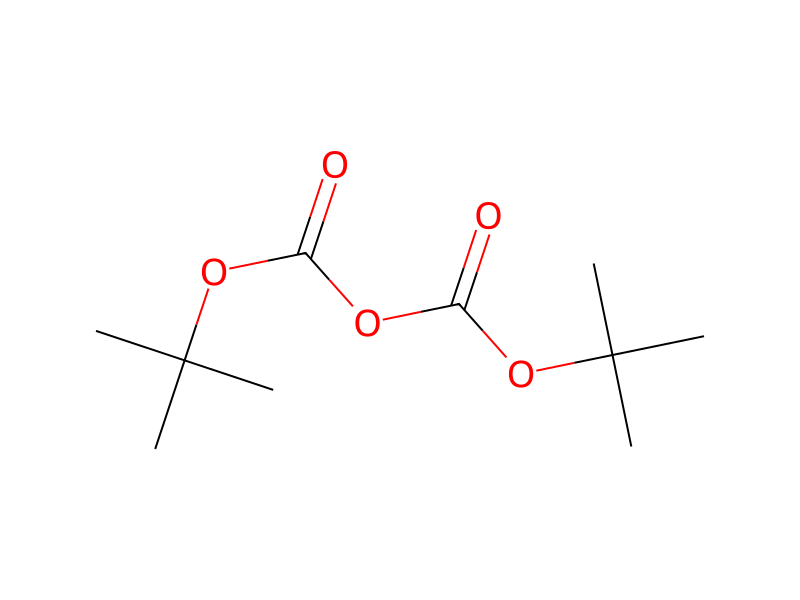
Grundinformationen
- CAS
24424-99-5- Standard-SMILES
CC(C)(C)OC(=O)OC(=O)OC(C)(C)C- InChIKey
DYHSDKLCOJIUFX-UHFFFAOYSA-N- Summenformel
- C10H18O5
- Durchschnittliche Molmasse
- 218,25 g/mol
- Monoisotopische Masse
- 218,11542368
Überblick
Tert-butoxycarbonyl anhydride is an acyclic carboxylic anhydride. It is functionally related to a dicarbonic acid.
Namen und Bezeichner
- Bevorzugter Name
- Di-tert-butyl dicarbonate
- IUPAC
- tert-butyl (2-methylpropan-2-yl)oxycarbonyl carbonate
- Lokaler Name
- Di(tert-butyl)carbonat
- Englischer Name
- Di-tert-butyl dicarbonate
- Summenformel
- C10H18O5
- Molmasse
- 218.25
Namen und Synonyme
Di-tert-butyl dicarbonate24424-99-5di-tert-Butyl pyrocarbonateBis(tert-butoxycarbonyl)oxideBOC-anhydrideBoc2ODi-tert-butyldicarbonateDicarbonic acid, bis(1,1-dimethylethyl) esterDi(tert-butyl) carbonateZ10Q236C3GDTXSID4051904Boc2O cpd
Weitere Namen anzeigen
BOC(BOC)2Otert-butyldicarbonateDBDCDi-tert-butyL
Boc(2)O cpdRefChem:132516DTXCID9030466246-240-1BOC anhydridedi-t-Butyl dicarbonatetert-Butoxycarbonyl anhydrideDiboc
Datenbank-Bezeichner
- CAS
24424-99-5- PubChem CID
- 90495
- DTXSID
DTXSID4051904- ChEBI
CHEBI:48500- UNII
- Z10Q236C3G
- EC Number
- 246-240-1
- Nikkaji
- J88.260G
Eigenschaften
Berechnete StruktureigenschaftenWird ergänzt
- XLogP
- 2,7
- Polarare Oberfläche (TPSA)
- 61,8 Ų
- H-Brücken-Donoren
- 0
- H-Brücken-Akzeptoren
- 5
- Frei drehbare Bindungen
- 6
- Schwere Atome
- 15
- Formalladung
- 0
- Komplexität
- 218
Experimentelle und physikochemische Eigenschaften
Chemical ClassesOther Classes -> Esters, Other
Physical DescriptionWhite solid with a mild odor; mp = 22-24 deg C; [Alfa Aesar MSDS]
Physikochemische Eigenschaften
- Schmelzpunkt
- 23 °C · 23 °C (lit.)
- Siedepunkt
- 56 · 56-57 °C/0.5 mmHg (lit.)
- Dichte
- 0.95 g/mL · 0.95 g/mL at 25 °C (lit.)
- Dampfdruck
- 3.85 Pa · 3.85Pa at 25℃
- Brechungsindex
- 20 · n20/D 1.409(lit.)
- Flammpunkt
- 99 °F · 99 °F
- storage temp.
- 2 · 2-8°C
- Löslichkeit
- Chloroform (Sparingly), Methanol (Slightly)
- Aggregatzustand
- Low Melting Crystalline Solid
- Farbe
- White
- Wichte
Sicherheit und Regulatorisches
Sicherheitsangaben dienen nur zur Orientierung und ersetzen weder das Sicherheitsdatenblatt (SDB) des Lieferanten noch geltende Vorschriften oder eine fachliche Bewertung.
GHS-Klassifizierung
GHS Classification
This chemical does not meet GHS hazard criteria for 0.5% (1 of 183) of reports.
Danger
H225 (26.8%): Highly Flammable liquid and vapor [Danger Flammable liquids]
P210, P233, P240, P241, P242, P243, P260, P261, P264, P264+P265, P271, P272, P280, P284, P302+P352, P303+P361+P353, P304+P340, P305+P351+P338, P305+P354+P338, P316, P317, P319, P320, P321, P332+P317, P333+P317, P337+P317, P362+P364, P370+P378, P403+P233, P403+P235, P405, and P501 (click each P-code to see the statement)
Aggregated GHS information provided per 183 reports by companies from 35 notifications to the ECHA C&L Inventory. Each notification may be associated with multiple companies.
Gefahrenhinweise
Regulatory Information
Chemical: Dicarbonic acid, bis(1,1-dimethylethyl) ester
Status: Active Update: 05-09-2017 https://echa.europa.eu/registration-dossier/-/registered-dossier/5501
Di(t-butyl) carbonate: HSNO Approval: HSR004455 Approved with controls
Hazards Summary
Causes dyspnea and weight loss in inhalation lethal-concentration studies of rats; [RTECS] An irritant that may cause serious eye injury; May cause skin sensitization; Highly toxic by inhalation; [Alfa Aesar MSDS] No results in PubMed: 24424-99-5 AND (sensitizer OR sensitization OR allergic OR contact dermatitis)
Hazard Classes and CategoriesFlam. Liq. 2 (26.8%)
Sicherheit und Schutzausrüstung
Protective Action Criteria (PAC)
Chemie und Industrie
Verwendung und Herstellung
General Manufacturing InformationDicarbonic acid, 1,3-bis(1,1-dimethylethyl) ester: ACTIVE
Anwendungen
VerwendenDi-tert-butyl dicarbonate (Boc2O) is a widely used reagent for introducing protecting groups in peptide synthesis. It plays an important role in the preparation of 6-acetyl-1,2,3,4-tetrahydropyridine by reacting with 2-piperidone. It serves as a protecting group used in solid phase peptide synthesis.
Darstellung
synthetischeThe preparation of Di-tert-butyl dicarbonate is as follows:To a monoester sodium salt solution were added 2g of N, N-dimethylformamide, 1g of pyridine, 1g of triethylamine,Cooling to -5~0°C, 60g diphosgene was slowly added dropwise within 1.5h dropwise addition was complete, warmed to room temperature (25°C), incubated for 2h, the reaction was allowed to stand after filtration, washing organic solution. Dried with anhydrous magnesium sulfate, the solvent was distilled off at atmospheric pressure to give crude product 65~70g. After cooling and crystallization, 57-60g of di-tert-butyl dicarbonate were obtained in a yield of 60-63%.
Vor- und nachgelagerte Produkte
Vorgelagerte Rohstoffe
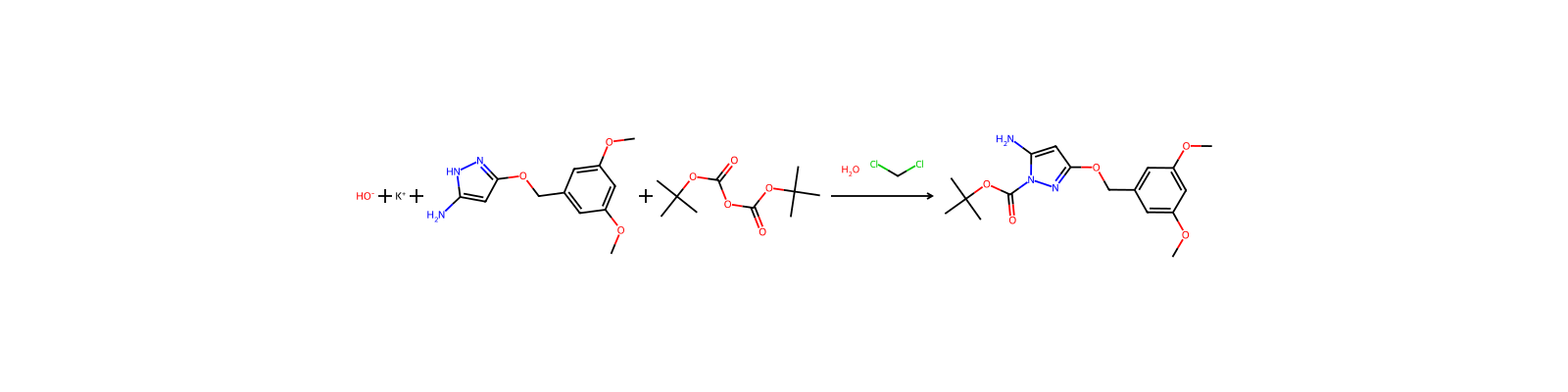
Zugehörige Reaktionen
1.487


Notizen zur Verbindung
Wird geladen…