Amphomycin
Daten werden ergänzt – lade die Seite später neu, um den aktuellen Stand zu sehen
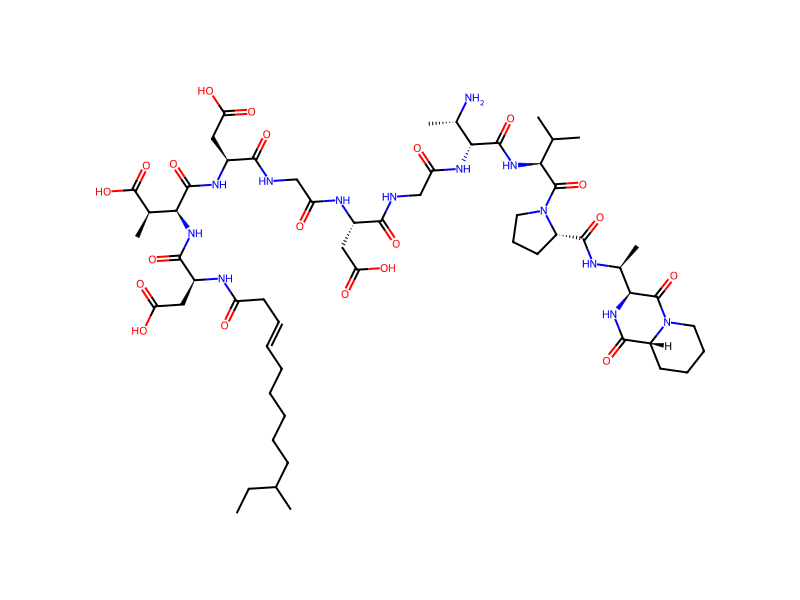
Grundinformationen
- CAS
1402-82-0- Standard-SMILES
CCC(C)CCCCC/C=C/CC(=O)N[C@@H](CC(=O)O)C(=O)N[C@H](C(=O)N[C@@H](CC(=O)O)C(=O)NCC(=O)N[C@@H](CC(=O)O)C(=O)NCC(=O)N[C@@H](C(=O)N[C@H](C(=O)N1CCC[C@H]1C(=O)N[C@@H](C)[C@@H]1NC(=O)[C@H]2CCCCN2C1=O)C(C)C)[C@H](C)N)[C@@H](C)C(=O)O- InChIKey
XBNDESPXQUOOBQ-LSMLZNGOSA-N- Summenformel
- C58H91N13O20
- Durchschnittliche Molmasse
- 1.290,437 g/mol
- Monoisotopische Masse
- 1.289,65033231
Namen und Bezeichner
- Bevorzugter Name
- Amphomycin
- IUPAC
- N-[(3E)-10-Methyldodec-3-enoyl]-L-alpha-aspartyl-3-methyl-L-alpha-aspartyl-L-alpha-aspartylglycyl-L-alpha-aspartyl-N-[(2R,3S)-3-amino-1-({(2S)-1-[(2S)-2-({(1S)-1-[(3S,9aR)-1,4-dioxooctahydro-2H-pyrido[1,2-a]pyrazin-3-yl]ethyl}carbamoyl)pyrrolidin-1-yl]-3-methyl-1-oxobutan-2-yl}amino)-1-oxobutan-2-yl]glycinamide
- Lokaler Name
- Amphomycin
- Englischer Name
- Amphomycin
- Summenformel
- C58H91N13O20
- Molmasse
- 1290.43
Namen und Synonyme
amfamycinNsc267431Amphomycin
Datenbank-Bezeichner
- CAS
1402-82-0- PubChem CID
- 91663250
- DTXSID
DTXSID101017657- ChEMBL
CHEMBL2103921- UNII
- 4P63B997RT
- EC Number
- 215-760-0
Eigenschaften
Physikochemische Eigenschaften
- Siedepunkt
- 854.06 °C · 854.06°C (rough estimate)
- Dichte
- 1.0985 · 1.0985 (rough estimate)
- Brechungsindex
- 1.67 · 1.6700 (estimate)
- storage temp.
- -20 °C · Store at -20°C
- Löslichkeit
- Soluble in DMSO
- Aggregatzustand
- solid
- Farbe
- Crystals
Sicherheit und Regulatorisches
Sicherheitsangaben dienen nur zur Orientierung und ersetzen weder das Sicherheitsdatenblatt (SDB) des Lieferanten noch geltende Vorschriften oder eine fachliche Bewertung.
Sicherheitsdaten
- Toxizität
- LD50 orl-mus: 500 mg/kg 85GDA2 4(1),317,80
Chemie und Industrie
Anwendungen
VerwendenAmphomycin is a lipopeptide antibiotic produced by Streptomycetes and Actinoplanes, initially reported by researchers at Bristol-Myers in 1953 from Streptomyces canus. Amphomycin was marketed as a complex of closely related analogues in the 1950s and 1960s. Structure elucidation was not completed until 2000. Amphomycin is active against Gram positive bacteria, inhibiting peptidoglycan synthesis and blocking cell wall development. Amphomycin is closely related to a number of “lost” antibiotics, aspartocin, crystallomycin, glumamycin, friulimicin, laspartocin, tsushimycin and zaomycin. Interest in amphomycin was re-awakened with the discovery of friulimicin activity against antibiotic resistant strains.
Vor- und nachgelagerte Produkte
Vorgelagerte Rohstoffe
Anbieter14 Anbieter
Career Henan Chemica Co+86-0371-86658258 +86-13203830695 · [email protected]
Shaanxi Cuikang Pharmaceutical Technology Co., Ltd+86-13119157289 · [email protected]
孟成科技(上海)有限公司400-820-6829 · [email protected]
MedBio脉铂医药021-69568360 18916172912 · [email protected]
上海维亦特生物科技有限公司15317051735 · [email protected]
BOC Sciences16314854226; +8616314854226 · [email protected]
浙江珲达生物科技有限公司0571-89903022 18679456698 · [email protected]
Zugehörige Reaktionen
0
Keine Reaktionsaufzeichnungen unter den aktuellen Filterkriterien.
Notizen zur Verbindung
Wird geladen…