StartseiteMCPWorkbenchSkills
StartseiteWorkbenchBenachrichtigungenMein Bereich
llms.txt · MCP-AnleitungDatenschutz · Nutzungsbedingungen · Supportv1.8.0
  1. Startseite
  2. /Verbindung

Hexaflumuron

HCID 91741
Neue NotizNeue ReaktionAnfrage stellen
Druckvorschau
GrundinformationenÜberblickNamen und BezeichnerEigenschaftenSicherheit und RegulatorischesChemie und IndustrieZugehörige ReaktionenNotizen zur Verbindung
TeilstruktursucheÄhnliche Strukturen suchen

Grundinformationen

CAS
86479-06-3
Standard-SMILES
O=C(NC(=O)c1c(F)cccc1F)Nc1cc(Cl)c(OC(F)(F)C(F)F)c(Cl)c1
InChIKey
RGNPBRKPHBKNKX-UHFFFAOYSA-N
Summenformel
C16H8Cl2F6N2O3
Durchschnittliche Molmasse
461,1 g/mol
Monoisotopische Masse
459,9816165

Überblick

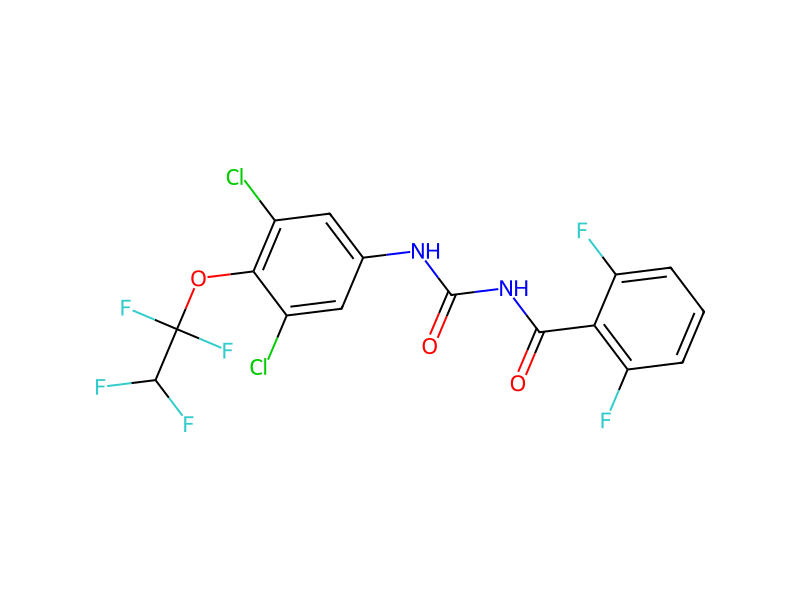
Hexaflumuron is an N-acylurea that is urea in which a hydrogen attached to one of the nitrogens is replaced by a 2,6-difluorobenzoyl group, while a hycrogen attached to the other nitorgen is replaced by a 3,5-dichloro-4-(1,1,2,2-tetrafluoroethoxy)phenyl group. It is a dichlorobenzene, an organochlorine insecticide, an aromatic ether, a benzoylurea insecticide, an organofluorine insecticide and a N-acylurea.

Namen und Bezeichner

Bevorzugter Name
Hexaflumuron
IUPAC
N-[[3,5-dichloro-4-(1,1,2,2-tetrafluoroethoxy)phenyl]carbamoyl]-2,6-difluorobenzamide
Englischer Name
Hexaflumuron
Summenformel
C16H8Cl2F6N2O3
Molmasse
461.14

Namen und Synonyme

Hexaflumuron86479-06-3HexafluoronHexafluronRecruitSentriconSonetDTXSID3032620XRD-473OMS 30311-(3,5-Dichloro-4-(1,1,2,2-tetrafluoroethoxy)phenyl)-3-(2,6-difluorobenzoyl)urea4GW50R449T
Weitere Namen anzeigen
CONSOLxrd473TruenoCONSULTOMS-3031ai3-29832Consult(TMCONSULT(R)
DTXCID1012620CHEBI:39383DE-473N-(((3,5-dichloro-4-(1,1,2,2-tetrafluoroethoxy)phenyl)amino)carbonyl)-2,6-difluorobenzamideBenzamide, N-(((3,5-dichloro-4-(1,1,2,2-tetrafluoroethoxy)phenyl)amino)carbonyl)-2,6-difluoro-N-({[3,5-dichloro-4-(1,1,2,2-tetrafluoroethoxy)phenyl]amino}carbonyl)-2,6-difluorobenzamideBenzamide, N-[[[3,5-dichloro-4-(1,1,2,2-tetrafluoroethoxy)phenyl]amino]carbonyl]-2,6-difluoro-RefChem:786078

Datenbank-Bezeichner

CAS
86479-06-3
PubChem CID
91741
DTXSID
DTXSID3032620
ChEMBL

Eigenschaften

Berechnete Struktureigenschaften

XLogP
5,7
Polarare Oberfläche (TPSA)
67,4 Ų
H-Brücken-Donoren
2
H-Brücken-Akzeptoren
9
Frei drehbare Bindungen
5
Schwere Atome
29
Formalladung
0
Komplexität
581

Experimentelle und physikochemische Eigenschaften

PFAS · 2 Einträge

PFAS -> Other/unspecified

PFAS -> PFAS identified in REACH Regulation EC No. 1272/2008

Pesticides · 4 Einträge

Insecticides

Active substance -> EU Pesticides database: Not approved

Pesticides -> Other Insecticides

Insecticides

LogP · 2 Einträge

log Kow = 5.68

5.46

Density · 2 Einträge

Relative density (water=1): 1.7

Density (at 20 °C): 1.68 g/cm³

Color/FormWhite solid
Solubility · 3 Einträge

Methanol 11.3, xylene 5.2 (both g/l @ 20 °C)

In water, 0.027 mg/l @ 18 °C

Solubility in water, mg/l at 18 °C: 0.027 (practically insoluble)

Decomposition · 3 Einträge

Photolysis DT50 6.3 days (pH 5.0, 25 °C).

The substance decomposes on burning producing toxic and corrosive fumes including nitrogen oxides, hydrogen chloride, hydrogen fluoride.

below boiling point

Sicherheit und Regulatorisches

Sicherheitsangaben dienen nur zur Orientierung und ersetzen weder das Sicherheitsdatenblatt (SDB) des Lieferanten noch geltende Vorschriften oder eine fachliche Bewertung.

GHS-Klassifizierung

GHS Classification · 6 Einträge

Warning

H400: Very toxic to aquatic life [Warning Hazardous to the aquatic environment, acute hazard]

P273, P391, and P501 (click each P-code to see the statement)

Warning

H400 (100%): Very toxic to aquatic life [Warning Hazardous to the aquatic environment, acute hazard]

P273, P391, and P501 (click each P-code to see the statement)

Gefahrenhinweise

Regulatory Information · 2 Einträge

2004/129/EC

REACH registered substance: hexaflumuron (ISO); 1-(3,5-dichloro-4-(1,1,2,2-tetrafluoroethoxy)phenyl)-3-(2,6-difluorobenzoyl)urea (EC: 401-400-1)

Fire HazardsLiquid formulations containing organic solvents may be flammable. Gives off irritating or toxic fumes (or gases) in a fire.
Fire PotentialLiquid formulations containing organic solvents may be flammable.
Hazards SummaryRats were given orally up to 100 mg/kg for 28 days; No overt signs of toxicity, but reticulocyte counts were increased; [HSDB] May induce methemoglobinemia; [ICSC] May cause irritation; [MSDSonline]
UN ClassificationUN Hazard Class: 9; UN Pack Group: III
FIFRA Requirements · 1 Eintrag

New Active Ingredients ... includes pesticide active ingredients initially registered after November 1, 1984, that currently have active product registrations. By law, these newer pesticides are not subject to the reregistration program. They must, however, meet the new safety standard of the FQPA, and will be reviewed on a 15-year cycle under the registration review program. ... Active Ingredient Number: 118202; Tpye of Pesticide: conventional-insecticide/termiticide; Use Site: non-food use, wood, ornamentals; Year: 1994.

Chemie und Industrie

Pharmakologische Informationen

ATC CodeQP - Antiparasitic products, insecticides and repellents
MeSH Pharmacological ClassificationPesticides designed to control insects that are harmful to man. The insects may be directly harmful, as those acting as disease vectors, or indirectly harmful, as destroyers of crops, food products, or textile fabrics.
Absorption, Distribution and ExcretionThe substance can be absorbed into the body by inhalation.

Verwendung und Herstellung

Uses · 5 Einträge

Used as insecticide (inhibits chitin production); [Merck Index]

Farming (Pesticides) [Category: Industry]

For Hexaflumuron (USEPA/OPP Pesticide Code: 118202) ACTIVE products with label matches. /SRP: Registered for use in the U.S. but approved pesticide uses may change periodically and so federal, state and local authorities must be consulted for currently approved uses./

/Control of Lepidoptera, Coleoptera, Homoptera, and Diptera on top fruit, cotton, and potatoes/

Insecticide

Methods of ManufacturingRH Rigterink, RJ Sbragia, EP 71279; eidem, US 4,468,405 (1983, 1984 both to Dow)
Formulations/Preparations · 4 Einträge

USEPA/OPP Pesticide Code 118202; Trade Names: DE-473, NAF-46.

Mixtures: [hexaflumuron] chloropyrifos

Emulsifiable concentrate; suspension concentrate

Recruit (0.1% Hexaflumuron), Recruit AG (0.5% Hexaflumuron, 99.5% inert ingredients), Recruit 50% Concentrate, Recruit II (0.5% Hexaflumuron, 99.5% inert ingredients)

Household ProductsInformation on 1 consumer products that contain Hexafluoron in the following categories is provided:
Use Classification

Zugehörige Reaktionen

2
Reaktionsaufzeichnung erstellen
Reaktionsgleichung von HRID 1611255
HRID 1611255als Eduktuspto-grants-2006_01
Reaktionsgleichung von HRID 1890219
HRID 1890219als Eduktuspto-grants-2013_08

Notizen zur Verbindung

Wird geladen…

Auf dieser SeiteGrundinformationenÜberblickNamen und BezeichnerEigenschaftenSicherheit und RegulatorischesChemie und IndustrieZugehörige ReaktionenNotizen zur Verbindung
Weitere Aktionen
Neue NotizNeue ReaktionAnfrage stellen
CHEMBL1892746
ChEBI
CHEBI:39383
UNII
4GW50R449T
EC Number
401-400-1、617-865-0
Nikkaji
J381.676A
Melting Point · 2 Einträge

202-205 °C

202-205 °C

Vapor Pressure · 3 Einträge

0.00000044 [mmHg]

4.43X10⁻⁷ mm Hg @ 25 °C

Vapor pressure at 25 °C: negligible

Physical Description · 2 Einträge

Colorless or white solid; [ICSC]

WHITE CRYSTALS OR POWDER.

Stability/Shelf LifeUndergoes 60% hydrolysis in 35 days (pH 9). Photolysis DT50 6.3 days (pH 5.0, 25 °C).
Collision Cross Section · 2 Einträge

188.22 Ų [M+H]+ [CCS Type: TW]

187.85 Ų [M+H]+

Physikochemische Eigenschaften

Schmelzpunkt
197 · 197-199°
Dichte
1.4069 · 1.4069 (estimate)
Dampfdruck
5.9 x · 5.9 x l0-5 Pa (25 °C)
storage temp.
2 · Sealed in dry,2-8°C
Löslichkeit
10 mg/ml,DMSO: · DMF: 10 mg/ml,DMSO: 10 mg/ml,DMSO:PBS(pH 7.2) (1:2): 0.3 mg/ml
Aggregatzustand
Solid
Wasserlöslichkeit
2.7 x · 2.7 x l0-22 mg l-1 (18 °C)
pka
8.54 · 8.54±0.46(Predicted)
Farbe
Off-white to light yellow
BRN
8168725 · 8168725
Henry's Law Constant
9.9 · 9.9×10-1 mol/(m3Pa) at 25℃, Duchowicz et al. (2020)
Stabilität
Stable. Incompatible with strong oxidizing agents.
Major Application
agricultureenvironmental
InChI
InChI=1S/C16H8Cl2F6N2O3/c17-7-4-6(5-8(18)12(7)29-16(23,24)14(21)22)25-15(28)26-13(27)11-9(19)2-1-3-10(11)20/h1-5,14H,(H2,25,26,27,28)
InChIKey
RGNPBRKPHBKNKX-UHFFFAOYSA-N
SMILES
C(NC(NC1=CC(Cl)=C(OC(F)(F)C(F)F)C(Cl)=C1)=O)(=O)C1=C(F)C=CC=C1F
CAS Datenbank
86479 · 86479-06-3(CAS DataBase Reference)
EPA chemische Informationen
Hexaflumuron (86479-06-3)
Chemical DangersDecomposes on burning. This produces toxic and corrosive fumes including nitrogen oxides, hydrogen chloride and hydrogen fluoride.
Packaging and LabellingDo not transport with food and feedstuffs.
Toxic Combustion ProductsGives off irritating or toxic fumes (or gases) in a fire.
Hazard Classes and Categories · 4 Einträge

Aquatic Acute 1 (100%)

Acute Tox. 4 (97.4%)

Hazardous to the aquatic environment (acute) - category 1

Aquatic Acute 1

Skin, Eye, and Respiratory IrritationsEvaporation at 20 °C is negligible; a nuisance-causing concn of airborne particles can, however, be reached quickly on spraying or when dispersed, especially if powdered.

Sicherheit und Schutzausrüstung

Fire FightingIn case of fire in the surroundings, use appropriate extinguishing media.
First Aid Measures · 4 Einträge

Fresh air, rest.

Rinse and then wash skin with water and soap.

First rinse with plenty of water for several minutes (remove contact lenses if easily possible), then refer for medical attention.

Rinse mouth.

Safe StorageSeparated from food and feedstuffs. Well closed. Store in an area without drain or sewer access.
Fire Fighting ProceduresIn case of fire in the surroundings: all extinguishing agents allowed.
Storage Conditions/Keep/ separated from food and feedstuffs. Well closed.
Cleanup Methods · 1 Eintrag

Do NOT wash away into sewer. Sweep spilled substance into sealable containers; if appropriate, moisten first to prevent dusting. Carefully collect remainder, then remove to safe place. ... Provision to contain effluent from fire extinguishing.

Disposal Methods · 1 Eintrag

SRP: At the time of review, criteria for land treatment or burial (sanitary landfill) disposal practices are subject to significant revision. Prior to implementing land disposal of waste residue (including waste sludge), consult with environmental regulatory agencies for guidance on acceptable disposal practices.

Spillage Disposal · 1 Eintrag

Personal protection: particulate filter respirator adapted to the airborne concentration of the substance. Do NOT let this chemical enter the environment. Sweep spilled substance into covered containers. If appropriate, moisten first to prevent dusting. Carefully collect remainder. Then store and dispose of according to local regulations.

Preventive MeasuresDo not eat, drink, or smoke during work. Wash hands before eating.
Eye PreventionWear safety spectacles.
Inhalation RiskEvaporation at 20 °C is negligible; a nuisance-causing concentration of airborne particles can, however, be reached quickly on spraying or when dispersed, especially if powdered.
Skin PreventionProtective gloves.

Toxikologische Informationen

Ecotoxicity Values · 2 Einträge

LD50 Mallard ducks oral >2000 mg/kg

LD50 Bee oral & contact >0.1 mg/bee

Environmental Fate · 3 Einträge

TERRESTRIAL FATE: Based on a classification scheme(1), an estimated Koc value of 29,300(SRC), determined from a log Kow of 5.68(2) and a regression-derived equation(3), indicates that hexaflumuron is expected to be immobile in soil(SRC). Volatilization of hexaflumuron from moist soil surfaces is expected to be an important fate process(SRC) given an estimated Henry's Law constant of 1.0X10⁻⁵ atm-cu m/mole(SRC), derived from its vapor pressure, 4.43X10⁻⁷ mm Hg(2), and water solubility, 0.027 mg/l(2). Hexaflumuron is not expected to volatilize from dry soil surfaces(SRC) based upon its vapor pressure(2). However, adsorption to soil is expected to attenuate volatilization(SRC). In soil, the aerobic biodegradation half-life for hexaflumuron ranged from 56 to 190 days under different moisture and temperature conditions(4). Under anaerobic conditions, the biodegradation half-life for hexaflumuron ranged from 40-64 days at 25 °C(4). Photodegradation of hexaflumuron may be important since it has a half-life in water of 6.3 days(4).

AQUATIC FATE: Based on a classification scheme(1), an estimated Koc value of 29,300(SRC), determined from a log Kow of 5.68(2) and a regression-derived equation(3), indicates that hexaflumuron is expected to adsorb to suspended solids and sediment(SRC). Volatilization from water surfaces is expected(3) based upon an estimated Henry's Law constant of 1.0X10⁻⁵ atm-cu m/mole(SRC), derived from its vapor pressure, 4.4X10⁻⁷ mm Hg(2), and water solubility, 0.027 mg/l(2). Using this Henry's Law constant and an estimation method(3), volatilization half-lives for a model river and model lake are 2.2 hrs and 8.5 days, respectively(SRC). However, volatilization from water surfaces is expected to be attenuated by adsorption to suspended solids and sediment in the water column. The estimated volatilization half-life from a model pond is 290 months if adsorption is considered(4). According to a classification scheme(5), an estimated BCF of 4,700(SRC), from its log Kow (2) and a regression-derived equation(6), suggests the potential for bioconcentration in aquatic organisms is very high(SRC). Based on soil biodegradation studies, hexaflumuron is expected to biodegrade in water under aerobic and anaerobic conditions(SRC). In soil the aerobic biodegradation half-life for hexaflumuron ranged from 56 to 190 days under different moisture and temperature conditions(7). Under anaerobic conditions in soil, the biodegradation half-life for hexaflumuron ranged from 40-64 days at 25 °C(7). The hydrolysis of hexaflumuron in natural water was a first order process with a mean half-life of 42.3 days(7). The aqueous photolysis of hexaflumuron resulted in 2,6-difluorobenzamide, 3,5-dichloro-4-hydroxyaniline, and CO2 as the major degradation products. The photodegradation was a first order process with a half-life of approx 6.3 days(7).

ATMOSPHERIC FATE: According to a model of gas/particle partitioning of semivolatile organic compounds in the atmosphere(1), hexaflumuron, which has a vapor pressure of 4.43X10⁻⁷ mm Hg at 25 °C(2), will exist in both the vapor and particulate phases in the ambient atmosphere(SRC). Vapor-phase hexaflumuron is degraded in the atmosphere by reaction with photochemically-produced hydroxyl radicals(SRC); the half-life for this reaction in air is estimated to be 18.3 hrs(SRC), calculated from its rate constant of 21X10-12 cu cm/molecule-sec at 25 °C(SRC) that was derived using a structure estimation method(3). Particulate-phase hexaflumuron may be removed from the air by wet and dry deposition(SRC). Based on aqueous photolysis studies(2), hexaflumuron has the potential for direct photolysis(SRC).

Adverse EffectsMethemoglobinemia - The presence of increased methemoglobin in the blood; the compound is classified as secondary toxic effect
Exposure RoutesThe substance can be absorbed into the body by ingestion and by inhalation of dust.
Ecotoxicity Excerpts · 1 Eintrag

/AQUATIC SPECIES/ Hexaflumuron, an insect growth regulator (IGR), was found to be nonlethal to four species of larvivorous fish, Poecilia reticulata, Gambusia affinis, Aplocheilus blochii and Tilapia mossambica at | 1.0 mg/l. These species were found to be tolerant with higher LD50 values ranging from 2.21-3.097 mg/l. Absolute survival (100%) was observed in all the four species at 1.0 mg/l for more than 8 days. Fish safety factor or suitability index computed for each fish species against the three vector mosquitoes showed maximum value for P. reticulata which indicated its higher tolerance than other species. Fishes that exhibited decreased swimming activity on exposure at 1.0 mg/l regained normal activity on withdrawal of exposure. No adverse effect was noticed in the reproduction of G. affinis.

ICSC Environmental Data · 1 Eintrag

The substance is very toxic to aquatic organisms. Bioaccumulation of this chemical may occur in fish. The substance may cause long-term effects in the aquatic environment. Avoid release to the environment in circumstances different to normal use.

Soil Adsorption/Mobility · 1 Eintrag

Hexaflumuron is strongly adsorbed on a wide range of soils(1,4). The Koc of hexaflumuron is estimated as 29,300(SRC), using a log Kow of 5.68(1) and a regression-derived equation(2). According to a classification scheme(3), this estimated Koc value suggests that hexaflumuron is expected to be immobile in soil(SRC). Soil Kd (desorption constants) values ranged from 147 to 1,326(4) and soil Kom values ranged from 3,096 to 41,170(1).

Artificial Pollution SourcesHexaflumuron's production may result in its release to the environment through various waste streams; it's use as an insecticide(1,2) will result in its direct release to the environment(SRC).
Environmental Biodegradation · 2 Einträge

AEROBIC: Hexaflumuron biodegrades under aerobic conditions(SRC). Levels of radioactivity in the 14CO2 traps from and aerobic soil degradation experiment were very low with a total of only 0.7-2.1% of the applied activity observed 84 days after treatment with (14C-aniline)hexaflumuron(1). However, previous investigations using benzoyl 14C-labeled hexaflumuron have shown greater amounts of 14CO2 suggesting that this part of the molecule is more readily degraded to CO2(1). TLC of the extracts of the soil samples incubated under aerobic conditions showed the presence of two metabolites, 3,5-dichloro-4-(1,1,2,2-tetrafluoroethoxy)aniline and 2,5-dichloro-4-(1,1,2,2-tetrafluoroethoxy)phenylurea in addition to the parent(1). Levels of both metabolites generally increased with incubation time, and the greatest levels were observed at the higher temperatures and moisture contents(1). The half-life of (14C-aniline)hexaflumuron in Castle Rising soil under different temperature and moisture regimes were as follows: 159 days (moisture, 50% of 0.33 bar; 25 °C); 90 days (moisture, 75% of 0.33 bar; 25 °C); 64 days (moisture, 100% of 0.33 bar; 25 °C); 190 days (moisture, 75% of 0.33 bar; 10 °C); 90 days (moisture, 75% of 0.33 bar; 25 °C); 56 days (moisture, 75% of 0.33 bar; 35 °C)(1).

ANAEROBIC: Analysis of the anaerobic soils showed the presence of 3,5-dichloro-4-(1,1,2,2-tetrafluoroethoxy)aniline as the major metabolite (8-18% of applied activity), with an unknown metabolite of greater polarity than any of the reference standards observed at levels up to 5% of applied radioactivity(1). Half-lives of (14C-aniline)hexaflumuron at 25 °C under anaerobic conditions were in the range 40-64 days(1).

Environmental Bioconcentration · 1 Eintrag

An estimated BCF of 4,700 was calculated for hexaflumuron(SRC), using a log Kow of 5.68(1) and a regression-derived equation(2). According to a classification scheme(3), this BCF suggests the potential for bioconcentration in aquatic organisms is very high(SRC).

Volatilization from Water/Soil · 1 Eintrag

The Henry's Law constant for hexaflumuron is estimated as 1.0X10⁻⁵ atm-cu m/mole(SRC) derived from its vapor pressure, 4.43X10⁻⁷ mm Hg(1), and water solubility, 0.027 mg/l(1). This Henry's Law constant indicates that hexaflumuron is expected to volatilize from water surfaces(3). Based on this Henry's Law constant, the volatilization half-life from a model river (1 m deep, flowing 1 m/sec, wind velocity of 3 m/sec)(2) is estimated as 2.2 hrs(SRC). The volatilization half-life from a model lake (1 m deep, flowing 0.05 m/sec, wind velocity of 0.5 m/sec)(2) is estimated as 8.5 days(SRC). Hexaflumuron's estimated Henry's Law constant indicates that volatilization from moist soil surfaces may occur(SRC). However, volatilization from moist soil and water surfaces is expected to be attenuated by adsorption(SRC). The estimated volatilization half-life from a model pond is 290 months if adsorption is considered(3). Hexaflumuron is not expected to volatilize from dry soil surfaces(SRC) based upon its vapor pressure(1).

Non-Human Toxicity Excerpts · 1 Eintrag

/LABORATORY ANIMALS: Subchronic or Prechronic Exposure/ The effects of five benzoylphenylurea insecticides /including/ ...hexaflumuron... were comparatively evaluated on hematological parameters in rats. Sixty adult Wistar-rats were divided into five dose groups and a control group. Daily doses of 100 mg/kg of each tested insecticide were administered by gavage for 28 days, after which rats were sacrificed and blood was taken for examination. Parameters measured were red blood cell count, hemoglobin (Hb), hematocrit, mean corpuscular volume, mean corpuscular Hb concentration, methemoglobin (metHb), and reticulocyte counts. Results showed that treatment with insecticides at the dose given did not produce any overt signs of toxicity. ...The reticulocyte level was increased in all treated groups, even at dose levels of 50mg/kg. The authors conclude that the metHb level incr and reticulocyte incr are the most sensitive parameters, but that one might be independent of the other.

Regulatorische Informationen

FIFRA Requirements · 1 Eintrag

New Active Ingredients ... includes pesticide active ingredients initially registered after November 1, 1984, that currently have active product registrations. By law, these newer pesticides are not subject to the reregistration program. They must, however, meet the new safety standard of the FQPA, and will be reviewed on a 15-year cycle under the registration review program. ... Active Ingredient Number: 118202; Tpye of Pesticide: conventional-insecticide/termiticide; Use Site: non-food use, wood, ornamentals; Year: 1994.

Sicherheitsdaten

wgk
2
ridadr
UN 3077
RTECS-Nr.
CV3800000
risk_code
50/53
Toxizität
LD50 oral in rat: > 5gm/kg
hazard_code
N
safety_code
60-61
hazard_class
9
packing_group
III
Speicherklasse
11 - Combustible Solids
Giftige Stoffe Daten
86479-06-3(Hazardous Substances Data)
Hazard Classifications
Aquatic Acute 1Aquatic Chronic 1
Insecticides
General Manufacturing Information · 2 Einträge

Mode of action: Systemic insecticide. Inhibits chitin synthesis.

The Sentricon Termite Colony Elimination System ... was launched commercially in 1995 after receiving EPA registration as a reduced risk pesticide. Sentricon represents truly novel technology employing an Integrated Pest Management approach using monitoring and targeted delivery of a highly specific bait. ... The properties of hexaflumuron as a termite control agent are attractive from an environmental and human risk perspective, but more importantly, the potential for adverse affects is dramatically reduced since it is present only in very small quantities in stations with termite activity. The comparisons to barrier methods show significant reduction in the use of hazardous materials and substantial reduction in potential impacts on human health and the environment.[

Anwendungen · 2 Einträge

BeschreibungHexaflumuron is a benzoylphenyl urea-type insecticide and is the common name for N-(((3,5- dichloro-4-(1,1,2,2-tetrafluoro-ethoxy)phenyl)amino)carbonyl)-2,6-difluorobenzamide. It the active ingredient in several termite control products registered to Dow AgroSciences LLC, a wholly owned subsidiary of The Dow Chemical Company. Hexaflumuron was the first active ingredient to be registered with the U.S. Environmental Protection Agency (EPA) as a reduced-risk pesticide. A reduced-risk pesticide is one that the EPA believes has low impact on human health, low toxicity to non-target organisms, and low potential for groundwater contamination. Hexaflumuron’s mode of action is to inhibit chitin synthesis. Termites produce chitin to form or maintain an exoskeleton.Hexaflumuron is an odorless white solid that is formulated into low-concentration solid briquettes that are contained within tamper-resistant bait stations. Formulated hexaflumuron briquettes contain about 0.5% of the active ingredient, with the balance comprised almost entirely of cellulose.Hexaflumuron formulations have been marketed under the trade names RECRUIT® AG termite bait, SHATTER*termite bait, SENTRI*TECH, RECRUTE® Pro, Hex-Pro(TM) Termite Baiting System, Sentricon(TM) IG Termite Bait, Sentricon(TM) AG Termite Bait, Sentricon® Termite Colony Elimination System.

VerwendenHexaflumuron is an benzoylphenylurea based chitin synthesis inhibitor used against Ephestia figulilella.

Vor- und nachgelagerte Produkte

Vorgelagerte Rohstoffe

Flufenoxuron4-(1,1,2,2-Tetrafluoroethoxy)anilineTetrahydrothiophen-1,1-dioxidKaliumfluoridPhenylisocyanat2,6-Difluorbenzamid2,6-Difluorobenzoyl isocyanateChlorfluazuronCarbonylchloridCyanhydric acidOxalyldichlorid
Ergänzende Hinweise · 1 Eintrag

DefinitionChEBI: An N-acylurea that is urea in which a hydrogen attached to one of the nitrogens is replaced by a 2,6-difluorobenzoyl group, while a hycrogen attached to the other nitorgen is replaced by a 3,5-dichloro-4-(1,1,2,2-tetrafluoroethoxy)phenyl group.