Grundinformationen
- Standard-SMILES
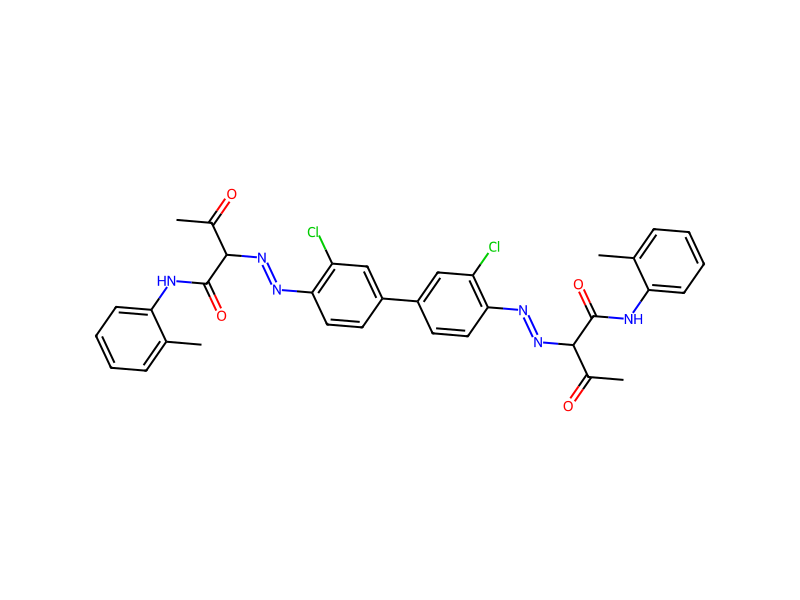
CC(=O)C(N=Nc1ccc(-c2ccc(N=NC(C(C)=O)C(=O)Nc3ccccc3C)c(Cl)c2)cc1Cl)C(=O)Nc1ccccc1C- InChIKey
LQZFGPJGXVFSTR-UHFFFAOYSA-N- Summenformel
- C34H30Cl2N6O4
- Durchschnittliche Molmasse
- 657,5 g/mol
- Monoisotopische Masse
- 656,1705588
Namen und Bezeichner
- Bevorzugter Name
- C.I. Pigment Yellow 14
- IUPAC
- 2-[[2-chloro-4-[3-chloro-4-[[1-(2-methylanilino)-1,3-dioxobutan-2-yl]diazenyl]phenyl]phenyl]diazenyl]-N-(2-methylphenyl)-3-oxobutanamide
- Lokaler Name
- 2,2'-[(3,3'-Dichlor[1,1'-biphenyl]-4,4'-diyl)bis(azo)]bis[N-(2-methylphenyl)-3-oxobutyramid]
- Englischer Name
- Pigment Yellow 14
- Summenformel
- C34H30Cl2N6O4
- Molmasse
- 657.55
Namen und Synonyme
Benzidine Yellow GResorcin Brown RPermanent Yellow GRadiant YellowVulcan Fast Yellow GLake Yellow GALight Yellow JBVPlastol Yellow GGPlastol Yellow GPBenzidene Yellow GBenzidine Yellow LSilotermo Yellow G
Weitere Namen anzeigen
BENZIDINE YELLOWYellow 12c.i. 21095CIPIGMENT YELLOW 12Yellow 14C.I.P.Y14aaotyellowYOLLW2gs14yongguhuang
Irgalite Yellow BRLight Yellow JBVTPermagen Yellow GAResamine Yellow GPVynamon Yellow 2GBenzidine Yellow OTCalcotone Yellow GPHostaperm Yellow GT
Datenbank-Bezeichner
- CAS
5468-75-7- PubChem CID
- 93006
- DTXSID
DTXSID9027601- UNII
- 586X0864EC
- EC Number
- 226-789-3
- Nikkaji
- J35.636K
Eigenschaften
Berechnete Struktureigenschaften
- XLogP
- 8,8
- Polarare Oberfläche (TPSA)
- 142 Ų
- H-Brücken-Donoren
- 2
- H-Brücken-Akzeptoren
- 8
- Frei drehbare Bindungen
- 11
- Schwere Atome
- 46
- Formalladung
- 0
- Komplexität
- 1.050
Experimentelle und physikochemische Eigenschaften
Physical Description
Dry Powder; Wet Solid; CBI; Dry Powder; Wet Solid; Liquid; Wet Solid; Other Solid; Dry Powder; Liquid; Liquid; Dry Powder; Other Solid
Solid; [EPA ChAMP: Hazard Characterization: C.I. Pigment Yellow 14 - 2010] Yellow odorless powder; [BASF MSDS]
Physikochemische Eigenschaften
- Siedepunkt
- 793.4 · 793.4±60.0 °C(Predicted)
- Dichte
- 1.4203 · 1.4203 (rough estimate)
- Brechungsindex
- 1.735 · 1.7350 (estimate)
- pka
- 0.99 · 0.99±0.59(Predicted)
- Aggregatzustand
- Solid:nanomaterial
- Farbe
- Yellow to orange
- Stabilität
- Light Sensitive
- LogP
- 0.5 at · 0.5 at 24℃ and pH7
- CAS Datenbank
- 5468 · 5468-75-7(CAS DataBase Reference)
- EPA chemische Informationen
- 14 · C.I. Pigment Yellow 14 (5468-75-7)
Sicherheit und Regulatorisches
GHS-Klassifizierung
GHS Classification
This chemical does not meet GHS hazard criteria for 96.8% (489 of 505) of all reports.
Not Classified;Reported as not meeting GHS hazard criteria by 489 of 505 companies (only 3.2% companies provided GHS information). For more detailed information, please visit ECHA C&L website.
Aggregated GHS information provided per 505 reports by companies from 5 notifications to the ECHA C&L Inventory.;Reported as not meeting GHS hazard criteria per 489 of 505 reports by companies.;There are 3 notifications provided by 16 of 505 reports by companies with hazard statement code(s).;Information may vary between notifications depending on impurities, additives, and other factors. The percentage value in parenthesis indicates the notified classification ratio from companies that provide hazard codes. Only hazard codes with percentage values above 10% are shown. For more detailed information, please visit ECHA C&L website.
Gefahrenhinweise
Regulatory Information
Chemical: Butanamide, 2,2'-[(3,3'-dichloro[1,1'-biphenyl]-4,4'-diyl)bis(azo)]bis[N-(2-methylphenyl)-3-oxo-
Butanamide, 2,2'-[(3,3'-dichloro[1,1'-biphenyl]-4,4'-diyl)bis(2,1-diazenediyl)]bis[N-(2-methylphenyl)-3-oxo- is listed on the EPA's Chemical Data Reporting (CDR) system. Manufacturers and importers of Butanamide, 2,2'-[(3,3'-dichloro[1,1'-biphenyl]-4,4'-diyl)bis(2,1-diazenediyl)]bis[N-(2-methylphenyl)-3-oxo- are required to report information about their production and use of this chemical to the EPA under the Toxic Substances Control Act (TSCA). (40 eCFR Part 711)
Status: Active Update: 21-02-2023 https://echa.europa.eu/registration-dossier/-/registered-dossier/15898
Butanamide, 2,2'-[(3,3'-dichloro[1,1'-biphenyl]-4,4'-diyl)bis(azo)]bis[N-(2-methylphenyl)-3-oxo-: Does not have an individual approval but may be used under an appropriate group standard
Other Safety Information
IMAP assessments - Butanamide, 2,2'-[(3,3'-dichloro[1,1'-biphenyl]-4,4'-diyl)bis(azo)]bis[N-(2-methylphenyl)-3-oxo-: Environment tier I assessment;IMAP assessments - Selected benzidine-congener-based pigments: Human health tier II assessment
Hazards Summary
Not irritating to skin or eyes in rabbits; [IUCLID] Supporting chemicals demonstrate mild irritation or irritation to rabbit skin and eyes; No evidence of skin sensitization in guinea pigs; No systemic toxicity in repeated-dose inhalation and oral studies of rats (doses up to 410 mg/m3 and 2,500 mg/kg/day); No systemic, reproductive, or developmental toxicity in a combined study of rats at doses up to 1,000 mg/kg/day; No evidence of carcinogenicity in rats or mice; [EPA ChAMP: Hazard Characterization: C.I. Pigment Yellow 14 - 2010] Not expected to cause irritation or other adverse health effects if handled properly; [BASF MSDS] See Benzidine.
Hazard Classes and CategoriesNot Classified
Sicherheit und Schutzausrüstung
Protective Action Criteria (PAC)
15 [mg/m3]
170 [mg/m3]
990 [mg/m3]
Regulatorische Informationen
Regulatory Information
Chemical: Butanamide, 2,2'-[(3,3'-dichloro[1,1'-biphenyl]-4,4'-diyl)bis(azo)]bis[N-(2-methylphenyl)-3-oxo-
Butanamide, 2,2'-[(3,3'-dichloro[1,1'-biphenyl]-4,4'-diyl)bis(2,1-diazenediyl)]bis[N-(2-methylphenyl)-3-oxo- is listed on the EPA's Chemical Data Reporting (CDR) system. Manufacturers and importers of Butanamide, 2,2'-[(3,3'-dichloro[1,1'-biphenyl]-4,4'-diyl)bis(2,1-diazenediyl)]bis[N-(2-methylphenyl)-3-oxo- are required to report information about their production and use of this chemical to the EPA under the Toxic Substances Control Act (TSCA). (40 eCFR Part 711)
Status: Active Update: 21-02-2023 https://echa.europa.eu/registration-dossier/-/registered-dossier/15898
Butanamide, 2,2'-[(3,3'-dichloro[1,1'-biphenyl]-4,4'-diyl)bis(azo)]bis[N-(2-methylphenyl)-3-oxo-: Does not have an individual approval but may be used under an appropriate group standard
Sicherheitsdaten
- tsca
- TSCA listed
- RTECS-Nr.
- EJ3512500
- risk_code
- 36/37/38
- safety_code
- 26-36/37/39
Chemie und Industrie
Verwendung und Herstellung
Uses
Used in the paints-lacquers-varnishes and polymers industries; Used as a coloring agent; [IUCLID] Used to make adhesives, wood products, other plastic products, paints and coatings, other agricultural chemicals, printing inks, synthetic dyes, and pigments; Used in photofinishing, printing, adhesives, sealants, non-pesticidal agricultural products, glass and ceramic products, rubber and plastics products, paints and coatings, paper products, photographic supplies, and wood and wood furniture; [EPA ChAMP: Hazard Characterization: C.I. Pigment Yellow 14 - 2010]
Pulp and Paper Processing [Category: Industry];Painting (Pigments, Binders, and Biocides) [Category: Paint];Working with Glues and Adhesives [Category: Other];Photographic Processing [Category: Other];Textiles (Printing, Dyeing, or Finishing) [Category: Industry];Glass Manufacturing [Category: Industry]
Substance listed with specific concentration in tattoo ink and/or permanent make up according to EU Commission Regulation 2020/2081. The concentration limit (by weight) is 0.1%.
Plastics -> Typical concentration range in plastic materials -> 2%
U.S. Production2023: 2,500,000 - <4,000,000 lb;2022: 5,500,000 - <7,000,000 lb;2021: 5,500,000 - <7,000,000 lb;2020: 5,500,000 - <7,000,000 lb
Consumer UsesNot Known or Reasonably Ascertainable;Dye;Pigment
Industry UsesPigment;Dye
Use Classification
Plastics -> Pigments agents
Plastics -> Polymer Type -> PUR; PVC (soft); PVC (rigid)
General Manufacturing Information
Printing Ink Manufacturing;Textiles, apparel, and leather manufacturing;All Other Chemical Product and Preparation Manufacturing;Paint and Coating Manufacturing;Synthetic Dye and Pigment Manufacturing;Plastics Material and Resin Manufacturing;Plastics Product Manufacturing;Custom Compounding of Purchased Resins;Printing and Related Support Activities
Butanamide, 2,2'-[(3,3'-dichloro[1,1'-biphenyl]-4,4'-diyl)bis(2,1-diazenediyl)]bis[N-(2-methylphenyl)-3-oxo-: ACTIVE
Anwendungen
VerwendenPigment Yellow 14 is an organic azo dye used in the textile and printing industries. Pigment Yellow 14 is also used in composite coatings applied to PVC.
Vor- und nachgelagerte Produkte
Vorgelagerte Rohstoffe
Anbieter50 Anbieter
郑州阿尔法化工有限公司+86-18530059196 · [email protected]
宁波君龙新材料有限公司0574 88552216 19032109277 · [email protected]
上海麦克林生化科技股份有限公司021-50706066 15221275939 · [email protected]
江苏艾康生物医药研发有限公司025-58851090 19370895928 · [email protected]
杭州品高化工有限公司0571-87658025 · [email protected]
陕西缔都新材料有限公司029-63373950 17392216152 · [email protected]
Dayang Chem (Hangzhou) Co.,Ltd.+86-0571-88938639 17705817739 · [email protected]
武汉绿景丰华生物科技有限公司19972070065 · [email protected]
太原市瑞和丰科贸有限公司+86 351 7031519 · [email protected]
山东洛克化工有限公司17653113209 13065062079 · [email protected]
超彩实业有限公司0574-83851061 · [email protected]
沈阳依莱普克斯化工有限公司024-31124838 15840046119
河南玖科化工有限公司0370-2071226 17303700913
玛雅试剂+86 (573) 82222445 (0)18006601000 452520369 · [email protected]
上海敏寒医药科技有限公司17612188245 · [email protected]
湖北隆信化工实业有限公司15271551270 · [email protected]
郑州安步防护用具有限公司+86-0371-88006763; +86-15988602810 · [email protected]
Hebei Huanzhou Chemical Products Co., Ltd.+8619133532821 · [email protected]
上海湄水化工科技有限公司021-60549325 18616193163
上海将来实业股份有限公司400-0066400 13621662912 · [email protected]
HBCChem, Inc.+1-510-219-6317 · [email protected]
TargetMol中国(陶术生物)021-021-33632979 15002134094 · [email protected]
海南瀚海致远生物科技有限公司18171012772 · [email protected]
厦门志信化学有限公司+86-5922680277 +86-13806087780 · [email protected]
山东智尚新材料有限公司+8617653113209 · [email protected]
艾吉析科技(上海)有限公司17721401538;17717235263 17721401538 · [email protected]
Qiuxian Baitai New Material Co., LTD+86-19932103556 · [email protected]
河南沃咖斯生物科技有限公司18537671377 · [email protected]
杭州迈昂进出口有限公司0571-56076803 18667038366
武汉克米克生物医药技术有限公司027-13163388153 13163388153 · [email protected]
山东西亚化学有限公司4009903999 13395398332 · [email protected]
佛山晟熠生物科技有限公司18064670521 · [email protected]
杭州洁汉化工有限公司+86-571-86217390; +8618058761490 · [email protected]
武汉峰耀同辉化学制品有限公司027-87466105 15377573527 · [email protected]
河南天孚化工有限公司+86-0371-55170693 +86-19937530512 · [email protected]
厦门盈融达化工有限公司+86-0592-6210733 · [email protected]
上海帅燊实业有限公司021-37590756 57450129
career henan chemical co+86-0371-86658258 · [email protected]
上海亿化化工有限公司021-58771921 13818686088 · [email protected]
SHANDONG ZHI SHANG CHEMICAL CO.LTD0531-68652808 18953170293 · [email protected]
河南阿尔法化工有限公司0371-55055611 18137792234 · [email protected]
上海鼎芬化学科技有限公司021-37590756 · [email protected]
爆牛贸易重庆有限公司+86-023-6139-8061 +86-86-13650506873 · [email protected]
上海博湖生物科技有限公司021-57763112 13585886131 · [email protected]
湖北信康医药化工有限公司027-027-59308705 18871579363 · [email protected]
XIAMEN AMITY INDUSTRY AND TRADE CO., LTD.+8618950047208 · [email protected]
上海有集材料有限公司13052376889 13681663468 · [email protected]
SUZHOU SENFEIDA CHEMICAL CO.,LTD+86-0512-83500002 +86-15195660023 · [email protected]
河南伊诺凯新材料有限公司17634273666 · [email protected]
BOC Sciences+1-631-485-4226 · [email protected]
Zugehörige Reaktionen
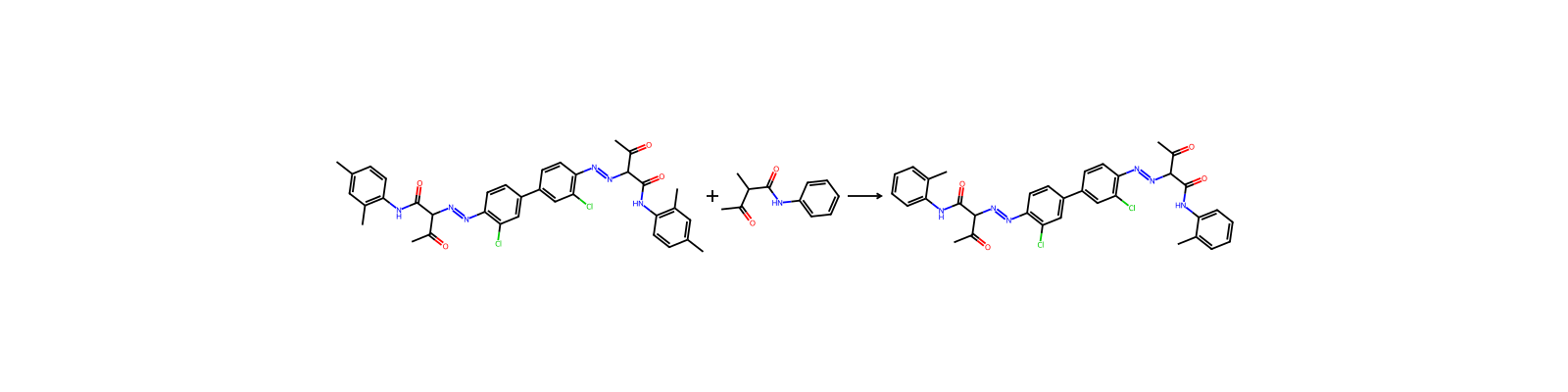
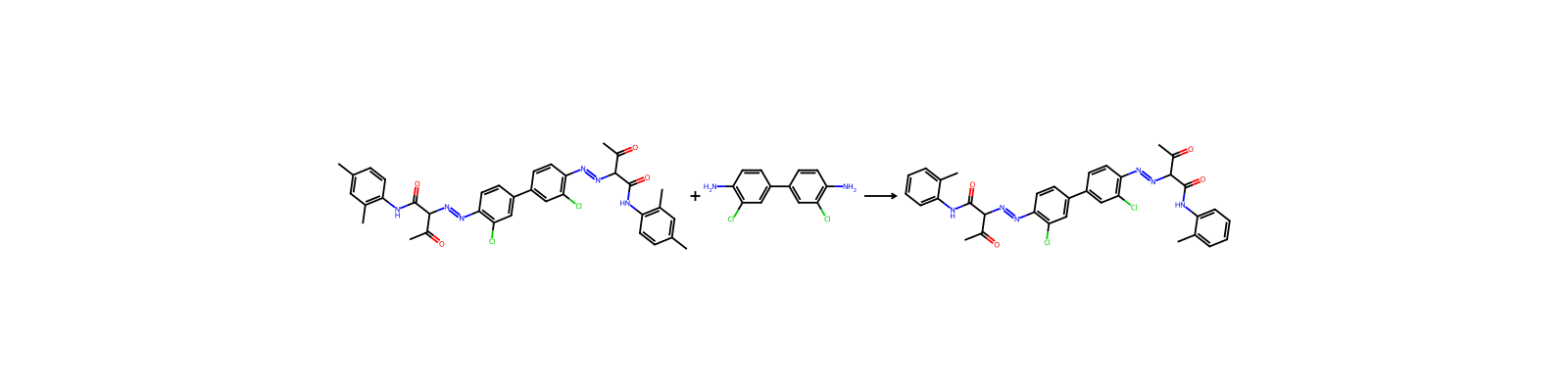
2
Verknüpfte Notizen
Wird geladen…