
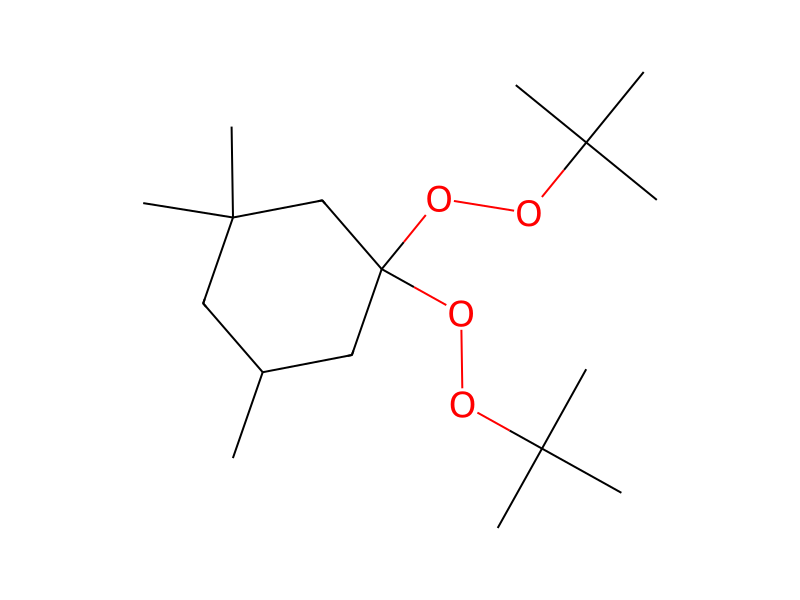
Grundinformationen
- Standard-SMILES
CC1CC(C)(C)CC(OOC(C)(C)C)(OOC(C)(C)C)C1- InChIKey
NALFRYPTRXKZPN-UHFFFAOYSA-N- Summenformel
- C17H34O4
- Durchschnittliche Molmasse
- 302,4 g/mol
- Monoisotopische Masse
- 302,24570957
Überblick
See other relationships...
Namen und Bezeichner
- Bevorzugter Name
- 1,1-Bis(tert-butylperoxy)-3,3,5-trimethylcyclohexane
- IUPAC
- 1,1-bis(tert-butylperoxy)-3,3,5-trimethylcyclohexane
- Lokaler Name
- Di-tert-butyl-3,3,5-trimethylcyclohexylidendiperoxid
- Englischer Name
- 1,1-Di-(tert-butylperoxy)-3,3,5-trimethylcyclohexane
- Summenformel
- C17H34O4
- Molmasse
- 302.46
Namen und Synonyme
1,1-Bis(tert-butylperoxy)-3,3,5-trimethylcyclohexaneCCRIS 6844Di-tert-butyl 3,3,5-trimethylcyclohexylidene diperoxideDTXSID4020165Peroxide, (3,3,5-trimethylcyclohexylidene)bis((1,1-dimethylethyl)peroxide, (3,3,5-trimethylcyclohexylidene)bis[(1,1-dimethylethyl)Peroxide, 1,1'-(3,3,5-trimethylcyclohexylidene)bis(2-(1,1-dimethylethyl)Peroxide, 1,1'-(3,3,5-trimethylcyclohexylidene)bis[2-(1,1-dimethylethyl)RefChem:409722DTXCID80165229-782-3946-237-1
Weitere Namen anzeigen
TMCH29perhexa3mVAROX 231luperco231glupersol231perhexa3m40
6731-36-8Luperox 2311,1-Bis(t-butylperoxy)-3,3,5-trimethylcyclohexane1,1-di-(tert-butylperoxy)-3,3,5-trimethylcyclohexanePerhexa 3MTrigonox 29Luperco 231GLupersol 231
Datenbank-Bezeichner
- CAS
6731-36-8、6731-86-8- PubChem CID
- 93038
- DTXSID
DTXSID4020165- EC Number
- 229-782-3、946-237-1
- Nikkaji
- J3.090B
Eigenschaften
Berechnete Struktureigenschaften
- XLogP
- 5
- Polarare Oberfläche (TPSA)
- 36,9 Ų
- H-Brücken-Donoren
- 0
- H-Brücken-Akzeptoren
- 4
- Frei drehbare Bindungen
- 6
- Schwere Atome
- 21
- Formalladung
- 0
- Komplexität
- 318
Experimentelle und physikochemische Eigenschaften
Chemical ClassesIndustrial compound
Physical DescriptionCBI; Liquid
Physikochemische Eigenschaften
- Schmelzpunkt
- -20 °C · -20 °C
- Siedepunkt
- 403.47 °C · 403.47°C (rough estimate)
- Dichte
- 0.895 · 0.895
- Dampfdruck
- 0.009 Pa · 0.009Pa at 20℃
- Brechungsindex
- 20 · n20/D 1.441(lit.)
- Flammpunkt
- 62 °C · 62 °C
- storage temp.
- Refrigerator (+4°C)
- Löslichkeit
- Acetonitrile (Slightly), Chloroform (Sparingly)
- Aggregatzustand
- Solution
- Farbe
- Clear
- Wasserlöslichkeit
- immiscible
- InChI
- InChI=1S/C17H34O4/c1-13-10-16(8,9)12-17(11-13,20-18-14(2,3)4)21-19-15(5,6)7/h13H,10-12H2,1-9H3
- InChIKey
- NALFRYPTRXKZPN-UHFFFAOYSA-N
- SMILES
- O(C1(CC(C)CC(C)(C)C1)OOC(C)(C)C)OC(C)(C)C
- LogP
- 7 at · 7 at 25℃
- CAS Datenbank
- 6731 · 6731-36-8(CAS DataBase Reference)
- EPA chemische Informationen
- 1 · Peroxide, 1,1'-(3,3,5-trimethylcyclohexylidene)bis[2-(1,1-dimethylethyl) (6731-36-8)
Sicherheit und Regulatorisches
GHS-Klassifizierung
GHS Classification
This chemical does not meet GHS hazard criteria for 8.3% (20 of 240) of reports.
Danger
H241 (91.7%): Heating may cause a fire or explosion [Danger Self-reactive substances and mixtures; Organic peroxides]
P210, P234, P235, P240, P273, P280, P370+P380+P375[+P378], P391, P403, P410, P411, P420, and P501 (click each P-code to see the statement)
Aggregated GHS information provided per 240 reports by companies from 8 notifications to the ECHA C&L Inventory. Each notification may be associated with multiple companies.
Danger
Gefahrenhinweise
Regulatory Information
Chemical: Peroxide, (3,3,5-trimethylcyclohexylidene)bis[(1,1-dimethylethyl)
Hazard Traits - Bioaccumulation; Environmental Persistence
Peroxide, 1,1'-(3,3,5-trimethylcyclohexylidene)bis[2-(1,1-dimethylethyl) is listed on the EPA's Chemical Data Reporting (CDR) system. Manufacturers and importers of Peroxide, 1,1'-(3,3,5-trimethylcyclohexylidene)bis[2-(1,1-dimethylethyl) are required to report information about their production and use of this chemical to the EPA under the Toxic Substances Control Act (TSCA). (40 eCFR Part 711)
Status: Active Update: 16-09-2022 https://echa.europa.eu/registration-dossier/-/registered-dossier/13187
Peroxide, (3,3,5-trimethylcyclohexylidene)bis(1,1-dimethylethyl)-, â¤57% in dibutyl phthalate â¥43%: Does not have an individual approval but may be used under an appropriate group standard
Other Safety InformationIMAP assessments - Peroxide, (3,3,5-trimethylcyclohexylidene)bis[(1,1-dimethylethyl): Human health tier I assessment
Hazard Classes and Categories
Org. Perox. B (91.7%)
Org. Perox. B (100%)
Organic peroxides - Type B
Sicherheitsdaten
- wgk
- 3
- tsca
- TSCA listed
- ridadr
- UN 3110 5.2
- hs_code
- 29096000
- RTECS-Nr.
- SD8600000
- risk_code
- 8-7-41-37/38-36/37/38-62-50-61-53-2-50/53
- hazard_code
- O,Xi,N,T,E
- safety_code
- 7-17-36/37/39-3/7-28B-26-14A-14-47-61-45-53-35-28
- hazard_class
- 5.2
- packing_group
- II
Chemie und Industrie
Verwendung und Herstellung
U.S. Production2023: 550,000 - <700,000 lb
Consumer UsesNot Known or Reasonably Ascertainable
Industry UsesIntermediate
General Manufacturing Information
All Other Basic Organic Chemical Manufacturing
Peroxide, 1,1'-(3,3,5-trimethylcyclohexylidene)bis[2-(1,1-dimethylethyl): ACTIVE
Anwendungen
Verwenden1,1-Di-tert-butylperoxy-3,5,5-trimethylcyclohexane is a crosslinking agent that may be used in polymerization reactions.
Anbieter50 Anbieter
Hebei Chuanghai Biotechnology Co., Ltd+86-17732866630 · [email protected]
Career Henan Chemica Co+86-0371-86658258 +86-13203830695 · [email protected]
Baoji Guokang Healthchem co.,ltd+8615604608665 15604608665 · [email protected]
Dayang Chem (Hangzhou) Co.,Ltd.+86-0571-88938639 17705817739 · [email protected]
武汉绿景丰华生物科技有限公司19972070065 · [email protected]
Syntechem Co.,Ltd[email protected]
上海迈瑞尔生化科技有限公司4006356688 18621169109 · [email protected]
天津中信凯泰化工有限公司022-66880623 · [email protected]
安耐吉化学&3A(安徽泽升科技有限公司)021-58432009 400-005-6266 · [email protected]
广东云星生物技术有限公司0751-18902340975/189023400307 18902340307 · [email protected]
辽宁中茂新材料有限公司+86-13656229759; +86-13656229759 · [email protected]
南通合润生物科技有限公司18362409333 · [email protected]
玛雅试剂+86 (573) 82222445 (0)18006601000 452520369 · [email protected]
天津希恩思生化科技有限公司400 638 7771 · [email protected]
赛默飞世尔科技(中国)有限公司800-810-5118 · [email protected]
PT CHEM GROUP LIMITED+86-85511178; +86-85511178 · [email protected]
HBCChem, Inc.+1-510-219-6317 · [email protected]
陕西缔都医药化工有限公司+86-29-87569262 +86-15003564040 · [email protected]
池州凯隆进出口贸易有限公司[email protected]
天津荣燊化工有限公司18317763565; 18317763565 · [email protected]
广东翁江化学试剂有限公司0751-2815987 13927875076 · [email protected]
武汉峰耀同辉化学制品有限公司027-87466205 15377579727 · [email protected]
厦门志信化学有限公司+86-5922680277 +86-13806087780 · [email protected]
辽宁中茂新材料有限公司13656229759; 13656229759 · [email protected]
常熟市新裕华进出口有限公司0512-52678575 13776233393 · [email protected]
陕西缔都医药化工有限公司029-029-81120477 17792793610 · [email protected]
启源(广东)医药化工有限公司18026564465 · [email protected]
武汉克米克生物医药技术有限公司027-13163388153 13163388153 · [email protected]
济南杰森药业有限公司0531-82956131 15069164249 · [email protected]
成都康巴斯生物科技有限公司18582381569 · [email protected]
盼得(上海)国际贸易有限公司80159919 18662931292 · [email protected]
巴师傅(上海)生物医药科技有限公司60662071 18117346937 · [email protected]
河南天孚化工有限公司+86-0371-55170693 +86-19937530512 · [email protected]
厦门盈融达化工有限公司+86-0592-6210733 · [email protected]
career henan chemical co+86-0371-86658258 · [email protected]
天津中信凯泰化工有限公司86-22-66880623 +8618622897568 · [email protected]
北京迈瑞达科技有限公司010-82387566 · [email protected]
广东翁江化学试剂有限公司0751-2815688 13927872512 · [email protected]
湖南秉航新材料有限公司0731-85567275 19313119732 · [email protected]
海蔚化学86-21-51086038 · [email protected]
济南国辰泰富化工有限公司0531-88162029 13256661585 · [email protected]
沈阳莫德医药科技有限公司024-23982345 · [email protected]
ANHUI WITOP BIOTECH CO., LTD+8618071025641 · [email protected]
XIAMEN AMITY INDUSTRY AND TRADE CO., LTD.+8618950047208 · [email protected]
SUZHOU SENFEIDA CHEMICAL CO.,LTD+86-0512-83500002 +86-15195660023 · [email protected]
重庆卡兰医药有限公司[email protected]
Henan Allgreen Chemical Co.,LTD+86-37155567971 +86-13633837469 · [email protected]
Hefei TNJ Chemical Industry Co.,Ltd.+86-0551-65418671 +86-189 4982 3763 · [email protected]
CD Chemical Group Limited+86-13651442114 · [email protected]
江苏雷恩环保科技有限公司66814573 16651336298 · [email protected]
Zugehörige Reaktionen
5


Verknüpfte Notizen
Wird geladen…