
Stickstoffmonoxid
Nitroxyl
Daten werden ergänzt – lade die Seite später neu, um den aktuellen Stand zu sehen
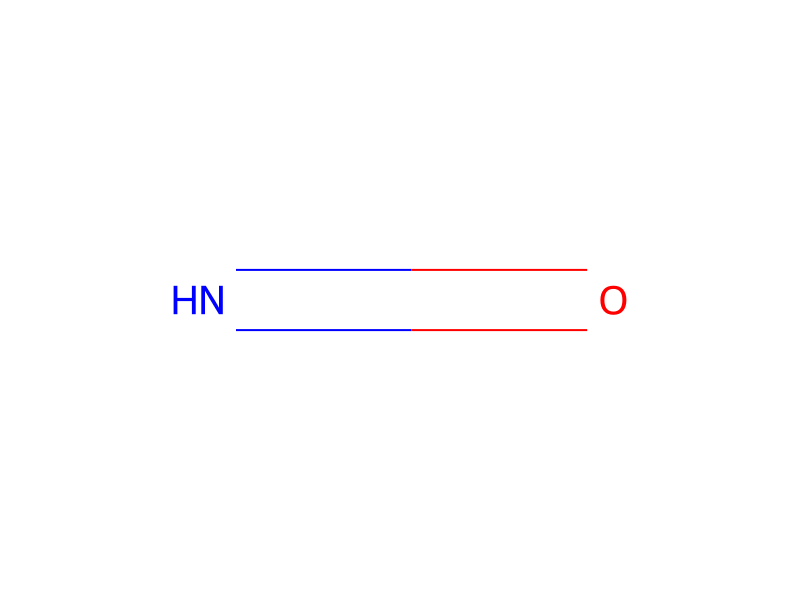
Grundinformationen
- CAS
10102-43-9- Standard-SMILES
N=O- InChIKey
ODUCDPQEXGNKDN-UHFFFAOYSA-N- Summenformel
- HNO
- Durchschnittliche Molmasse
- 31,014 g/mol
- Monoisotopische Masse
- 31,00581365
Überblick
Nitroxyl is a nitrogen oxoacid consisting of an oxygen atom double-bonded to an NH group.
Namen und Bezeichner
- Bevorzugter Name
- Nitroxyl
- IUPAC
- nitroxyl
- Lokaler Name
- Stickstoffmonoxid
- Englischer Name
- Nitric oxide
- Summenformel
- NO*
- Molmasse
- 30.01
Namen und Synonyme
NitroxylNitrosyl hydrideazanoneoxidanimineNitroxide radical14332-28-6GFQ4MMS07WJ985.316BCHEBI:84879HNO compoundRefChem:166163HNO
Weitere Namen anzeigen
NOnitricNITROGEN MONOXIDENitrogen monooxideStickoxideNITRICMONOXIDEDIBROMOHEXAMIDINE ISETHIONATEoxo-amidogenitricoxide0stickmonoxyd
Nitronous oxideOXOAMINEStickmonoxyd [German]HYDROGEN NITROXIDEOxyde nitrique [French]UNII-GFQ4MMS07WBioxyde d'azote [French]RCRA waste no. P076
Datenbank-Bezeichner
- CAS
10102-43-9、14332-28-6- PubChem CID
- 945
- DTXSID
DTXSID901361717- ChEMBL
CHEMBL1234765- ChEBI
CHEBI:84879- UNII
- GFQ4MMS07W
- Nikkaji
- J985.316B
Eigenschaften
Berechnete StruktureigenschaftenWird ergänzt
- XLogP
- 0,2
- Polarare Oberfläche (TPSA)
- 40,9 Ų
- H-Brücken-Donoren
- 1
- H-Brücken-Akzeptoren
- 2
- Frei drehbare Bindungen
- 0
- Schwere Atome
- 2
- Formalladung
- 0
- Komplexität
- 2
Experimentelle und physikochemische Eigenschaften
SpringerMaterials PropertiesSchoenflies notation
Physikochemische Eigenschaften
- Schmelzpunkt
- 163.6 °C · −163.6 °C(lit.)
- Siedepunkt
- 151.7 °C · −151.7 °C(lit.)
- Dichte
- -150.2 · d-150.2 (liq) 1.27; Relative d (gas) 1.036 (air = 1); Absolute d (gas) 1.227 (air = 1)
- Dampfdichte
- 1.05 · 1.05 (vs air)
- Brechungsindex
- 25 · nD25 1.0002697
- Löslichkeit
- 20 °C · At 20 °C and at a pressure of 101 kPa, 1 volume dissolves in about 21 volumes of water.
- Aggregatzustand
- colorless gas
- Farbe
- colorless
- Wasserlöslichkeit
- 2 O · slightly soluble H2O [HAW93]
- Spezifische Wärmekapazität
- 1 J/ · Cp(gas): 1 J/(g·K), at 25℃
Sicherheit und Regulatorisches
Sicherheitsangaben dienen nur zur Orientierung und ersetzen weder das Sicherheitsdatenblatt (SDB) des Lieferanten noch geltende Vorschriften oder eine fachliche Bewertung.
Sicherheitsdaten
- OEB
- A
- OEL
- TWA: 25 ppm (30 mg/m3)
- wgk
- 1
- IDLA
- 100 ppm
- tsca
- TSCA listed
- ridadr
- UN 1660 (NITRIC OXIDE, COMPRESSED)
- RTECS-Nr.
- QX0525000
- risk_code
- 8-23-34-44
- Toxizität
- LCLo inhalation in dog: 5000ppm/25M
- hazard_code
- O,T
- safety_code
- 17-23-36/37/39-45
- hazard_class
- 2.3
- Speicherklasse
- 2A - Gases
- DOT Classification
- 2.3, Hazard Zone A (Gas poisonous by inhalation)
- Giftige Stoffe Daten
- 10102-43-9(Hazardous Substances Data)
- Hazard Classifications
- Acute Tox. 1 InhalationOx. Gas 1Press. Gas Compr. GasSkin Corr. 1B
Chemie und Industrie
Pharmakologische Informationen
MeSH Pharmacological Classification
Naturally occurring or synthetic substances that inhibit or retard oxidation reactions. They counteract the damaging effects of oxidation in animal tissues.
Drugs intended to prevent damage to the brain or spinal cord from ischemia, stroke, convulsions, or trauma. Some must be administered before the event, but others may be effective for some time after. They act by a variety of mechanisms, but often directly or indirectly minimize the damage produced by endogenous excitatory amino acids.
Anwendungen
Beschreibungnear room temperature (its liquid density at 20°C is 1.45 g/cm3). Nitrogen monoxide (NO) is commonly called nitric oxide,Nitric oxide is colorless and has a sharp sweet odor;Nitric oxide is nonfl ammable, toxic gases.Nitric oxide is a free radical that quickly reacts in air to produce nitrogen dioxide.It is also an important biological messenger and transmitter.
HistoryNitric oxide was prepared in 1772 by Joseph Priestley (1733–1804) and described in his volumes Experiments and Observations of Different Kinds of Air published between 1774 and 1786. Priestley called nitric oxide nitrous air, nitrogen dioxide nitrous acid vapor, and nitrous oxide phlogisticated nitrous air, but also referred to the latter as diminished nitrous air. He observed the change of clear nitric oxide to red nitrogen dioxide. Priestley prepared nitric oxide by reacting nitric acid with a metal such as copper: 3Cu(s) + 8HNO3(aq) → 2NO(g) + 3Cu(NO3)2(aq) + 4H2O(l).
VerwendenNitric oxide is used as an intermediate in themanufacture of nitric acid, in the preparationof metal nitrosyls, in bleaching of rayon,and in incandescent lamps. It is produced byheating air at high temperatures.
Vor- und nachgelagerte Produkte
Vorgelagerte Rohstoffe
Zugehörige Reaktionen
44


Notizen zur Verbindung
Wird geladen…