
1-Fluornaphthalin
1-Fluoronaphthalene
Daten werden ergänzt – lade die Seite später neu, um den aktuellen Stand zu sehen

Grundinformationen
- CAS
321-38-0- Standard-SMILES
Fc1cccc2ccccc12- InChIKey
CWLKTJOTWITYSI-UHFFFAOYSA-N- Summenformel
- C10H7F
- Durchschnittliche Molmasse
- 146,16 g/mol
- Monoisotopische Masse
- 146,05317844
Überblick
1-fluoronaphthalene appears as needles. (NTP, 1992)
Namen und Bezeichner
- Bevorzugter Name
- 1-Fluoronaphthalene
- IUPAC
- 1-fluoronaphthalene
- Lokaler Name
- 1-Fluornaphthalin
- Englischer Name
- 1-Fluoronaphthalene
- Summenformel
- C10H7F
- Molmasse
- 146.16
Namen und Synonyme
1-FLUORONAPHTHALENE321-38-0Naphthalene, 1-fluoro-alpha-Fluoronaphthalene0920702UT7NSC-4690DTXSID7059808RefChem:75827DTXCID1038454206-287-0Fluoronaphthalene.alpha.-Fluoronaphthalene
Weitere Namen anzeigen
48720-uuoronaphthaLDuloxetine-81-FluoronaphthFluorophthalene
Duloxetine EP Impurity G1-fluoro naphthalene1-FluornaftalenDuloxetine IMpurity GNSC 46901-fluoronapthaleneEINECS 206-287-01-fluoro-naphtalene
Datenbank-Bezeichner
- CAS
321-38-0- PubChem CID
- 9450
- DTXSID
DTXSID7059808- UNII
- 0920702UT7
- EC Number
- 206-287-0
- Nikkaji
- J9.228B
Eigenschaften
Berechnete StruktureigenschaftenWird ergänzt
- XLogP
- 3,7
- Polarare Oberfläche (TPSA)
- 0 Ų
- H-Brücken-Donoren
- 0
- H-Brücken-Akzeptoren
- 1
- Frei drehbare Bindungen
- 0
- Schwere Atome
- 11
- Formalladung
- 0
- Komplexität
- 133
Experimentelle und physikochemische Eigenschaften
PolymersOther Classes -> Halogenated Polyaromatics
SpringerMaterials Properties13C nuclear magnetic resonance spectrum
Density1.1322 at 68 °F (NTP, 1992) - Denser than water; will sink
Boiling Point419 °F at 756 mmHg (NTP, 1992)
Melting Point16 °F (NTP, 1992)
Vapor Pressure0.09 [mmHg]
Physical Description
1-fluoronaphthalene appears as needles. (NTP, 1992)
CBI
Solid; [CAMEO] Colorless liquid; [Alfa Aesar MSDS]
Physikochemische Eigenschaften
- Schmelzpunkt
- -13 °C · -13 °C (lit.)
- Siedepunkt
Sicherheit und Regulatorisches
Sicherheitsangaben dienen nur zur Orientierung und ersetzen weder das Sicherheitsdatenblatt (SDB) des Lieferanten noch geltende Vorschriften oder eine fachliche Bewertung.
GHS-Klassifizierung
GHS Classification
This chemical does not meet GHS hazard criteria for 5.5% (3 of 55) of reports.
Warning
H315 (94.5%): Causes skin irritation [Warning Skin corrosion/irritation]
P261, P264, P264+P265, P271, P280, P302+P352, P304+P340, P305+P351+P338, P319, P321, P332+P317, P337+P317, P362+P364, P403+P233, P405, and P501 (click each P-code to see the statement)
Aggregated GHS information provided per 55 reports by companies from 12 notifications to the ECHA C&L Inventory. Each notification may be associated with multiple companies.
Gefahrenhinweise
Regulatory Information
Naphthalene, 1-fluoro- is listed on the EPA's Chemical Data Reporting (CDR) system. Manufacturers and importers of Naphthalene, 1-fluoro- are required to report information about their production and use of this chemical to the EPA under the Toxic Substances Control Act (TSCA). (40 eCFR Part 711)
Status: Active Update: 05-12-2022 https://echa.europa.eu/registration-dossier/-/registered-dossier/18128
DOT LabelPoison
Fire HazardsExcerpt from ERG Guide 153 [Substances - Toxic and/or Corrosive (Combustible)]:
Health HazardsExcerpt from ERG Guide 153 [Substances - Toxic and/or Corrosive (Combustible)]:
Hazards SummaryA skin and strong eye irritant; [Alfa Aesar MSDS] See Naphthalene.
Reactive GroupFluorinated Organic Compounds
Reactivity Profile
Chemie und Industrie
Verwendung und Herstellung
U.S. Production2023: <50,000 lb
Industry UsesNot Known or Reasonably Ascertainable
General Manufacturing Information
All Other Basic Organic Chemical Manufacturing
Naphthalene, 1-fluoro-: ACTIVE
Anwendungen
Verwenden1-Fluoronaphthalene is a fluorinated naphthalene derivative that is metabolized by fungal monooxygenase-epoxide hydrolase. It is also used as a pharmaceutical intermediate. It is Duloxetine impurity.
Darstellung
synthetischeThe preparation of 1-Fluoronaphthalene is as follows:1) Diazotization reaction: 1500 g of hydrochloric acid (mass concentration: 25%) and 300 g of naphthylamine were added to a 3000 mL three-necked flask, stirred and heated to 75 ° C to dissolve, and the temperature was lowered to below 5 ° C, and 148 g was slowly added at this temperature. Sodium nitrite, stirred at low temperature for 0.3 hours after the addition, to obtain a diazonium salt solution;2) Substitution reaction: 360 g of fluoroboric acid solution (concentration: 45%) was added to the resulting solution obtained in the step 1), stirred for 0.25 h, filtered, and the filter cake was dried at a temperature of 50 ° C for 0.2 h to obtain Dry naphthylamine diazonium salt fluoroborate double salt;3) Hot air decomposition: the dried diazonium salt fluoroborate double salt is slowly added to the reactor through which hot air (hot air temperature is 85-90 ° C), and the dried powdered naphthylamine diazonium salt fluoroborate double salt is The hot air blows up the dispersion and absorbs the heat for thermal decomposition to obtain a 1-fluoronaphthalene solution containing a small amount of solid impurities;4) Purification treatment: the 1-fluoronaphthalene solution obtained in the step 3) is first washed with pure water for 3 to 6 times, then neutralized with a soda ash to a pH of 6.8 to 7.2, and finally the oil layer is separated by filtration, and the filtrate is taken. The distillation treatment gave 210 g of a naphthalene-based fluorine-containing intermediate 1-fluoronaphthalene in an amount of 99.8%.
Zugehörige Reaktionen
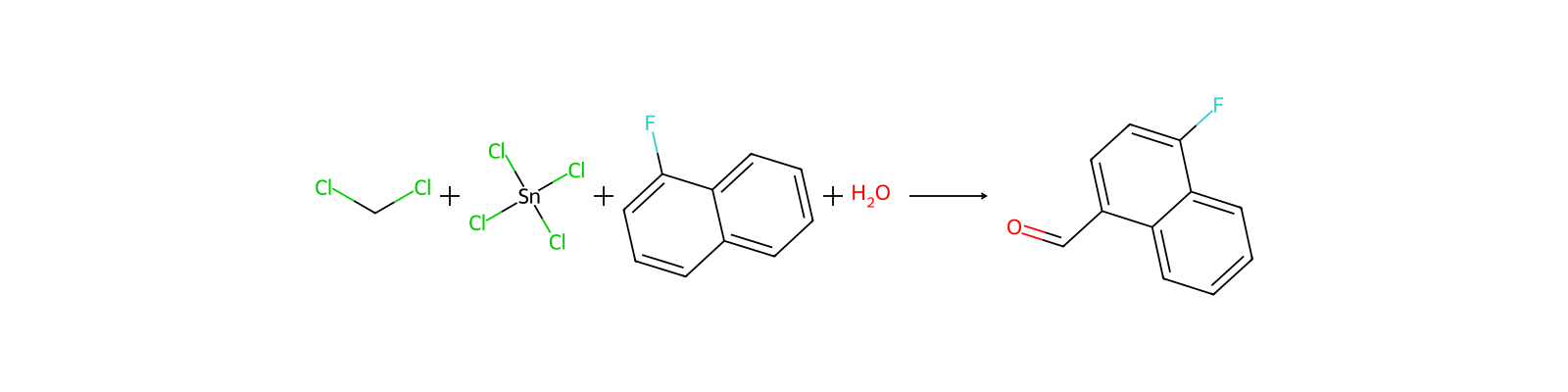
45




Notizen zur Verbindung
Wird geladen…