StartseiteMCPWorkbenchSkills
StartseiteWorkbenchBenachrichtigungenMein Bereich
llms.txt · MCP-AnleitungDatenschutz · Nutzungsbedingungen · Supportv1.8.3
  1. Startseite
  2. /Verbindung

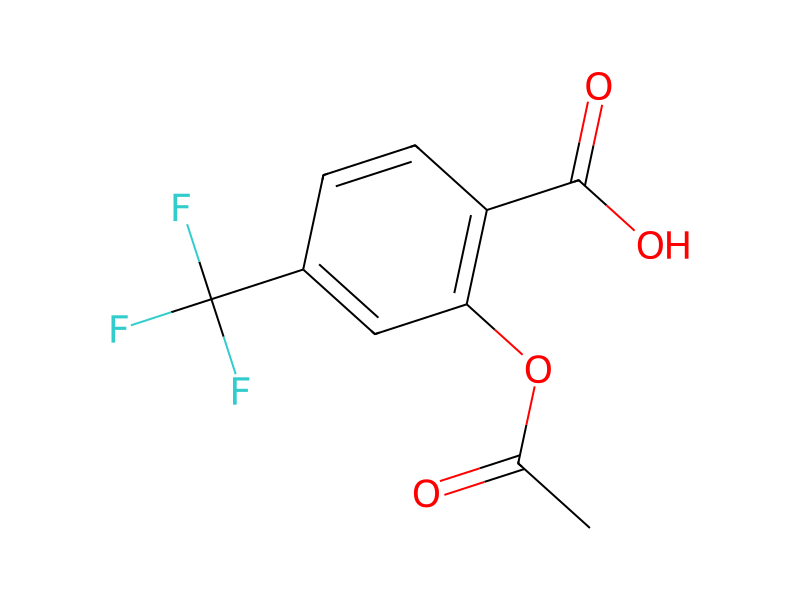
3-Acetoxy-α,α,α-trifluor-p-toluylsure

Triflusal

HCID 9458
Neue Reaktion
Drucken
GrundinformationenÜberblickNamen und BezeichnerEigenschaftenSicherheit und RegulatorischesChemie und IndustrieZugehörige ReaktionenNotizen zur Verbindung
TeilstruktursucheÄhnliche Strukturen suchen

Grundinformationen

CAS
322-79-2
Standard-SMILES
CC(=O)Oc1cc(C(F)(F)F)ccc1C(=O)O
InChIKey
RMWVZGDJPAKBDE-UHFFFAOYSA-N
Summenformel
C10H7F3O4
Durchschnittliche Molmasse
248,15 g/mol
Monoisotopische Masse
248,02964319

Überblick

2-acetyloxy-4-(trifluoromethyl)benzoic acid is a member of benzoic acids, a member of salicylates and a carboxylic ester.

Namen und Bezeichner

Bevorzugter Name
Triflusal
IUPAC
2-acetyloxy-4-(trifluoromethyl)benzoic acid
Lokaler Name
3-Acetoxy-α,α,α-trifluor-p-toluylsure
Englischer Name
Triflusal
Summenformel
C10H7F3O4
Molmasse
248.16

Namen und Synonyme

Triflusal322-79-22-Acetoxy-4-trifluoromethylbenzoic acid2-(Acetyloxy)-4-(trifluoromethyl)benzoic acidTriflusalumDTXSID80453051Z0YFI05OODTXCID6025305RefChem:191611B01AC18206-297-5Disgren
Weitere Namen anzeigen
ur1501DrisgenTriflusal-d3Triflusal CRSTriflusal (UR1501)TRIFLUOROTRIMESICACIDTriflusal, 10 mM in DMSO4-trifluoromethylsalicylicacidacetate
2-Acetoxy-4-(trifluoromethyl)benzoic Acid2-acetyloxy-4-(trifluoromethyl)benzoic acidAflenTriflusal [INN]MFCD00866793TrifluxBenzoic acid, 2-(acetyloxy)-4-(trifluoromethyl)-Prestwick1_000528

Datenbank-Bezeichner

CAS
322-79-2
PubChem CID
9458
DTXSID
DTXSID8045305
ChEMBL
CHEMBL1332032

Eigenschaften

Berechnete Struktureigenschaften

XLogP
2,1
Polarare Oberfläche (TPSA)
63,6 Ų
H-Brücken-Donoren
1
H-Brücken-Akzeptoren
7
Frei drehbare Bindungen
3
Schwere Atome
17
Formalladung
0
Komplexität
313

Experimentelle und physikochemische Eigenschaften

Drugs · 2 Einträge

Pharmaceuticals -> Listed in ZINC15

Pharmaceuticals -> Blood and blood forming organs -> Antithrombotic agents

Solubility<1 mg/ml
Melting Point114-117ºC

Physikochemische Eigenschaften

Schmelzpunkt
120 · 120-122° (upon slow heating); 110-112° (upon quick heating)
Siedepunkt
316 · 316.0±42.0 °C(Predicted)
Dichte
1.433 · 1.433±0.06 g/cm3(Predicted)
storage temp.
2 · Sealed in dry,2-8°C
Löslichkeit
30 mg/mL · DMSO: >30mg/mL
pka
2.97 · 2.97±0.10(Predicted)
Aggregatzustand
powder
Farbe
white to off-white
Merck
14 · 14,9688

Sicherheit und Regulatorisches

Sicherheitsangaben dienen nur zur Orientierung und ersetzen weder das Sicherheitsdatenblatt (SDB) des Lieferanten noch geltende Vorschriften oder eine fachliche Bewertung.

GHS-Klassifizierung

GHS Classification · 4 Einträge

Warning

H302 (100%): Harmful if swallowed [Warning Acute toxicity, oral]

P261, P264, P264+P265, P270, P271, P272, P280, P301+P317, P302+P352, P304+P340, P305+P351+P338, P319, P321, P330, P332+P317, P333+P317, P337+P317, P362+P364, P403+P233, P405, and P501 (click each P-code to see the statement)

Aggregated GHS information provided per 44 reports by companies from 6 notifications to the ECHA C&L Inventory. Each notification may be associated with multiple companies.

Gefahrenhinweise

Hazard Classes and CategoriesAcute Tox. 4 (100%)

Sicherheitsdaten

wgk
3
hs_code
2918.29.7500
RTECS-Nr.
GP4250000
risk_code
22-36/37/38-43
hazard_code
Xn
safety_code
26-36/37
Speicherklasse
11 - Combustible Solids
Hazard Classifications
Acute Tox. 4 OralEye Irrit. 2Skin Irrit. 2Skin Sens. 1STOT SE 3

Chemie und Industrie

Pharmakologische Informationen

ATC Code · 2 Einträge

B - Blood and blood forming organs

QB - Blood and blood forming organs

Protein BindingTriflusal binds almost completely to plasma proteins reaching a 99% of the administered dose.
Pharmacodynamics · 1 Eintrag

Triflusal is an antithrombotic anticoagulant. It irreversibly inhibits the production of thromboxane-B2 in platelets by acetylating cycloxygenase-1. Triflusal affects many other targets such as NF kappa B, which is a gene expression regulatory factor for cycloxygenase-a and cytokines. Numerous studies comparing the efficacy and safety profile (i.e. systemic hemorrhage) between triflusal and acetylsalsylic acid has shown either no significant difference or a better effacy and safety profile for triflusal. Triflusal has been shown to protect cerebral tissue due to its inhibition of lipid peroxidation resulting from anoxia-reoxygenation.

Mechanism of Action · 1 Eintrag

Triflusal is chemically related to acetylsalicylic acid (ASA) and irreversibly inhibits cycloxygenase-1 (COX-1) in platelets. Acetylation of the active group of COX-1 prevents the formation of thromboxane-B2 in platelets. However, it is unique because it spares the arachidonic acid metabolic pathway in endothelial cells. In addition, it favors the production of nitric oxide, a vasodilator.

Biological Half-LifeIn the healthy human, the half-life is 0.5 +/- 0.1h, while that of HTB is 34.3 +/- 5.3h.
Metabolism/MetabolitesIn the liver, triflusal undergoes deacetylation, forming its main metabolite 2-OH-4-trifluoromethyl benzoic acid (HTB). This major metabolite seems to have marked antiplatelet properties in vitro.
MeSH Pharmacological Classification · 1 Eintrag

Drugs or agents which antagonize or impair any mechanism leading to blood platelet aggregation, whether during the phases of activation and shape change or following the dense-granule release reaction and stimulation of the prostaglandin-thromboxane system.

Zugehörige Reaktionen

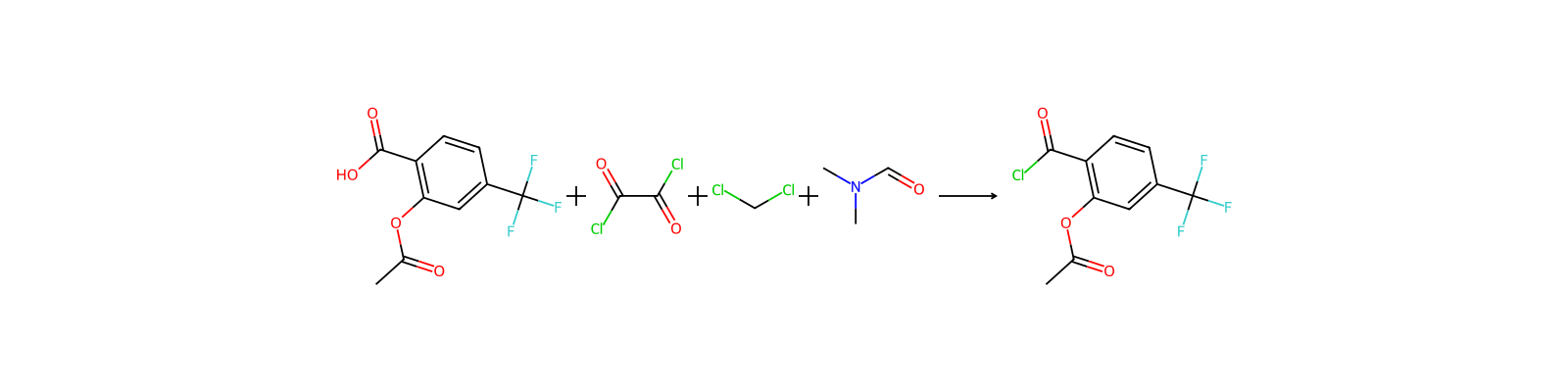
2
Reaktionsaufzeichnung erstellen
Reaktionsgleichung von HRID 98027
HRID 98027als Edukt
Reaktionsgleichung von HRID 1038770
HRID 1038770als Edukt

Notizen zur Verbindung

Auf dieser SeiteGrundinformationenÜberblickNamen und BezeichnerEigenschaftenSicherheit und RegulatorischesChemie und IndustrieZugehörige ReaktionenNotizen zur Verbindung
ChEBI
CHEBI:94721
UNII
1Z0YFI05OO
EC Number
206-297-5
Nikkaji
J5.672C
InChI
1S/C10H7F3O4/c1-5(14)17-8-4-6(10(11,12)13)2-3-7(8)9(15)16/h2-4H,1H3,(H,15,16)
InChIKey
RMWVZGDJPAKBDE-UHFFFAOYSA-N
SMILES
FC(F)(F)c1cc(c(cc1)C(=O)O)OC(=O)C
CAS Datenbank
322 · 322-79-2(CAS DataBase Reference)
Absorption, Distribution and Excretion · 4 Einträge

Absorbed in the small intestine with a bioavailability range from 83% to 100%. There is no significant difference between the absorption of the oral solution and capsule formulation. Triflusal displays a Cmax of 11.6 mcg/ml and a tmax of 0.88 h. The major metabolite of triflusal presents different pharmacokinetic properties by showing a Cmax and tmax of 92.7 mcg/ml and 4.96 h, respectively.

The elimination pathway of triflusal is primarily renal. Urine analysis has shown the presence of unchanged triflusal, HTB and the glycine conjugate of HTB.

The reported volume of distribution for triflusal is of 34L.

Renal clearance is 0.8 +/- 0.2L/h and 0.18 +/1 0.04L/h for triflusal and HTB, respectively.

Anwendungen

VerwendenAn analog of Aspirin; inhibits platelet aggregation. Antithrombotic.

Vor- und nachgelagerte Produkte

Nachgelagerte Produkte

acetate4-Trifluoromethylsalicylic acid