HuagongsheHuagongshe Chemie-Druckbericht · Nur für Forschungszwecke
1,2,4,5-Tetrafluorbenzol
1,2,4,5-TetrafL · p-Tetrafluorobenzene · 1,2,4,5-Tetrafluorbenzol · 1,2,4,5-Tetrafluorobenzyl · 1,2,4,5-TETRAFLUOROBENZENE · 2,3,5,6-Tetrafluorobenzene · benzene,1,2,4,5-tetrafluoro- · 1,2,4,5-Tetrafluorobenzene,98%
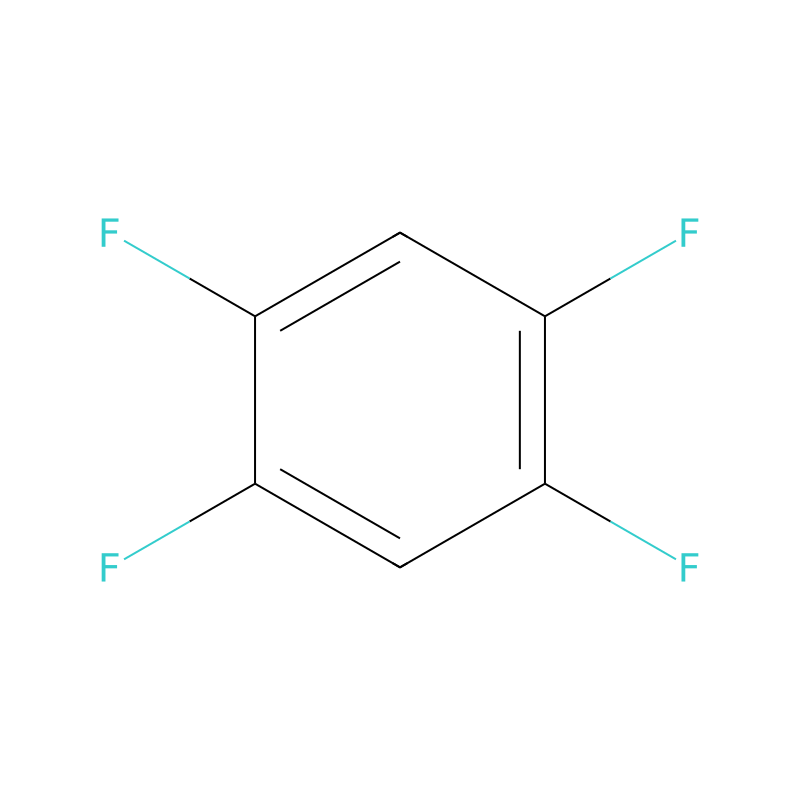
Identifikatoren & physikalische Daten
| CAS No. | 327-54-8 |
|---|---|
| Summenformel | C6H2F4 |
| Durchschnittliche Molmasse | 150,07 g/mol |
| Monoisotopische Masse | 150,00926271 g/mol |
| SMILES | Fc1cc(F)c(F)cc1F |
| InChIKey | SDXUIOOHCIQXRP-UHFFFAOYSA-N |
| PubChem CID | 9474 |
| EC No. | 206-319-3 |
| DTXSID | DTXSID90186367 |
| Lokaler Name | 1,2,4,5-Tetrafluorbenzol |
Chemische & physikalische Eigenschaften
| XLogP | 2,3 |
|---|---|
| Polarare Oberfläche (TPSA) | 0 |
| H-Brücken-Donoren | 0 |
| H-Brücken-Akzeptoren | 4 |
| Frei drehbare Bindungen | 0 |
| Schwere Atome | 10 |
| Formalladung | 0 |
| Komplexität | 90 |
| Kovats Retention Index | 604 |
| Schmelzpunkt | 4 °C (lit.) |
| Siedepunkt | 90 °C (lit.) |
| Dichte | 1.344 g/mL at 25 °C (lit.) |
| Brechungsindex | n20/D 1.407(lit.) |
| Flammpunkt | 61 °F |
| Lagerbedingungen | Sealed in dry,2-8°C |
| Aggregatzustand | clear liquid |
| Farbe | Colorless to Almost colorless |
| Wichte | 1.344 |
| Löslichkeit | Not miscible or difficult to mix in water. |
| BRN | 1909052 |
| Henry-Konstante | 5.6×10⁻⁴ mol/(m3Pa) at 25℃, Duchowicz et al. (2020) |
| InChI | InChI=1S/C6H2F4/c7-3-1-4(8)6(10)2-5(3)9/h1-2H |
| InChIKey | SDXUIOOHCIQXRP-UHFFFAOYSA-N |
| SMILES | C1(F)=CC(F)=C(F)C=C1F |
| CAS Datenbank | 327-54-8(CAS DataBase Reference) |
| NIST chemische Informationen | Benzene, 1,2,4,5-tetrafluoro-(327-54-8) |
Sicherheit & Vorschriften
| GHS-Einstufung | DangerH225 (100%): Highly Flammable liquid and vapor [Danger Flammable liquids]H315 (100%): Causes skin irritation [Warning Skin corrosion/irritation]H319 (100%): Causes serious eye irritation [Warning Serious eye damage/eye irritation]H335 (98.5%): May cause respiratory irritation [Warning Specific target organ toxicity, single exposureRespiratory tract irritation]P210, P233, P240, P241, P242, P243, P261, P264, P264+P265, P271, P280, P302+P352, P303+P361+P353, P304+P340, P305+P351+P338, P319, P321, P332+P317, P337+P317, P362+P364, P370+P378, P403+P233, P403+P235, P405, and P501 (click each P-code to see the statement)Aggregated GHS information provided per 68 reports by companies from 7 notifications to the ECHA C&L Inventory. Each notification may be associated with multiple companies.Information may vary between notifications depending on impurities, additives, and other factors. The percentage value in parenthesis indicates the notified classification ratio from companies that provide hazard codes. Only hazard codes with percentage values above 10% are shown. For more detailed information, please visit ECHA C&L website. |
|---|---|
| Hazard Classes and Categories | Flam. Liq. 2 (100%)Skin Irrit. 2 (100%)Eye Irrit. 2 (100%)STOT SE 3 (98.5%) |
| Wassergefährdungsklasse (WGK) | 3 |
| UN-Transportnummer | UN 1993 3/PG 2 |
| Zollcode | 29039990 |
| R-Sätze (R) | 11-36/37/38 |
| Gefahrensymbole | F,Xi |
| hazard_note | Flammable/Irritant |
| Sicherheitshinweise (S) | 16-26-36/37/39-37/39-33-7/9 |
| Gefahrenklasse | 3Eye Irrit. 2Flam. Liq. 2Skin Irrit. 2STOT SE 3 |
| Verpackungsgruppe | II |
| Lagerklasse | 3 - Flammable liquids |
Anwendungen & Verwendung
Verwenden
It is employed as intermediate in organic synthesis. It is also used as pharmaceutical intermediate.