
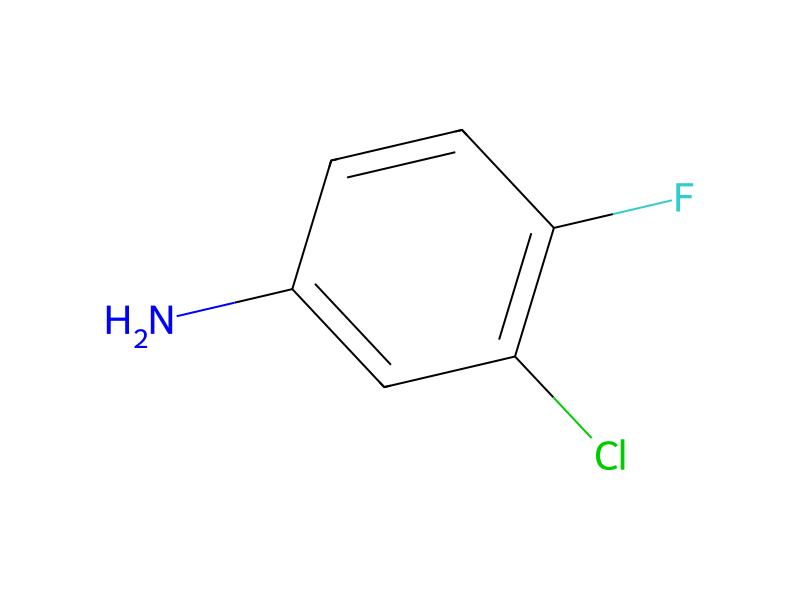
Grundinformationen
- Standard-SMILES
Nc1ccc(F)c(Cl)c1- InChIKey
YSEMCVGMNUUNRK-UHFFFAOYSA-N- Summenformel
- C6H5ClFN
- Durchschnittliche Molmasse
- 145,56 g/mol
- Monoisotopische Masse
- 145,009455
Namen und Bezeichner
- Bevorzugter Name
- 3-Chloro-4-fluoroaniline
- IUPAC
- 3-chloro-4-fluoroaniline
- Lokaler Name
- 3-Chlor-4-fluoranilin
- Englischer Name
- 3-Chloro-4-fluoroaniline
- Summenformel
- C6H5ClFN
- Molmasse
- 145.56
Namen und Synonyme
3-CHLORO-4-FLUOROANILINE367-21-5Benzenamine, 3-chloro-4-fluoro-Aniline, 3-chloro-4-fluoro-7L63CC70UQNSC-10290DTXSID0038754RefChem:93423DTXCID8018754206-682-83-Chloro-4-fluorobenzenamine4-FLUORO-3-CHLOROANILINE
Weitere Namen anzeigen
FluorochloroanilineNSC 102903-Chloro-4-fluAKOS BBS-00003577Chloro-4-fluoroanil3-Chloro-4-fluoroaniGefitinib Impurity KGefitinib IMpurity V
3-Chloro-4-fluorophenylamineGefitinib Impurity 363-chloro-4-fluoro aniline3-chloro-4-fluoro-anilineMFCD000077674-fluoro-3-chlorophenylamine3-Chloro-4-fluoroaniline(Chunks or pellets)3-chloro-4-fluoro-phenylamine
Datenbank-Bezeichner
- CAS
367-21-5- PubChem CID
- 9708
- DTXSID
DTXSID0038754- UNII
- 7L63CC70UQ
- EC Number
- 206-682-8
- Nikkaji
- J94.735K
Eigenschaften
Berechnete Struktureigenschaften
- XLogP
- 2,1
- Polarare Oberfläche (TPSA)
- 26 Ų
- H-Brücken-Donoren
- 1
- H-Brücken-Akzeptoren
- 2
- Frei drehbare Bindungen
- 0
- Schwere Atome
- 9
- Formalladung
- 0
- Komplexität
- 99
Physikochemische Eigenschaften
- Schmelzpunkt
- 42 · 42-44 °C (lit.)
- Siedepunkt
- 227 · 227-228 °C (lit.)
- Dichte
- 1 · 1,226 g/cm3
- Dampfdruck
- 0.01 hPa · 0.01 hPa (20 °C)
- Brechungsindex
- 1 · 1,54-1,542
- Flammpunkt
- 230 °F · >230 °F
- storage temp.
- 30 °C · Store below +30°C.
- Löslichkeit
- 10 g/l · 10g/l
- pka
- 3.6 · 3.60±0.10(Predicted)
- Aggregatzustand
- Crystalline Solid
- Farbe
- Beige to brown
- PH
- 7 · 7 (10g/l, H2O, 20℃)
- Wasserlöslichkeit
- 10 g/L · 10 g/L (20 ºC)
- BRN
- 1562786 · 1562786
- Stabilität
- Stable. Incompatible with strong oxidizing agents, acids, acid chlorides, acid anhydrides, chloroformates. May be air-sensitive.
- InChI
- 1S/C6H5ClFN/c7-5-3-4(9)1-2-6(5)8/h1-3H,9H2
- InChIKey
- YSEMCVGMNUUNRK-UHFFFAOYSA-N
- SMILES
- Nc1ccc(F)c(Cl)c1
- CAS Datenbank
- 367 · 367-21-5(CAS DataBase Reference)
- EPA chemische Informationen
- 3 · 3-Chloro-4-fluoroaniline (367-21-5)
Sicherheit und Regulatorisches
GHS-Klassifizierung
GHS Classification
Danger
H301 (55.7%): Toxic if swallowed [Danger Acute toxicity, oral];H302 (43%): Harmful if swallowed [Warning Acute toxicity, oral];H311 (60.8%): Toxic in contact with skin [Danger Acute toxicity, dermal];H318 (36.7%): Causes serious eye damage [Danger Serious eye damage/eye irritation];H331 (55.7%): Toxic if inhaled [Danger Acute toxicity, inhalation];H373 (60.8%): May causes damage to organs through prolonged or repeated exposure [Warning Specific target organ toxicity, repeated exposure]
P260, P261, P262, P264, P264+P265, P270, P271, P280, P301+P316, P301+P317, P302+P352, P304+P340, P305+P354+P338, P316, P317, P319, P321, P330, P361+P364, P403+P233, P405, and P501 (click each P-code to see the statement)
Aggregated GHS information provided per 79 reports by companies from 10 notifications to the ECHA C&L Inventory. Each notification may be associated with multiple companies.;Information may vary between notifications depending on impurities, additives, and other factors. The percentage value in parenthesis indicates the notified classification ratio from companies that provide hazard codes. Only hazard codes with percentage values above 10% are shown. For more detailed information, please visit ECHA C&L website.
Gefahrenhinweise
Regulatory Information
Status: Active Update: 25-10-2022 https://echa.europa.eu/registration-dossier/-/registered-dossier/24633
3-Chloro-4-fluoroaniline: Does not have an individual approval but may be used under an appropriate group standard
Hazard Classes and CategoriesAcute Tox. 3 (55.7%);Acute Tox. 4 (43%);Acute Tox. 3 (60.8%);Eye Dam. 1 (36.7%);Acute Tox. 3 (55.7%);STOT RE 2 (60.8%)
Regulatorische Informationen
Regulatory Information
Status: Active Update: 25-10-2022 https://echa.europa.eu/registration-dossier/-/registered-dossier/24633
3-Chloro-4-fluoroaniline: Does not have an individual approval but may be used under an appropriate group standard
Sicherheitsdaten
- F
- 9-23
- wgk
- 2
- tsca
- TSCA listed
- ridadr
- UN 2811 6.1/PG 2
- hs_code
- 29214210
- risk_code
- 23/24/25-33-36/37/38-20/21/22
- Toxizität
- LD50 orally in Rabbit: 506 mg/kg
- hazard_code
- T,Xi,Xn
- hazard_note
- Irritant/Toxic
- safety_code
- 36/37/39-45-26
- hazard_class
- 6.1
- packing_group
- III
- Speicherklasse
- 6.1C - Combustible acute toxic Cat.3toxic compounds or compounds which causing chronic effects
- Hazard Classifications
- Acute Tox. 3 DermalAcute Tox. 3 InhalationAcute Tox. 3 OralSTOT RE 2
Chemie und Industrie
Verwendung und Herstellung
General Manufacturing InformationBenzenamine, 3-chloro-4-fluoro-: ACTIVE
Vor- und nachgelagerte Produkte
Vorgelagerte Rohstoffe
Nachgelagerte Produkte
Anbieter50 Anbieter
国药集团化学试剂有限公司86-21-63210123 · [email protected]
梯希爱(上海)化成工业发展有限公司021-67121386 · [email protected]
衢州润东化工有限公司0570-8789886 18892685668 · [email protected]
上海阿拉丁生化科技股份有限公司400-6206333 13167063860 · [email protected]
爱斯特(成都)生物制药股份有限公司+86-28-85122536 85324413 · [email protected]
上海赫文斯化工有限公司15721252604 17321035817 · [email protected]
韶远科技(上海)有限公司021-50795510 4000665055 · [email protected]
科瑞迪化学400-821-5857 021-64326257 · [email protected]
Syntechem Co.,Ltd[email protected]
上海迈瑞尔生化科技有限公司4006356688 18621169109 · [email protected]
北京华威锐科化工有限公司0757-86329057 18934348241 · [email protected]
阿法埃莎(中国)化学有限公司400-6106006 · [email protected]
安耐吉化学&3A(安徽泽升科技股份有限公司)400-0056266 · [email protected]
武汉凯威斯科技有限公司86-027-67849912 · [email protected]
上海瀚鸿科技股份有限公司021-54306202 13764082696 · [email protected]
上海景颜化工科技有限公司13817811078 · [email protected]
嘉兴市艾森化工有限公司0573-85285100 18627885956 · [email protected]
Pure Chemistry Scientific Inc.001-857-928-2050 or 1-888-588-9418 · [email protected]
上海攀鸿化工科技有限公司021-56491756 13512199871 · [email protected]
武汉丰泰威远科技有限公司027-87465837 19945049750 · [email protected]
上海忆嵘生物科技有限公司18049974220 · [email protected]
孝感深远化工有限公司15527621225; 15527621225 · [email protected]
山东西亚化学有限公司13355009207 13355009207 · [email protected]
玛雅试剂+86 (573) 82222445 (0)18006601000 452520369 · [email protected]
四川库利南科技有限公司400-1166-196 18981987031 · [email protected]
天津希恩思生化科技有限公司400 638 7771 · [email protected]
南京维奥化工有限公司Please Send Email 18652950785 · [email protected]
武汉华邦化学新材料有限公司027-83229541 13971313286 · [email protected]
武汉艾瑞尔化学科技有限公司18986259541 18986259541 · [email protected]
泰州志诚化工科技有限公司0523-82837785 13914525028 · [email protected]
济南邦德化工技术有限公司86-531-88280989 · [email protected]
山东铭枫医药科技有限公司053155551677 15315114555 · [email protected]
艾科试剂4008-755-333 18080918076 · [email protected]
上海思域化工科技有限公司86-21-34053660 · [email protected]
赛默飞世尔科技(中国)有限公司800-810-5118 · [email protected]
南京诺利斯医药科技有限公司13901585132 · [email protected]
江苏艾康生物医药研发有限公司025-66113011 13913916777 · [email protected]
上海健超生物科技有限公司150-2103-5486 18017383231 · [email protected]
TCI AMERICA800-4238616 · [email protected]
TOKYO CHEMICAL INDUSTRY CO., LTD.03-36680489 · [email protected]
TCI Europe320-37350700 · [email protected]
上海贤鼎生物科技有限公司4009209199 · [email protected]
深圳振强药物研发有限公司0755-66853366 13670046396 · [email protected]
上海卓锐化工有限公司021-69180038
深圳康特腾科技有限公司86-0755-86635001 · [email protected]
越林试剂021-62960152 · [email protected]
上海睿升化工科技有限公司+86-021-50935922
Clearsynth Labs Limited+91-22-26355700 · [email protected]
广州爱纯医药科技有限公司020-39119399 18927568969 · [email protected]
无锡中坤生化科技有限公司+86 0510-85629785
Zugehörige Reaktionen
353


Verknüpfte Notizen
Wird geladen…