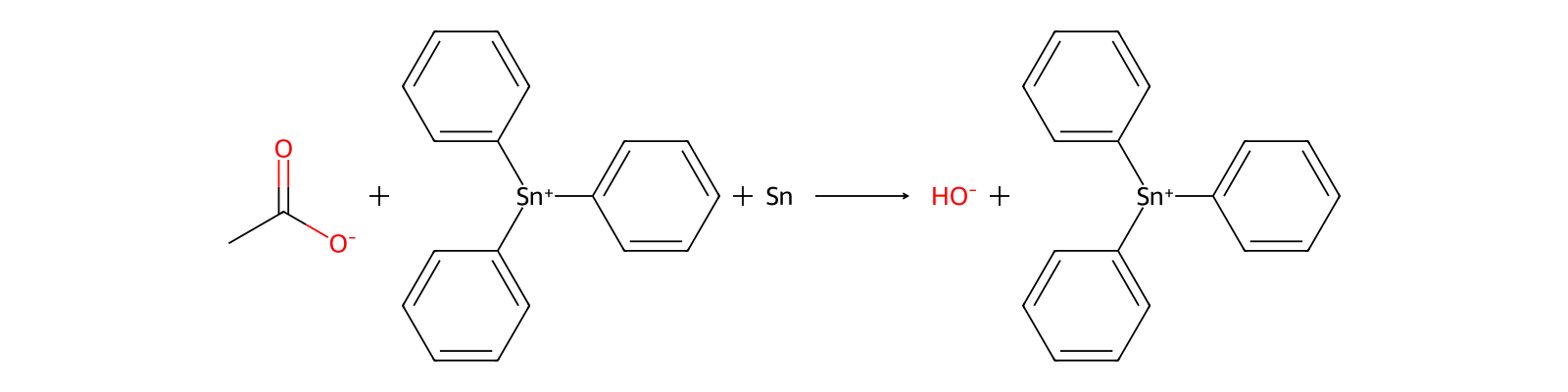
Triphenyltin hydroxide
Daten werden ergänzt – meist innerhalb einer Minute fertig

Grundinformationen
- CAS
76-87-9- Standard-SMILES
[OH-].c1cc[c]([Sn+]([c]2ccccc2)[c]2ccccc2)cc1- InChIKey
BFWMWWXRWVJXSE-UHFFFAOYSA-M- Summenformel
- C18H16OSn
- Durchschnittliche Molmasse
- 367 g/mol
- Monoisotopische Masse
- 368,02230983
Überblick
Triphenyltin hydroxide is an odorless white powder. Stable at room temperature. Melting point 121-123 °C. Moderately soluble in most organic solvents (Farm Chemical Handbook). Insoluble in water. Non corrosive. Used as a fungicide.
Namen und Bezeichner
- Bevorzugter Name
- Triphenyltin hydroxide
- IUPAC
- triphenylstannanylium hydroxide
Namen und Synonyme
TriphenylhydroxytinTriphenyl tin hydroxideKKL46V5313FentineNSC-113243RefChem:900035Triphenyltin hydroxide (TPTH)200-990-6(Sn(OH)Ph3)76-87-9Brestan H 47.5 WP fungicideCHEBI:30473
Weitere Namen anzeigen
Dowco 186DTXCID501409DTXSID1021409Du-TerDu-Ter FungicideDu-Ter Fungicide Wettable PowderDu-Ter PB-47 FungicideDu-Ter W-50
Datenbank-Bezeichner
- CAS
76-87-9- PubChem CID
- 9907219
- DTXSID
DTXSID1021409- UNII
- KKL46V5313
- EC Number
- 200-990-6
Eigenschaften
Berechnete StruktureigenschaftenWird ergänzt
- Polarare Oberfläche (TPSA)
- 1 Ų
- H-Brücken-Donoren
- 1
- H-Brücken-Akzeptoren
- 1
- Frei drehbare Bindungen
- 3
- Schwere Atome
- 20
- Formalladung
- 0
- Komplexität
- 202
Experimentelle und physikochemische Eigenschaften
Chemical Classes
Metals -> Tin Compounds, Organic
Teratogens
Pesticides
Fungicides, Herbicides
Active substance -> EU Pesticides database: Not approved
Pesticide (Triphenyltin hydroxide) -> USDA PDB
LogP
log Kow = 3.53
3.66
OdorODORLESS
Density
1.54 at 68 °F (NTP, 1992) - Denser than water; will sink
1.54 g/cu cm @ 20 °C
1.54 g/cm³
Color/Form
Crystalline solid
White solid
Solubility
less than 1 mg/mL at 70 °F (NTP, 1992)
In ethanol ca. 10, dichloromethane 171, diethyl ether 28, acetone ca. 50 (all in g/l at 20 °C). In benzene 41 g/l (as bis(triphenytin)oxide).
Slightly sol in toluene and alcohol
In water, 1.2 ppm @ 20 °C.
Solubility in water, g/100ml: 0.0001 (very poor)
CorrosivityNoncorrosive
Flash Point
400 °C
400 °C
Endocrine DisruptorsPotential endocrine disrupting compound
Decomposition
When heated to decomp it emits acrid smoke and fumes.
Slowly decomposed by sunlight, and more rapidly by u.v. light to give inorganic tin via di- and mono- phenyltin compounds.
Decomposes below melting point at 80 °C.
Melting Point
244 to 248 °F (NTP, 1992)
119 °C
118 °C
Sicherheit und Regulatorisches
GHS-Klassifizierung
GHS Classification
Danger
H301: Toxic if swallowed [Danger Acute toxicity, oral]
P203, P260, P261, P262, P264, P264+P265, P270, P271, P273, P280, P284, P301+P316, P302+P352, P304+P340, P305+P354+P338, P316, P317, P318, P319, P320, P321, P330, P332+P317, P361+P364, P362+P364, P391, P403+P233, P405, and P501 (click each P-code to see the statement)
Danger
H301+H311 (84.6%): Toxic if swallowed or in contact with skin [Danger Acute toxicity, oral; acute toxicity, dermal]
P203, P260, P261, P262, P264, P264+P265, P270, P271, P273, P280, P284, P301+P316, P302+P352, P304+P340, P305+P354+P338, P308+P316, P316, P317, P318, P319, P320, P321, P330, P332+P317, P361+P364, P362+P364, P391, P403+P233, P405, and P501 (click each P-code to see the statement)
Gefahrenhinweise
Regulatory Information
Chemical: Stannane, hydroxytriphenyl-
Hazard Traits - Carcinogenicity; Developmental Toxicity
Regulation (EC) No 1107/2009 (amended)
Stannane, hydroxytriphenyl- is listed on the EPA's Chemical Data Reporting (CDR) system. Manufacturers and importers of Stannane, hydroxytriphenyl- are required to report information about their production and use of this chemical to the EPA under the Toxic Substances Control Act (TSCA). (40 eCFR Part 711)
Triphenyltin hydroxide (TPTH) is listed in the dataset of EPA Human Health Benchmarks for Pesticides under the Safe Drinking Water Act (40 eCFR 141)
2002/479/EC
DOT LabelPoison
Fire Hazards
Flash point data for this chemical are not available; however, it is probably combustible. (NTP, 1992)
Combustible. Liquid formulations containing organic solvents may be flammable.
Fire PotentialCombustible. Liquid formulations containing organic solvents may be flammable. NO open flames.
Health Hazards
SYMPTOMS: Symptoms of exposure to this compound may include skin and mucous membrane irritation, glycosuria, hyperglycemia, dizziness, blurred vision, transient loss of consciousness and convulsions. Common symptoms are severe headaches, nausea, vomiting and epigastric pain.
Hazards Summary
Animals given a single lethal dose have tremor, drowsiness, and ataxia; In other animal studies, it has effects on the immune and reproductive systems; [Reference #1] A skin, respiratory tract, and severe eye irritant; May cause CNS effects; Can be absorbed through skin; May be toxic to the immune and reproductive systems; [ICSC] Causes redness and pain to skin and eyes; Can be absorbed through skin; [HSDB] A skin and mucous membrane irritant; [CAMEO] A skin irritant; Corrosive to eyes; May cause skin sensitization; [eChemPortal: ERMA] A skin and respiratory tract irritant; May cause serious eye injury; [eChemPortal: ESIS] An irritant; May cause serious eye injury; Can be absorbed through skin; [MSDSonline] See ORGANOMETALS. See Tin, organic compounds.
Reactive GroupSalts, Basic
EC ClassificationSymbol: T+, N; R: 24/25-26-37/38-40-41-48/23-50/53-63; S: (1/2)-26-28-36/37/39-45-60-61
UN ClassificationUN Hazard Class: 6.1; UN Pack Group: II
FIFRA Requirements
As the federal pesticide law FIFRA directs, EPA is conducting a comprehensive review of older pesticides to consider their health and environmental effects and make decisions about their future use. Under this pesticide reregistration program, EPA examines health and safety data for pesticide active ingredients initially registered before November 1, 1984, and determines whether they are eligible for reregistration. In addition, all pesticides must meet the new safety standard of the Food Quality Protection Act of 1996. Triphenyltin hydroxide is found on List A, which contains most food use pesticides and consists of the 194 chemical cases (or 350 individual active ingredients) for which EPA issued registration standards prior to FIFRA, as amended in 1988. Case No: 0099; Pesticide type: Fungicide; Registration Standard Date: 09/01/94; Case Status: OPP is reviewing data from the pesticide's producers regarding its human health and/or environmental effects, or OPP is determining the pesticide's eligibility for reregistration and developing the Reregistration Eligibility Decision (RED) document.; Active ingredient (AI): Triphenyltin hydroxide; Data Call-in (DCI) Date(s): 09/28/90, 10/13/95; AI Status: The producers of the pesticide has made commitments to conduct the studies and pay the fees required for reregistration, and are meeting those commitments in a timely manner.
Tolerances are established for residues of the fungicide triphenyltin hydroxide in or on raw agricultural commodities as follows: cattle, goats, hogs, horses and sheep, kidney and liver; pecans; potatoes; and sugar beet, roots.
Reactivity ProfileTRIPHENYLTIN HYDROXIDE is sensitive to temperatures above 113 °F and prolonged exposure to light. Incompatible with strongly acidic compounds. Also incompatible with oils used in oil spray formulations (NTP, 1992).
Packaging and LabellingDo not transport with food and feedstuffs. Severe marine pollutant.
Sicherheit und Schutzausrüstung
Fire Fighting
Fires involving this material can be controlled with a dry chemical, carbon dioxide or Halon extinguisher. (NTP, 1992)
Use water spray, powder, foam, carbon dioxide. In case of fire: keep drums, etc., cool by spraying with water.
First Aid Measures
Fresh air, rest. Refer for medical attention.
Remove contaminated clothes. Rinse and then wash skin with water and soap. Refer for medical attention .
First rinse with plenty of water for several minutes (remove contact lenses if easily possible), then refer for medical attention.
Give a slurry of activated charcoal in water to drink. Induce vomiting (ONLY IN CONSCIOUS PERSONS!). Give one or two glasses of water to drink. Refer for medical attention .
First Aid
EYES: First check the victim for contact lenses and remove if present. Flush victim's eyes with water or normal saline solution for 20 to 30 minutes while simultaneously calling a hospital or poison control center. Do not put any ointments, oils, or medication in the victim's eyes without specific instructions from a physician. IMMEDIATELY transport the victim after flushing eyes to a hospital even if no symptoms (such as redness or irritation) develop.
Safe StorageProvision to contain effluent from fire extinguishing. Separated from food and feedstuffs. Store in an area without drain or sewer access.
Exposure Control and Personal Protection0.002 [mg/m3], inhalable fraction, as Sn[German Research Foundation (DFG)]
Fire Fighting Procedures/Use/ powder, water spray, foam, carbon dioxide. In case of fire: keep drums, etc., cool by spraying with water.
Storage ConditionsProvision to contain effluent from fire extinguishing. /Store/ separated from food & feedstuffs.
Cleanup Methods
The compounds should not be allowed to enter drains or watercourses. /Triphenyltin compounds/
Do not wash away into sewer. Carefully collect remainder, then remove to safe place.
Nonfire Spill Response
SMALL SPILLS AND LEAKAGE: If a spill of this chemical occurs, FIRST REMOVE ALL SOURCES OF IGNITION, then you should dampen the solid spill material with acetone and transfer the dampened material to a suitable container. Use absorbent paper dampened with acetone to pick up any remaining material. Seal your contaminated clothing and the absorbent paper in a vapor-tight plastic bag for eventual disposal. Solvent wash all contaminated surfaces with acetone followed by washing with a soap and water solution. Do not reenter the contaminated area until the Safety Officer (or other responsible person) has verified that the area has been properly cleaned.
Disposal Methods
SRP: At the time of review, criteria for land treatment or burial (sanitary landfill) disposal practices are subject to significant revision. Prior to implementing land disposal of waste residue (including waste sludge), consult with environmental regulatory agencies for guidance on acceptable disposal practices.
Spillage Disposal
Personal protection: face shield, chemical protection suit and particulate filter respirator adapted to the airborne concentration of the substance. Sweep spilled substance into covered containers. If appropriate, moisten first to prevent dusting. Carefully collect remainder. Then store and dispose of according to local regulations. Do NOT let this chemical enter the environment.
Preventive Measures
Do NOT take working clothes home.
Do not transport with food & feedstuffs.
Toxikologische Informationen
Health EffectsBreathing or swallowing, or skin contact with organotins, can interfere with the way the brain and nervous system work, causing death in severe cases. Organic tin compounds may also damage the immune and reproductive system. (L307, L308)
Ecotoxicity Values
LC50 Gammarus fasciatus (scud) 66 ug/l/96 hr @ 15 °C (95% confidence limit 42-103 ug/l), mature /Technical, 100%/ /Static bioassay/
LC50 Salmo Gairdneri (rainbow trout) greater than 28 ug/l/96 hr @ 13 °C, wt 0.8 g /Technical, 100%/ /Static bioassay/
LC50 Carassius auratus (goldfish) 62 ug/l/96 hr @ 18 °C (95% confidence limit 49-75 ug/l), wt 1.0 g /Technical, 100%/ /Static bioassay/
LC50 Lepomis macrochirus (bluegill) 23 ug/l/96 hr @ 24 °C (95% confidence limit 19-28 ug/l), wt 0.5 g /Technical, 100%/ /Static bioassay/
For more Ecotoxicity Values (Complete) data for TRIPHENYLTIN HYDROXIDE (11 total), please visit the HSDB record page.
Environmental Fate
TERRESTRIAL FATE: Triphenyltin hydroxide will either exist as or be rapidly converted to triphenyltin oxides, hydroxides, carbonates, or hydrated cations(1). Oxides, hydroxides, carbonates, or cations are not expected to leach through soil(SRC). In a laboratory soil leaching study, triphenyltins were strongly attached to soil(2). This also suggests that triphenyltins (such as triphenyltin acetate) may be expected to have low mobility in soil(SRC). The Freundlich parameters, log k and 1/n, for triphenyltin to sediment were 1.81 and 0.793, respectively(3). Volatilization from moist soil surfaces is not expected to be an important fate process because the cation, oxides, hydroxides, or carbonates are not expected to volatilize(SRC). Triphenyltin hydroxide is not expected to volatilize from dry soil surfaces(SRC) based upon a vapor pressure of 3.53X10⁻⁷ mm Hg(7). Triphenyltin hydroxide may undergo biodegradation in the environment(SRC). For example, bacteria have been reported to cleave aryl-tin bonds in structurally similar triphenyltin acetate(4). Triphenyltin acetate degrades in normal, fertile, agricultural field at 11-16 °C in <6 wks under aerobic conditions and 6-18 weeks under anaerobic conditions(5).
AQUATIC FATE: If triphenyltin hydroxide is released to water, it probably either exists as, or will rapidly be converted to triphenyltin oxides, hydroxides, carbonates, or hydrated cations(1). Triphenyltin cation may react with water and behave like a simple protic acid with the formation of triphenyltin hydroxide(2). In seawater, the chloride ion may compete effectively with hydroxide ions resulting in the presence of triphenyltin chloride(2). Triphenyltin compounds may react with sulfides present in sediment, leading to the formation of bis(triphenyltin) sulfide(1). Cations, such as triphenyltin cation, generally adsorb to suspended solids and sediment(SRC). Volatilization from water surfaces is not expected to be an important fate process because the cation is not expected to volatilize(SRC). Triphenyltin cation may be susceptible to photolysis in water since triphenyltin hydroxide dissolved in pure water was approx 72% photodegraded by sunlight in 36 days apparently by a radical process; diphenyltin species were the only products observed(3). Un addition, structurally similar triphenyltin acetate is degraded to diphenyl-, monophenyl-, and inorganic tin species when irradiated at wavelengths >350 nm on a watch glass(1). According to a classification scheme(4), a BCF of 800 for rainbow trout(5), suggests the potential for bioconcentration of triphenyltin cation in aquatic organisms is high(SRC). Triphenyltin hydroxide may undergo biodegradation in the environment(SRC). For example, bacteria have been reported to cleave aryl-tin bonds in structurally similar triphenyltin acetate(6). Triphenyltin acetate degrades in normal, fertile, agricultural field at 11-16 °C in <6 wks under aerobic conditions and 6-18 weeks under anaerobic conditions(7).
ATMOSPHERIC FATE: According to a model of gas/particle partitioning of semivolatile organic compounds in the atmosphere(1), triphenyltin hydroxide, which has a vapor pressure of 3.5X10⁻⁷ mm Hg at 25 °C(2), will exist in both the vapor and particulate phases in the ambient atmosphere(SRC). Vapor-phase triphenyltin hydroxide is degraded in the atmosphere by reaction with photochemically-produced hydroxyl radicals(SRC); the half-life for this reaction in air is estimated to be 2.7 days(SRC), calculated from its rate constant of 6.0X10⁻¹² cu cm/molecule-sec at 25 °C(SRC) determined using a structure estimation method(3). Particulate-phase triphenyltin hydroxide may be removed from the air by wet and dry deposition(SRC). The residence time of triphenyltin hydroxide is estimated to be 27 hours over land and 19 hours over sea(4). Its typical traveling distance from source of release is 501 km(4). These estimates are based on the fraction of the mass in the particulate phase, 0.13, dry deposition rate, scavenging ratio, and estimated photodegradation rate(4).
Adverse EffectsNeurotoxin - Other CNS neurotoxin
Exposure Routes
The substance can be absorbed into the body by inhalation, through the skin and by ingestion.
Oral (L308) ; inhalation (L308) ; dermal (L308)
Toxicity Summary
IDENTIFICATION: Triphenyltin compounds are triphenyl derivatives of tetravalent tin. They are colorless solids with low vapor pressures. They are lipophilic and have low solubility in water. Triphenyl tin compounds have been used extensively as algicides and molluscicides in antifouling products since the 1960's. Use of organotins in antifouling paints have been restricted in many countries because of their catastrophic effects on the oyster industry and more general effects on the aquatic ecosystem. HUMAN EXPOSURE: There are no data concerning occupational exposure to triphenyltin compounds. A few poisoning case reports describe neurotoxic effects, which appeared to persist. Exposure of the general public to triphenyltin compounds occurs mostly from ingestion of contaminated seafood, which in some cases had high triphenyltin compound concentrations. ANIMAL STUDIES: Triphenyltin compounds given orally to rats are not readily absorbed and are excreted primarily by the feces and partily in the urine. They are metabolized to diphenyltin, monomethyltin and non-extractable bound residues. Absorbed triphenyltin compounds accumulate in kidney and liver to the greatest extent, with smaller amounts in other organs. Triphenyltins applied dermally can penetrate through the skin in a time and dose dependent manner. Triphenyltin compounds exert a variety of health effects in various animal species, including the effects on the immune system, reproductive/developmental effects at levels near maternally toxic (most lowest observed adverse effect levels are in several mg/kg range or lower), hyperplasia/adenomas in endocrine organs, apoptosis in thymus cells, calcium release in sarcoplasmic reticulum cells and eye irritation. Triphenyltin compounds are moderately acutely toxic to rats. They are not carcinogenic, but some data show that they are clastogenic. Triphenyltin compounds exert deleterious effects on aquatic organisms at very low concentrations. Triphenyltin is considered to be an endocrine disrupter, because of imposex, a phenomenon in which female gastropods develop male sex organs, is probably caused by hormonal disturbances. /Triphenyltin compounds/
IDENTIFICATION: Triphenyltin compounds are triphenyl derivatives of tetravalent tin. They are colorless solids with low vapor pressures. They are lipophilic and have low solubility in water. Triphenyltin compounds have been used extensively as algicides and molluscicides in antifouling paints since the 1960s. Use of triorganotins in antifouling paints has been restricted in many countries because of their catastrophic effecys on the oyster industry and more general effects on the aquatic ecosystem. HUMAN EXPOSURE: There are no data concerning the occupational exposure to triphenyltin compounds. A few poisoning case reports does describe neurotoxic effecys, which appeared to persist. Exposure of the general public to triphenyltin compounds occurs mostly from ingestion of contaminated seafood. Triphenyltin compounds given orally to rats are not readily absorbed and are excreted primarily in the feces and partly in the urine. They are metabolized to diphenyltin, and monophenyltin, and non-extractable bound residues. Absorbed triphenyltin compounds accumulate in the kidney and liver to the greatest extent, with smaller amounts in other organs. Triphenyltin compounds, applied dermally can penetrate through the skin in a time and dose dependent manner. Triphenyltin exerts a variety of health effects in various animal species, including effects on the immune system, reproductive/developmental effects at levels near those that are maternially toxic, ... hyperplasia/adenomas in endocrine organs, apoptosis in thymus cells, calcium release in sarcoplasmic reticulum cells, and eye irritation. Triphenyltin compounds are moderately acutely toxic to rats. They are not carcinogenic, but some data show that they are co-clastogenic. Triphenyltin compounds affect the immune system. A decrease in immunoglobulin (Ig) concentrations (even at the lowest dose level, i.e. 0.3 mgtriphenyltin hydroxide/kg body weight per day in a 2 yr feeding study in rats), lymphopenia (at 0.3 mg triphenyltin hydroxide/kg body weight per day in another 2 yr feeding study in rats), spenic atrophy (at 5 mg triphenyltin hydroxide/kg body weight per day in a 28 day feeding study in mice) have been observed. Females are generally more susceptible than males. Triphenyltin compounds exert deleterous effects on aquatic organisms at low concentrations. Triphenyltin is considered an endocrine disruptor, because of imposex, a phenomenon in which female gastropods develop male sex organs. /Triphenyltin cmpd & Triphenyltin hydroxide/
Organotin compounds produce neurotoxic and immunotoxic effects. Organotins may directly activate glial cells contributing to neuronal cell degeneration by local release of pro-inflammatory cytokines, tumor necrosis factor-_, and/or interleukins. They may also induce apoptosis by direct action on neuronal cells. Organotin compounds stimulate the neuronal release of and/or decrease of neuronal cell uptake of neurotransmitters in brain tissue, including aspartate, GABA, glutamate, norepinephrine, and serotonin. This may be either a contributing factor to or result of the neuronal cell loss. The immunotoxic effects of organotins are characterized by thymic atrophy caused by the suppression of proliferation of immature thymocytes and apoptosis of mature thymocytes. Organotin compounds are believed to exert these effects by suppressing DNA and protein synthesis, inducing the expression of genes involved in apoptosis (such as nur77), and disrupting the regulation of intracellular calcium levels, giving rise to the uncontrolled production of reactive oxygen species, release of cytochrome c to the cytosol, and the proteolytic and nucleolytic cascade of apoptosis. The suppression of proliferation of immature thymocytes further results in the suppression of T-cell-mediated immune responses. Organotins are also endocrine disruptors and are believed to contribute to obesity by inappropriate receptor activation, leading to adipocyte differentiation. Inorganic tin triggers eryptosis, contributing to tin-induced anemia. (L308, A182, A184)
Signs and Symptoms
Cough. Sore throat. Dizziness. Drowsiness.
MAY BE ABSORBED! Redness. Pain.
Redness. Pain. Blurred vision.
Abdominal pain. Further see Inhalation.
Inorganic or organic tin compounds placed on the skin or in the eyes can produce skin and eye irritation. (L308)
Acute Toxicity LinkChemical: TRIPHENYLTIN HYDROXIDE
Ongoing Test Status
The following link will take the user to the National Toxicology Program (NTP) Test Agent Search Results page, which tabulates all of the "Standard Toxicology & Carcinogenesis Studies", "Developmental Studies", and "Genetic Toxicity Studies" performed with this chemical. Clicking on the "Testing Status" link will take the user to the status (i.e., in review, in progress, in preparation, on test, completed, etc.) and results of all the studies that the NTP has done on this chemical. [http://ntp-apps.niehs.nih.gov/ntp_tox/index.cfm?fuseaction=ntpsearch.searchresults&searchterm=76-87-9]
ICSC Environmental Data
The substance is very toxic to aquatic organisms. Bioaccumulation of this chemical may occur along the food chain, for example in fish and molluscs. This substance does enter the environment under normal use. Great care, however, should be taken to avoid any additional release, for example through inappropriate disposal.
Soil Adsorption/Mobility
The Koc for triphenyltin hydroxide is 2,000(SRC), using a measured log Kow of 3.53(1) and a regression-derived equation(2). According to a classification scheme(3), this estimated Koc value suggests that triphenyltin hydroxide is expected to have low mobility in soil(SRC). If triphenyltin hydroxide is released to soil, it either exists as, or is rapidly converted to oxides, hydroxides, carbonates or hydrated cations(4). Oxides, hydroxides, carbonates or cations are not expected to leach through soil into groundwater(SRC). In a laboratory soil leaching study, triphenyltins were strongly attached to soil(5). This also suggests that triphenyltins (such as triphenyltin hydroxide) may be expected to have low mobility in soil(SRC). The Freundlich parameters, log k and 1/n, for triphenyltin to sediment were 1.81 and 0.793, respectively(6).
Human Toxicity Excerpts
Hypersensitivity reaction to a series of 36 triphenyltin-containing pesticide formulations was surveyed among 652 subjects in Italy. Among them, 180 were agricultural & 43 were ex-agricultural workers. Of the 652 subjects, 274 had contact dermatitis, mostly on the hands, & the other 378 were hospitalized for non-allergic skin disorders. Patch tests were performed on the upper back, & irritant & allergic reactions were evaluated. Irritant & allergic reactions were seen in 45 of 350 subjects & in 1 out of 350 subjects, respectively, with a patch of 1% TPTH. At 0.5% TPTH, irritant reactions were seen in 5 of 109 subjects, whereas no allergic reactions were seen in any of the 109 subjects. The report showed that TPTH is a moderately strong irritant.
Regulatorische Informationen
FIFRA Requirements
As the federal pesticide law FIFRA directs, EPA is conducting a comprehensive review of older pesticides to consider their health and environmental effects and make decisions about their future use. Under this pesticide reregistration program, EPA examines health and safety data for pesticide active ingredients initially registered before November 1, 1984, and determines whether they are eligible for reregistration. In addition, all pesticides must meet the new safety standard of the Food Quality Protection Act of 1996. Triphenyltin hydroxide is found on List A, which contains most food use pesticides and consists of the 194 chemical cases (or 350 individual active ingredients) for which EPA issued registration standards prior to FIFRA, as amended in 1988. Case No: 0099; Pesticide type: Fungicide; Registration Standard Date: 09/01/94; Case Status: OPP is reviewing data from the pesticide's producers regarding its human health and/or environmental effects, or OPP is determining the pesticide's eligibility for reregistration and developing the Reregistration Eligibility Decision (RED) document.; Active ingredient (AI): Triphenyltin hydroxide; Data Call-in (DCI) Date(s): 09/28/90, 10/13/95; AI Status: The producers of the pesticide has made commitments to conduct the studies and pay the fees required for reregistration, and are meeting those commitments in a timely manner.
Tolerances are established for residues of the fungicide triphenyltin hydroxide in or on raw agricultural commodities as follows: cattle, goats, hogs, horses and sheep, kidney and liver; pecans; potatoes; and sugar beet, roots.
State Drinking Water Guidelines(MN) MINNESOTA 4000 ug/l /Tin/
Chemie und Industrie
Pharmakologische Informationen
Mechanism of Action
To evaluate the functional significance of triphenyltin hydroxide-induced lymphopenia and lymphocyte depletion in thymus-dependent areas of spleen and lymph nodes, various immune function studies were carried out after 3 or 4 wk of triphenyltin hydroxide exposure. Weaned male rats were fed a diet containing 25 mg triphenyltin hydroxide/kg, a concentration that did not influence food intake and weight gain. As parameters of the cell-mediated immunity in two experiments, the delayed-type hypersensitivity reactions to ovalbumin and tuberculin were significantly suppressed. No effect was observed on allograft rejection, splenic clearance of Listeria monocytogenes at days 5 and 6 after infection and responsiveness of thymocytes to different T-cell mitogens. The response of splenic lymphocytes to the T-cell mitogen phytohemagglutinin was significantly suppressed ... Regarding the humoral immunity, no effect was observed on serum IgM and IgG levels, on the thymus-independent IgM response to Escherichia coli lipopolysaccharide, and on the primary and secondary IgM and IgG response to the thymus-dependent antigen tetanus toxoid. No effect was found on phagocytic and killing capacity of macrophages as demonstrated by unaltered splenic clearance of Listeria monocytogenes at days 1 and 2 after infection. Slightly enhanced mortality of triphenyltin hydroxide-treated animals was observed in a Listeria monocytogenes mortality assay. Triphenyltin hydroxide did not increase the susceptibility of rats to endotoxin lipopolysaccharide. In the rat, triphenyltin hydroxide exposure suppressed the cell-mediated immunity without compromising the humoral immunity and the mononuclear phagocyte system.
The effects of ten organotins on rat platelet aggregation mechanisms were examined. Bis(tri-n- butyltin)oxide was the most potent inhibitor of both adenosine diphosphate and collagen induced aggregation, and it was the only organotin that directly induced aggregation. It also increased the latent period for induction of aggregation by collagen. Triphenyltin hydroxide was a weak inhibitor of both adenosine diphosphate and collagen induced aggregation. However, in contrast to bis(tri-n-butyltin)oxide, it decreased the latent period for collagen-induced aggregation. A similar effect also was observed with diphenyltin dichloride, phenyltin trichloride, and cyhexatin. Tri-n-butyltin chloride and tetra-n- tributyltin demonstrated specificity in their action since aggregation induced by adenosine diphosphate but not collagen was inhibited. Tri-n-propyltin chloride, trimethyltin chloride, and fenbutatin oxide were without dicernible effect on rat platelet aggregation.
Metabolism/Metabolites
(14)C-Triphenyltin hydroxide was admin as single oral doses to a cow, sheep & rats. The major route of excretion was by way of the feces. The major (14)C-metabolites in urine were identified as hydroquinone, resorcinol, catechol & phenol & were probably present primarily as sulfate conjugates. With mass spectroscopy, the tin metabolites containing (14)C in feces were identified as ((C6H5)3Sn)2, ((C6H5)3Sn)2O, ((C6H5)3Sn)2S & a series of (14)C-triphenyltin hydroxide esters of fatty acids where R= C1 to C30: (C6H5)3SnO-CR=O.
Though tin metal is very poorly absorbed, tin compounds may be absorbed via oral, inhalation, or dermal routes, with organotin compounds being much more readily absorbed than inorganic tin compounds. Tin may enter the bloodstream and bind to hemoglobin, where it is distributed and accumulates mainly in the kidney, liver, lung, and bone. Organotin compounds may undergo dealkylation, hydroxylation, dearylation, and oxidation catalyzed by cytochrome P-450 enzymes in the liver. The alkyl products of dealkylation are conjugated with glutathione and further metabolized to mercapturic acid derivatives. Tin and its metabolites are excreted mainly in the urine and feces. (L308)
Absorption, Distribution and Excretion
Several studies have shown that TPTH orally admin to rats is eliminated mainly via the feces, with smaller amounts in the urine. Metabolites found in feces included di- & monophenyltin as well as a significant portion of non-extractable bound residues (the sulfate conjugates of hydroquinone, catechol, & phenol). In feces, the major substance present was unchanged parent compound.
TPTA was rapidly & completely hydrolyzed to TPTH at pH 3-8 & 23-24 °C.
Seven days after oral admin to rats, TPTH residues (approx 3% of the admin dose) were distributed mainly in the kidneys, followed by liver, brain, & heart.
Verwendung und Herstellung
Uses
Used in insecticides, non-systemic fungicides (potatoes, sugar beets, nuts, rice, beans, and vegetables), and antifouling paints; Not currently registered with the EPA for use in the US; [HSDB]
Banned for use as a pesticide for plant protection and biocide in the EU; [eChemPortal: ESIS]
Painting (Pigments, Binders, and Biocides) [Category: Paint]
For Triphenyltin hydroxide (USEPA/OPP Pesticide Code: 083601) there are 0 labels match. /SRP: Not registered for current use in the U.S., but approved pesticide uses may change periodically and so federal, state and local authorities must be consulted for currently approved uses./
Antifeeding compounds for insect pest control; nonsytemic fungicide. /Former use/
Fungicide. For early and late blight on potatoes, leaf spot on sugar beets, peanuts, scab, and several other diseases on pecans. Fungal diseases on rice, beans, garlic, onion, pepper, tomato. Exhibits antifeeding properties for surface-feeding insects. /Former use/
U.S. Production2023: 550,000 - <1,000,000 lb
Consumption PatternsTotal usage in the US is approximately 570,000 pounds of active ingredient per year.
Consumer UsesOther
Industry UsesOther
Methods of ManufacturingProduction /from/ ... triphenyltin chloride ... by hydrolysis with aqueous sodium hydroxide.
Formulations/Preparations
USEPA/OPP Pesticide Code 083601; Trade Names: DU-TER, ENT-28009, Dowco 186, Duter, Fenolovo, Super tin 4L, K 19, NCI-C00260, Suzu H, Tenhide, Tubotin, Vancide KS.
Dispersion, flowable suspension, wettable powder.
Tech grade is >95% pure
These incl: `Du-Ter', wp (190 g ai/kg); `Du-Ter Extra', wp (475 g/kg).
For more Formulations/Preparations (Complete) data for TRIPHENYLTIN HYDROXIDE (16 total), please visit the HSDB record page.
Use ClassificationFUNGICIDES
General Manufacturing Information
Pesticide, Fertilizer, and Other Agricultural Chemical Manufacturing
Stannane, hydroxytriphenyl-: ACTIVE
Triphenyltin hydroxide is a restricted use pesticide.
Anbieter18 Anbieter
江苏智芯廷科技有限公司18221391031 · [email protected]
上海迈瑞尔生化科技有限公司4006356688 18621169109 · [email protected]
阿法埃莎(中国)化学有限公司400-6106006 · [email protected]
梯希爱(上海)化工贸易有限公司021-61109150 · [email protected]
上海艾梯西生物科技有限公司18721763493
上海将来实业股份有限公司400-0066400 13621662912 · [email protected]
Sigma-Aldrich西格玛奥德里奇(上海)贸易有限公司021-61415566 800-8193336 · [email protected]
天津荣燊化工有限公司18317763565; 18317763565 · [email protected]
山东西亚化学有限公司4009903999 13395398332 · [email protected]
湖北世腾化工科技有限公司19086915685 18971850150 · [email protected]
陕西缔都医药化工有限公司029-81154043 17391733319 · [email protected]
江苏艾康生物医药研发有限公司025-58851090 13913916777 · [email protected]
深圳聚合生化科技有限公司+86-400-002-6226 · [email protected]
上海贝万塔生物科技有限公司021-67187366 19901745723 · [email protected]
上海宝杨宝欣生物科技有限公司021-56698539 19921169802 · [email protected]
上海安谱实验科技股份有限公司18502138905 · [email protected]
上海杰股生物科技有限公司021-51698675 · [email protected]
广东翁江化学试剂有限公司0751-2815983 13927872582 · [email protected]
Zugehörige Reaktionen
1
Notizen zur Verbindung
Wird geladen…