
L-(+)-α-Phenylglycin
L-Phenylglycine

Grundinformationen
- CAS
2935-35-5- Standard-SMILES
N[C@H](C(=O)O)c1ccccc1- InChIKey
ZGUNAGUHMKGQNY-ZETCQYMHSA-N- Summenformel
- C8H9NO2
- Durchschnittliche Molmasse
- 151,16 g/mol
- Monoisotopische Masse
- 151,06332853
Überblick
L-alpha-phenylglycine is the S stereoisomer of alpha-phenylglycine. It is an enantiomer of a D-alpha-phenylglycine. It is a tautomer of a L-alpha-phenylglycine zwitterion.
Namen und Bezeichner
- Bevorzugter Name
- L-Phenylglycine
- IUPAC
- (2S)-2-amino-2-phenylacetic acid
- Lokaler Name
- L-(+)-α-Phenylglycin
- Englischer Name
- L-Phenylglycine
- Summenformel
- C8H9NO2
- Molmasse
- 151.16
Namen und Synonyme
L-Phenylglycine2935-35-5L-(+)-2-PhenylglycinePhenylglycine, L-Glycine, 2-phenyl-, L-L-(+)-alpha-Aminophenylacetic acid3I753R0XI6Benzeneacetic acid, alpha-amino-, (alphaS)-DTXSID801022916NSC-206293Benzeneacetic acid, alpha-amino-, (S)-L-Phg amino acid
Weitere Namen anzeigen
PHENYLGLYCINEL-PhgPhg-OHL-Phg-OHL-(+)-PHENYLGLYCINEH-L-PHG-OHL-Aminophenyl
RefChem:8617402-phenylglycine, (L)-DTXCID901507343220-909-8H-Phg-Oh(S)-2-Amino-2-phenylacetic acid(2S)-2-amino-2-phenylacetic acidL-2-Phenylglycine
Datenbank-Bezeichner
- CAS
2935-35-5- PubChem CID
- 99291
- DTXSID
DTXSID801022916- ChEMBL
CHEMBL378605- ChEBI
CHEBI:439819
Eigenschaften
Berechnete Struktureigenschaften
- XLogP
- -1,7
- Polarare Oberfläche (TPSA)
- 63,3 Ų
- H-Brücken-Donoren
- 2
- H-Brücken-Akzeptoren
- 3
- Frei drehbare Bindungen
- 2
- Schwere Atome
- 11
- Formalladung
- 0
- Komplexität
- 141
Physikochemische Eigenschaften
- Schmelzpunkt
- 300 °C · >300 °C(lit.)
- Siedepunkt
- 273.17 °C · 273.17°C (rough estimate)
- Dichte
- 1.2023 · 1.2023 (rough estimate)
- Brechungsindex
- 158 ° · 158 ° (C=1, 1mol/L HCl)
- Flammpunkt
- 150 °C · 150 °C
- storage temp.
- Keep in dark place,Inert atmosphere,Room temperature
- Löslichkeit
- Aqueous Acid, Aqueous Base
- pka
- 1.83 · 1.83(at 25℃)
- Aggregatzustand
- Fine Crystalline Powder
- Farbe
- White
- Merck
- 14 · 14,7291
- BRN
- 2208675 · 2208675
- Major Application
- peptide synthesis
- InChI
- 1S/C8H9NO2/c9-7(8(10)11)6-4-2-1-3-5-6/h1-5,7H,9H2,(H,10,11)/t7-/m0/s1
- InChIKey
- ZGUNAGUHMKGQNY-ZETCQYMHSA-N
- SMILES
Sicherheit und Regulatorisches
Sicherheitsangaben dienen nur zur Orientierung und ersetzen weder das Sicherheitsdatenblatt (SDB) des Lieferanten noch geltende Vorschriften oder eine fachliche Bewertung.
GHS-Klassifizierung
GHS Classification
This chemical does not meet GHS hazard criteria for 33.3% (1 of 3) of reports.
Warning
H315 (66.7%): Causes skin irritation [Warning Skin corrosion/irritation]
P261, P264, P264+P265, P271, P280, P302+P352, P304+P340, P305+P351+P338, P319, P321, P332+P317, P337+P317, P362+P364, P403+P233, P405, and P501 (click each P-code to see the statement)
Aggregated GHS information provided per 3 reports by companies from 3 notifications to the ECHA C&L Inventory. Each notification may be associated with multiple companies.
Gefahrenhinweise
Regulatory InformationBenzeneacetic acid, .alpha.-amino-, (.alpha.S)-: Does not have an individual approval but may be used under an appropriate group standard
Hazard Classes and CategoriesSkin Irrit. 2 (66.7%)
Sicherheitsdaten
- wgk
- 3
- tsca
- TSCA listed
- hs_code
- 29224995
- safety_code
- 22-24/25
- Speicherklasse
- 11 - Combustible Solids
Chemie und Industrie
Verwendung und Herstellung
General Manufacturing InformationBenzeneacetic acid, .alpha.-amino-, (.alpha.S)-: ACTIVE
Anwendungen
BeschreibungL-Phenylglycine is an amide that belongs to the group of pyridoxal phosphate analogues. It has been shown to be a response element for enzymes and natural compounds in Escherichia coli and Saccharomyces cerevisiae. It inhibits aminotransferase activity, dopamine synthesis, and microbial metabolism in these organisms. This compound also has a structural analysis that includes x-ray diffraction data, which can be used to identify its three-dimensional structure.
VerwendenL-(+)-2-Phenylglycine is a derivative of Glycine (G615990), the smallest of all the amino acids, and is also used to treat schizophrenia, stroke, and benign prostatic hyperplasia. L-(+)-2-Phenylglycine is also used as an N-linked side chain of an SMTP (Stachybotrys microspora tripenyl phenols) congener, which was potent in enhancing plasminogen activation in S. microspora.
Vor- und nachgelagerte Produkte
Vorgelagerte Rohstoffe
Nachgelagerte Produkte
Zugehörige Reaktionen
12


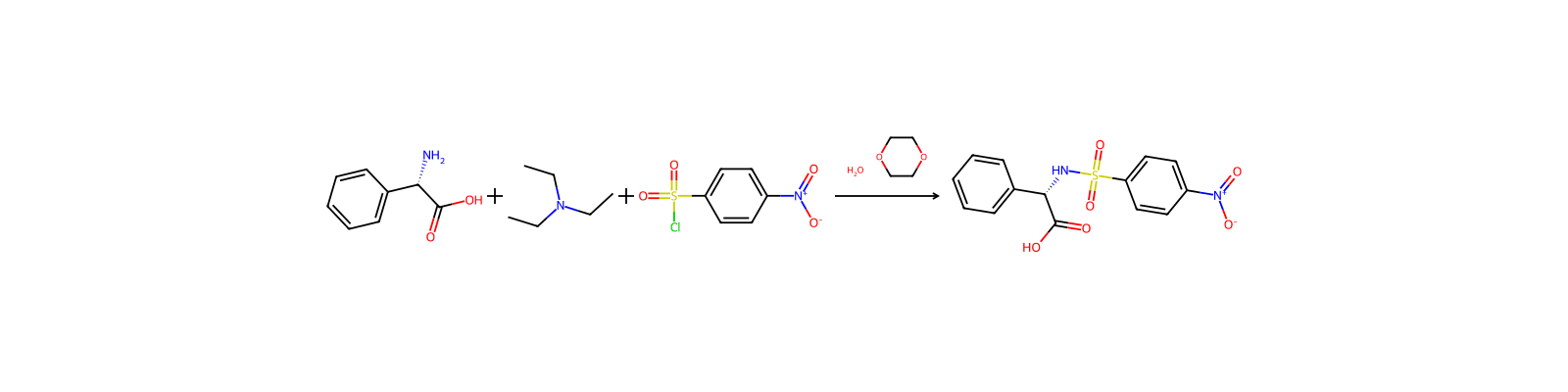


Notizen zur Verbindung
Wird geladen…