HuagongsheHuagongshe Chemie-Druckbericht · Nur für Forschungszwecke
Pyridin-2,3-diyldiamin
PYRIDINE-2,3-DIAMINE · 2,3-pyridinediamine · 3-DiaMinopyridine · 2,3-diamino-pyridin · 2,3-DIAMINOPYRIDINE · TIMTEC-BB SBB004339 · Pyridin-2,3-diaMine · Pyridine, 2,3-diamino-
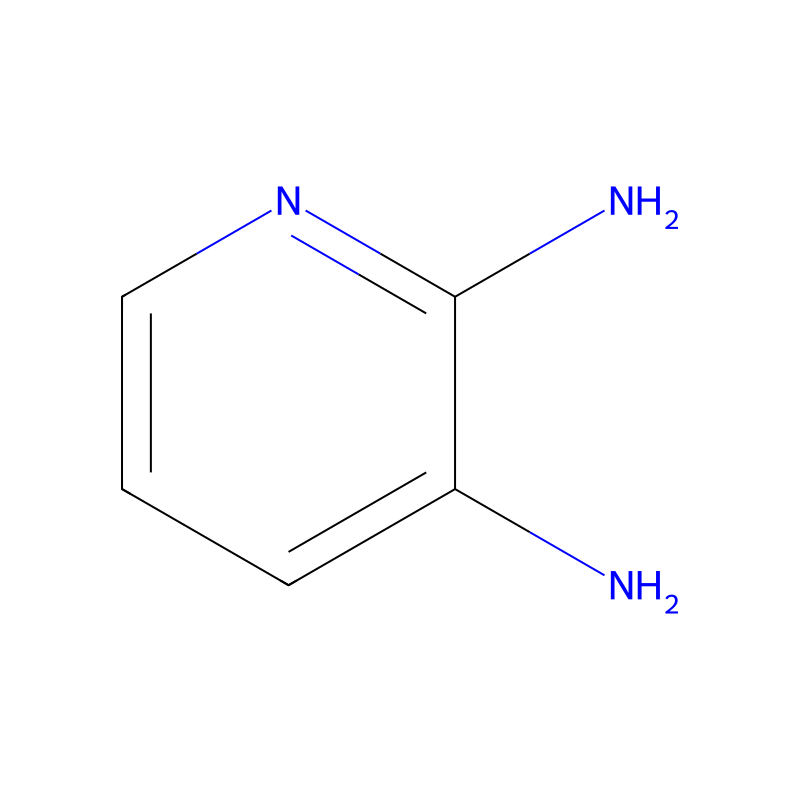
Identifikatoren & physikalische Daten
| CAS No. | 452-58-4 |
|---|---|
| Summenformel | C5H7N3 |
| Durchschnittliche Molmasse | 109,13 g/mol |
| Monoisotopische Masse | 109,06399722 g/mol |
| SMILES | Nc1cccnc1N |
| InChIKey | ZZYXNRREDYWPLN-UHFFFAOYSA-N |
| PubChem CID | 9956 |
| ChEBI | CHEBI:195591 |
| EC No. | 207-200-9 |
| DTXSID | DTXSID0051493 |
| Lokaler Name | Pyridin-2,3-diyldiamin |
Chemische & physikalische Eigenschaften
| XLogP | -0,2 |
|---|---|
| Polarare Oberfläche (TPSA) | 64,9 |
| H-Brücken-Donoren | 2 |
| H-Brücken-Akzeptoren | 3 |
| Frei drehbare Bindungen | 0 |
| Schwere Atome | 8 |
| Formalladung | 0 |
| Komplexität | 74,1 |
| Collision Cross Section | 118.5 Ų [M+H]+ [CCS Type: DTBuffer gas: N2Ionization: ESI+Dataset: TOXCASTSource Identifier: DTXSID0051493] |
| Schmelzpunkt | 110-115 °C (lit.) |
| Siedepunkt | 195°C 55mm |
| Dichte | 1.1118 (rough estimate) |
| Brechungsindex | 1.5340 (estimate) |
| Flammpunkt | 205 °C |
| Lagerbedingungen | Keep in dark place,Sealed in dry,Room Temperature |
| Löslichkeit | H2O: soluble50mg/mL, opaque (brown to very dark brown)100 g/L (20 ºC) |
| Aggregatzustand | Solid |
| pKa (Säurekonstante) | 6.78±0.36(Predicted) |
| Farbe | Very Dark Brown |
| BRN | 109869 |
| InChI | 1S/C5H7N3/c6-4-2-1-3-8-5(4)7/h1-3H,6H2,(H2,7,8) |
| InChIKey | ZZYXNRREDYWPLN-UHFFFAOYSA-N |
| SMILES | Nc1cccnc1N |
| CAS Datenbank | 452-58-4(CAS DataBase Reference) |
| NIST chemische Informationen | 2,3-Pyridinediamine(452-58-4) |
Sicherheit & Vorschriften
| GHS-Einstufung | DangerH301 (15.2%): Toxic if swallowed [Danger Acute toxicity, oral]P261, P264, P264+P265, P270, P271, P280, P301+P316, P301+P317, P302+P352, P304+P340, P305+P351+P338, P317, P319, P321, P330, P332+P317, P337+P317, P362+P364, P403+P233, P405, and P501 (click each P-code to see the statement)Aggregated GHS information provided per 46 reports by companies from 6 notifications to the ECHA C&L Inventory. Each notification may be associated with multiple companies. |
|---|---|
| Hazard Classes and Categories | Acute Tox. 3 (15.2%) |
| F | 9 |
| Wassergefährdungsklasse (WGK) | 3 |
| UN-Transportnummer | UN 2811 |
| Zollcode | 29333999 |
| RTECS-Nr. | US7548000 |
| R-Sätze (R) | 22-36/37/38-25 |
| Gefahrensymbole | Xn,Xi,T |
| hazard_note | Irritant |
| Sicherheitshinweise (S) | 26-36/37-45-37/39-28A-36 |
| Gefahrenklasse | 6.1Eye Irrit. 2Skin Irrit. 2STOT SE 3 |
| Verpackungsgruppe | II |
| Lagerklasse | 11 - Combustible Solids |
Anwendungen & Verwendung
Verwenden
2,3-Diaminopyridine was used in the synthesis of 2,3-diaminopyridinium-4-hydroxybenzoate1. It was used as internal standard in analysis of poly(amidoamine)dendrimers having different terminal functionalities by capillary electrophoresis. It was used as reagent in synthesis of imidazopyridines and organometallic complexes.