
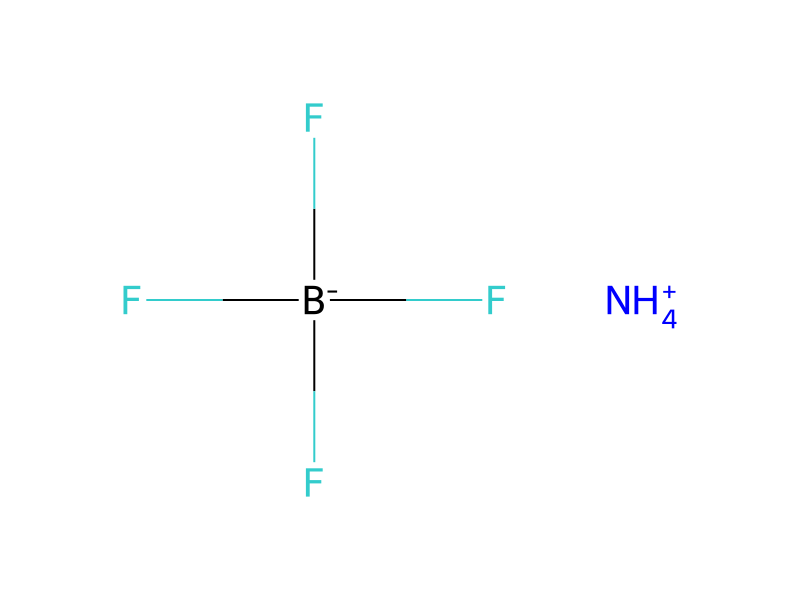
Grundinformationen
- Standard-SMILES
F[B-](F)(F)F.[NH4+]- InChIKey
PDTKOBRZPAIMRD-UHFFFAOYSA-O- Summenformel
- BF4H4N
- Durchschnittliche Molmasse
- 104,85 g/mol
- Monoisotopische Masse
- 105,0372919
Namen und Bezeichner
- Bevorzugter Name
- Ammonium fluoroborate
- IUPAC
- azanium tetrafluoroborate
- Lokaler Name
- Ammoniumtetrafluoroborat
- Englischer Name
- Ammonium fluoborate
- Summenformel
- BF4H4N
- Molmasse
- 104.84
Namen und Synonyme
Ammonium tetrafluoroborate13826-83-0Ammonium fluoroborateAMMONIUM FLUOBORATEAmmonium borofluorideAmmonium tetrafluoroborate(1-)Borate(1-), tetrafluoro-, ammoniumDTXSID8065660C945Z80O8XAMMONIUM FLUROBORATE [HSDB]AMMONIUM BOROFLUORIDE (NH4BF4)Ammonium fluoborate (6CI)
Weitere Namen anzeigen
ammonium floroborateAmmonium fluoboratAmmonium fluoroboratAmmonium Fluoborate,98%Ammonium fluoborate,99%ammoniumfluoroborate[qr]
HSDB 6286EINECS 237-531-4RefChem:557723AMMONIUM FLUROBORATEAmmonium tetrafluoroborate(1)AMMONIUM TETRAFLUOBORATEDTXCID5034488Ammonium tetrafluoroborate (1-)
Datenbank-Bezeichner
- CAS
13826-83-0- PubChem CID
- 9964072
- DTXSID
DTXSID8065660- UNII
- C945Z80O8X
- EC Number
- 237-531-4
Eigenschaften
Berechnete Struktureigenschaften
- Polarare Oberfläche (TPSA)
- 1 Ų
- H-Brücken-Donoren
- 1
- H-Brücken-Akzeptoren
- 5
- Frei drehbare Bindungen
- 0
- Schwere Atome
- 6
- Formalladung
- 0
- Komplexität
- 19
Experimentelle und physikochemische Eigenschaften
OdorOdorless
Density
1.871 at 59 °F 1.85 at 17.5 °C (USCG, 1999) - Denser than water; will sink
1.871 g/cu cm at 15 °C
1.85 @25 °C
Color/FormWhite powder, orthorhombic
Solubility
Water solubility (g/100 mL water): 3.09 at -1.0 °C; 5.26 at -1.5 °C; 10.85 at -2.7 °C; 12.20 at 0 °C; 25 at 16 °C; 25.83 at 25 °C; 44.09 at 50 °C; 67.50 at 75 °C; 98.93 at 100 °C; 113.7 at 108.5 °C
Solubility in HF at 0 °C: 19.89%
Soluble in ammonium hydroxide
CorrosivityCorrosive to aluminum
Decomposition
When heated to decomposition it emits very toxic fumes of /hydrogen fluoride and nitrogen oxides and ammonia./
The toxic action of the halogenated borons is considerably influenced by their decomposition products (hydrofluoric acid-, fluoboric acid-, hydrochloric acid-). /Halogenated borons/
Melting Point
446 °F (USCG, 1999)
487 °C (decomposes)
Sublimes at melting point
230 °C
Vapor Pressure0.001 lb/sq inch at 100 °F
Physical Description
Ammonium fluoborate appears as odorless white crystals. Sinks and mixes with water. (USCG, 1999)
White odorless solid; [HSDB] Soluble in water; [MSDSonline]
Autoignition TemperatureNot flammable (USCG, 1999)
Other Experimental PropertiesHeat of sublimation: 144 BTU/lb= 80.2 cal/g= 3.36X10+5 J/kg
Physikochemische Eigenschaften
- Schmelzpunkt
- 230 °C · 230 °C
- Dichte
- 1.871 g/mL · 1.871 g/mL at 25 °C(lit.)
- storage temp.
- Inert atmosphere,Room Temperature
- Aggregatzustand
- Powder
- Wichte
- 1.871 · 1.871
- Farbe
- White
- PH
- 3.5 · 3.5 (5g/l, H2O, 20℃)
- Wasserlöslichkeit
- soluble
- InChI
- InChI=1S/BF4.H3N/c2-1(3,4)5;/h;1H3/q-1;/p+1
- InChIKey
- PDTKOBRZPAIMRD-UHFFFAOYSA-O
- SMILES
- F[B-](F)(F)F.[NH4+]
- CAS Datenbank
- 13826 · 13826-83-0(CAS DataBase Reference)
- EPA chemische Informationen
- Ammonium fluoroborate (13826-83-0)
Sicherheit und Regulatorisches
GHS-Klassifizierung
GHS Classification
Danger
H290 (50%): May be corrosive to metals [Warning Corrosive to Metals];H314 (59%): Causes severe skin burns and eye damage [Danger Skin corrosion/irritation];H315 (41%): Causes skin irritation [Warning Skin corrosion/irritation];H319 (41%): Causes serious eye irritation [Warning Serious eye damage/eye irritation];H335 (41%): May cause respiratory irritation [Warning Specific target organ toxicity, single exposure; Respiratory tract irritation]
P234, P260, P261, P264, P264+P265, P271, P280, P301+P330+P331, P302+P352, P302+P361+P354, P304+P340, P305+P351+P338, P305+P354+P338, P316, P319, P321, P332+P317, P337+P317, P362+P364, P363, P390, P403+P233, P405, P406, and P501 (click each P-code to see the statement)
Aggregated GHS information provided per 78 reports by companies from 6 notifications to the ECHA C&L Inventory. Each notification may be associated with multiple companies.;Information may vary between notifications depending on impurities, additives, and other factors. The percentage value in parenthesis indicates the notified classification ratio from companies that provide hazard codes. Only hazard codes with percentage values above 10% are shown. For more detailed information, please visit ECHA C&L website.
Gefahrenhinweise
Regulatory Information
Chemical: Borate(1-), tetrafluoro-, ammonium
Status: Active Update: 11-03-2019 https://echa.europa.eu/registration-dossier/-/registered-dossier/27864
Restricted substance: Ammonium tetrafluoroborate;EC: 237-531-4;Restriction condition document: PDF link
Borate(1-), tetrafluoro-, ammonium: Does not have an individual approval but may be used under an appropriate group standard
The New Jersey Worker and Community Right to Know Act requires public and private employers to provide information about hazardous substances at their workplaces. (N.J.S.A. 34:5A-1 et. seq.)
DOT LabelCorrosive
Fire HazardsBehavior in Fire: Sublimes above 238 °C yielding toxic fumes. (USCG, 1999)
Fire PotentialMaterial itself does not burn or burns with difficulty.
Health HazardsINHALATION: May cause irritation of respiratory passages, nose bleeds, and nausea. EYES: May irritate. (USCG, 1999)
Hazards SummaryA skin, eye, and respiratory tract irritant; [HSDB] Harmful if swallowed; [MSDSonline] See Potassium tetrafluoroborate.
Reactive GroupSalts, Acidic
Special ReportsUSEPA/OWRS; Quality Criteria for Water 1986 Boron (1986) EPA 440/5-86-001
Reactivity Profile
Acidic inorganic salts are generally soluble in water. The resulting solutions contain moderate concentrations of hydrogen ions and have pH's of less than 7.0. They react as acids to neutralize bases. These neutralizations generate heat, but less or far less than is generated by neutralization of inorganic acids, inorganic oxoacids, and carboxylic acid. They usually do not react as either oxidizing agents or reducing agents but such behavior is not impossible. Many of these compounds catalyze organic reactions.
Air and Water ReactionsThe white solid sublimes above 238 °C. to form toxic fumes. The solid is water soluble.
CERCLA Reportable Quantities
Persons in charge of vessels or facilities are required to notify the National Response Center (NRC) immediately, when there is a release of this designated hazardous substance, in an amount equal to or greater than its reportable quantity of 5000 lb or 2270 kg. The toll free number of the NRC is (800) 424-8802. The rule for determining when notification is required is stated in 40 CFR 302.4 (section IV. D.3.b).
Clean Water Act Requirements
Ammonium fluoroborate is designated as a hazardous substance under section 311(b)(2)(A) of the Federal Water Pollution Control Act and further regulated by the Clean Water Act Amendments of 1977 and 1978. These regulations apply to discharges of this substance. This designation includes any isomers and hydrates, as well as any solutions and mixtures containing this substance.
Sicherheit und Schutzausrüstung
Fire FightingFire Extinguishing Agents: Water spray will probably reduce fume and irritant gases. (USCG, 1999)
First AidINHALATION: Remove to fresh air; if symptoms persist consult a physician.;EYES: Wash with water for 15 minutes and get medical attention.;INGESTION: Give 3 to 4 glasses of water and induce vomiting. Consult a physician. (USCG, 1999)
Fire Fighting Procedures
Extinguish fire using agent suitable for type of surrounding fire.
Water spray will probably reduce fume and irritant gases.
Storage ConditionsStorage temperature: Ambient (moderate)
Cleanup Methods
Environmental considerations - land spill: Dig a pit, pond, lagoon, holding area to contain liquid or solid material. /SRP: If time permits, pits, ponds, lagoons, soak holes, or holding areas should be sealed with an impermeable flexible membrane liner./ Cover solids with a plastic sheet to prevent dissolving in rain or fire fighting water.
Nonfire Spill Response
Excerpt from ERG Guide 154 [Substances - Toxic and/or Corrosive (Non-Combustible)]:;ELIMINATE all ignition sources (no smoking, flares, sparks or flames) from immediate area. Do not touch damaged containers or spilled material unless wearing appropriate protective clothing. Stop leak if you can do it without risk. Prevent entry into waterways, sewers, basements or confined areas. Absorb or cover with dry earth, sand or other non-combustible material and transfer to containers. DO NOT GET WATER INSIDE CONTAINERS. (ERG, 2024)
Disposal Methods
SRP: The most favorable course of action is to use an alternative chemical product with less inherent propensity for occupational exposure or environmental contamination. Recycle any unused portion of the material for its approved use or return it to the manufacturer or supplier. Ultimate disposal of the chemical must consider: the material's impact on air quality; potential migration in soil or water; effects on animal, aquatic, and plant life; and conformance with environmental and public health regulations.
Preventive Measures
If material not involved in fire: Keep material out of water sources and sewers. Build dikes to contain flow as necessary.
Keep upwind. ... Avoid breathing vapors or dusts. Wash away any material which may have contacted the body with copious amounts of water or soap and water.
SRP: The scientific literature for the use of contact lenses in industry is conflicting. The benefit or detrimental effects of wearing contact lenses depend not only upon the substance, but also on factors including the form of the substance, characteristics and duration of the exposure, the uses of other eye protection equipment, and the hygiene of the lenses. However, there may be individual substances whose irritating or corrosive properties are such that the wearing of contact lenses would be harmful to the eye. In those specific cases, contact lenses should not be worn. In any event, the usual eye protection equipment should be worn even when contact lenses are in place.
Isolation and Evacuation
Excerpt from ERG Guide 154 [Substances - Toxic and/or Corrosive (Non-Combustible)]:;IMMEDIATE PRECAUTIONARY MEASURE: Isolate spill or leak area in all directions for at least 50 meters (150 feet) for liquids and at least 25 meters (75 feet) for solids.;SPILL: Increase the immediate precautionary measure distance, in the downwind direction, as necessary.;FIRE: If tank, rail tank car or highway tank is involved in a fire, ISOLATE for 800 meters (1/2 mile) in all directions; also, consider initial evacuation for 800 meters (1/2 mile) in all directions. (ERG, 2024)
Threshold Limit Values (TLV)
8 hr Time Weighted Avg (TWA): 2.5 mg/cu m. /Fluorides, as F/
Excursion Limit Recommendation: Excursions in worker exposure levels may exceed 3 times the TLV-TWA for no more than a total of 30 minutes during a work day, and under no circumstances should they exceed 5 times the TLV-TWA, provided that the TLV-TWA is not exceeded. /Fluorides, as F/
A4; Not classifiable as a human carcinogen. /Fluorides, as F/
Biological Exposure Index (BEI): Determinant: Fluorides in urine; Sampling Time: prior to shift; BEI: 3 mg/g creatinine; Sampling Time: end of shift; BEI: 10 mg/g creatinine. The determinant may be present in biological specimens collected from subjects who have not been occupationally exposed, at a concentration which could affect interpretation of the result. Such background concentrations are incorporated in the BEI value. The determinant is nonspecific, since it is also observed after exposure to other chemicals. /Fluorides/
Protective Action Criteria (PAC)
10 [mg/m3]
110 [mg/m3]
690 [mg/m3]
Personal Protective Equipment (PPE)
Mechanical filter respirator if dusty or misty; self-contained breathing apparatus if fuming. Rubber gloves; safety glasses (dust) or chemical goggles (mist); full, clean work clothing. (USCG, 1999)
Wear appropriate chemical protective gloves, boots and goggles.
/Use/ mechanical filter respirator if dusty or misty, self-contained breathing apparatus if fuming.
Toxikologische Informationen
Medical Surveillance
Physical examinations of exposed personnel every six months including fluoride determinations in urine, studies of liver and kidney function; chest X-ray, annually. Protect from exposure those individuals with diseases of kidneys, liver, and lung. /Hydrofluoric acid/
No specific considerations are needed for boric acid or borates except for general health and liver and kidney function. /Boric acid and borates/
Human Toxicity Excerpts
/SIGNS AND SYMPTOMS/ Chronic effects: (from inhalation or ingestion), may cause fluorosis. Symptoms- weight loss, malaise, anemia, leukopenia, discoloration of teeth, osteosclerosis. /Hydrofluoric acid/
/SIGNS AND SYMPTOMS/ Contact of skin with anhydrous liquid produces severe burns that are felt immediately. Concentrated aqueous solution also cause early sensation of pain, but dilute solution may give no warning of injury. /Hydrofluoric acid/
/SIGNS AND SYMPTOMS/ All forms-dilute or concentrated solution or vapor of hydrofluoric acid (HF) ... cause severe burns. Inhalation of anhydrous HF or HF mists or vapors can cause severe respiratory tract irritation that may be fatal. /Hydrofluoric acid/
/SIGNS AND SYMPTOMS/ Acute effects: ...Inhalation, extreme irritation of respiratory tract... Ingestion, necrosis of esophagus and stomach with nausea, vomiting, diarrhea, circulatory collapse, death. /Hydrofluoric acid/
For more Human Toxicity Excerpts (Complete) data for AMMONIUM FLUOBORATE (6 total), please visit the HSDB record page.
Non-Human Toxicity Excerpts
/LABORATORY ANIMALS: Acute Exposure/ The danger of hydrofluoric acid solutions depends upon the concentration. Experimental splash burns in rabbits... have shown 20% solution to cause immediate damage with total corneal opacification with conjunctival eschemia, and with corneal stromal edema within an hour, followed by necrosis of anterior ocular structures. An 8% solution produced ischemia and corneal stromal edema persisting for 40-65 days, accompanied by corneal vascularization. Even a 2% solution caused mild persistent stromal edema and vascularization, but after 0.5% solution there was recovery in 10 days. /Hydrofluoric acid/
/LABORATORY ANIMALS: Chronic Exposure or Carcinogenicity/ Chronic exposure of guinea pigs and rabbits has caused injury of the cornea as well as of mucous membranes. /Hydrofluoric acid/
Evidence for CarcinogenicityA4; Not classifiable as a human carcinogen. /Fluorides, as F/
Antidote and Emergency Treatment
Maintain an open airway and assist ventilation if nescessary. treat coma, seizures, hypotension, and renal failure if they occur. There is no specific antidote. Administer activated charcoal (although boric acid is not well absorbed). Consider gastric lavage for large ingestions. /Boric acid, Borates, and Boron/
Hemodialysis is effective and is indicated after massive ingestions and for supportive care of renal failure. Peritoneal dialysishas not proved effective in enhancing elimination in infants. /Boric acid, Borates, and Boron/
In acute poisonings, if a large amount has been ingested and the patient is seen within one hour of exposure, gastrointestinal decontamination should be considered ... .It is important to keep in mind that vomiting and diarrhea are common, and severe poisoning may be associated with seizures. Therefore induction of emesis by syrup of ipecac is probably contraindicated in these exposures. Catharsis is not indicated if diarrhea is present. /Boric acid and Borates/
If ingestion of borate has been massive (several grams), or has extended over several days, administer intravenous glucose and electrolyte solutions to sustain urinary excretion of borate. Monitor fluid balance and serum electrolytes (including bicarbonate capacity ) regularly. Monitor cardiac status by ECG. Test the urine for proteins and cells to detect renal injury, and monitor serum concentration of borate. Metabolic acidosis may be treated with sodium bicarbonate. If shock develops, it may be necessary to infuse plasma or whole blood. Administer oxygen continuously. If oliguria (less than 25 to 30 mL urine per hour) occurs, intravenous fluids must be slowed or stopped to avoid overloading the circulation. Such patients should be referred to a center capable of providing intensive care for critically ill patients. /Boric acid and Borates/
For more Antidote and Emergency Treatment (Complete) data for AMMONIUM FLUOBORATE (7 total), please visit the HSDB record page.
Regulatorische Informationen
Regulatory Information
Chemical: Borate(1-), tetrafluoro-, ammonium
Status: Active Update: 11-03-2019 https://echa.europa.eu/registration-dossier/-/registered-dossier/27864
Restricted substance: Ammonium tetrafluoroborate;EC: 237-531-4;Restriction condition document: PDF link
Borate(1-), tetrafluoro-, ammonium: Does not have an individual approval but may be used under an appropriate group standard
The New Jersey Worker and Community Right to Know Act requires public and private employers to provide information about hazardous substances at their workplaces. (N.J.S.A. 34:5A-1 et. seq.)
CERCLA Reportable Quantities
Persons in charge of vessels or facilities are required to notify the National Response Center (NRC) immediately, when there is a release of this designated hazardous substance, in an amount equal to or greater than its reportable quantity of 5000 lb or 2270 kg. The toll free number of the NRC is (800) 424-8802. The rule for determining when notification is required is stated in 40 CFR 302.4 (section IV. D.3.b).
Clean Water Act Requirements
Ammonium fluoroborate is designated as a hazardous substance under section 311(b)(2)(A) of the Federal Water Pollution Control Act and further regulated by the Clean Water Act Amendments of 1977 and 1978. These regulations apply to discharges of this substance. This designation includes any isomers and hydrates, as well as any solutions and mixtures containing this substance.
State Drinking Water Guidelines
(CA) CALIFORNIA 1000 ug/L /Boron/
(NH) NEW HAMPSHIRE 630 ug/L /Boron/
(ME) MAINE 1,400 ug/L /Boron/
(MN) MINNESOTA 1,000 ug/L /Boron/
(WI) WISCONSIN 960 ug/L /Boron/
Federal Drinking Water GuidelinesEPA 600 ug/L /Boron/
Sicherheitsdaten
- wgk
- 3
- tsca
- TSCA listed
- ridadr
- UN 9088
- hs_code
- 2826 90 80
- RTECS-Nr.
- BQ6100000
- risk_code
- 36/37/38-34
- hazard_code
- C
- hazard_note
- Corrosive/Moisture Sensitive
- safety_code
- 26-36-45-36/37/39
- hazard_class
- 8
- Speicherklasse
- 8B - Non-combustible corrosive hazardous materials
- Giftige Stoffe Daten
- 13826-83-0(Hazardous Substances Data)
- Hazard Classifications
- Skin Corr. 1B
Chemie und Industrie
Pharmakologische Informationen
Absorption, Distribution and Excretion
Following daily oral intake of 6.4 mg sodium tetrafluoroborate by a volunteer for a period of 14 days, a daily average of 100% was excreted in the urine and 1.6% in the feces. The fluoride content of the volunteer's food was not determined. Sodium fluoroborate is therefore well absorbed, but the fluoride which enters the body is not stored. The authors attributed this to slow hydrolysis of the tetrafluoroborate ion. In another study with 3 volunteers and a study duration of 7 to 38 weeks, there were indications that fluoride which was absorbed in the form of sodium tetrafluoroborate was stored in the body. The amount was <10% of that absorbed into the bloodstream. /Sodium tetrafluoroborate/
In a further study... on the distribution of potassium tetrafluoroborate in various tissues, male albino rats (weighing 110 to 150 g; aged 11-13 weeks) were each iv injected with 1 umol 18F-labelled potassium tetrafluoroborate... . At 120 min after injection, the following relative specific activities (activity per gram of tissue/activity in serum) were determined: liver 0.29, spleen 0.37, kidney 0.60, lung 0.60, muscle 0.14, brain 0.03, femoral diaphysis 0.26, femoral epiphysis 0.29, incisors 0.27, cranial bone 0.27, cartilage 0.30. Further relative specific activities at 30, 120, and 240 min after injection were reported for serum/total injected dose as 1.75, 0.28, and 0.07, respectively, for muscle/serum as 0.14, 0.15, and 0.35, respectively, as well as for femoral epiphysis/serum as 0.35, 0.85, and 1.35, respectively, and for femoral epiphysis/femoral diaphysis as 1.0, 2.3, and 2.4, respectively. /Potassium tetrafluoroborate/
Rats (approx 200 g; 4 animals/group) were given a single ip injection of 5 ug 18F-labelled potassium tetrafluoroborate (it was not specified whether per kg bw or per rat). After 40, 60, 100, and 120 minutes, various organs were assessed for relative specific tetrafluoroborate activity (tissue/blood specific activity ratio). ...The highest activity was found in the thyroid gland, where it was 26 to 42 fold higher than in the other organs after 2 hours. Increases in dose to 50, 500, and 1000 ug potassium tetrafluoroborate did not increase the specific activity in the thyroid gland, but reduced it relative to the values found after administration of 5 ug, e.g. by about a factor of 20, 210 minutes after 1000 ug. /Potassium tetrafluoroborate/
Verwendung und Herstellung
Uses
Used in metal industry as high-temperature flux; Also used as a catalyst, flame retardant, and lubricant in aluminum cutting-oils; [HSDB]
Metal Preparation and Pouring [Category: Foundry]
Mainly used for the high temperature fluxing action required by the metals industry; catalyst; in flame retardants; acts as a solid lubricant in cutting-oil emulsions for aluminum rolling and forming
Methods of ManufacturingAmmonia reacts with fluoroboric acid to produce ammonium fluoborate; also, the fusion of ammonium bifluoride and boric acid
Formulations/PreparationsGrades or purity: 97.0% minimum
Anwendungen
VerwendenAmmonium fluoroborate is used as an analytical reagent. It is also applied in the textile printing and dyeing industry and used as a catalyst for resin finishing. It is mainly used for the high temperature fluxing action required by the metals industry; catalyst; in flame retardants and acts as a solid lubricant in cutting-oil emulsions for aluminum rolling and forming.
Vor- und nachgelagerte Produkte
Vorgelagerte Rohstoffe
Nachgelagerte Produkte
Anbieter50 Anbieter
国药集团化学试剂有限公司86-21-63210123 · [email protected]
北京华美互利生物化工010-56205725 · [email protected]
上海阿拉丁生化科技股份有限公司400-6206333 13167063860 · [email protected]
韶关阳安化工有限公司18902343715 · [email protected]
河北创海生物科技有限公司+86-86-13131129325 · [email protected]
Baoji Guokang Healthchem co.,ltd+8615604608665 15604608665 · [email protected]
Dayang Chem (Hangzhou) Co.,Ltd.+86-0571-88938639 17705817739 · [email protected]
上海迈瑞尔生化科技有限公司4006356688 18621169109 · [email protected]
阿法埃莎(中国)化学有限公司400-6106006 · [email protected]
安耐吉化学&3A(安徽泽升科技股份有限公司)400-0056266 · [email protected]
上海瀚鸿科技股份有限公司021-54306202 13764082696 · [email protected]
Pure Chemistry Scientific Inc.001-857-928-2050 or 1-888-588-9418 · [email protected]
合肥天健化工有限公司551-65418679 15856988503;15837135945 · [email protected]
上海忆嵘生物科技有限公司18049974220 · [email protected]
孝感深远化工有限公司15527621225; 15527621225 · [email protected]
山东西亚化学有限公司13355009207 13355009207 · [email protected]
玛雅试剂+86 (573) 82222445 (0)18006601000 452520369 · [email protected]
四川库利南科技有限公司400-1166-196 18981987031 · [email protected]
天津希恩思生化科技有限公司400 638 7771 · [email protected]
斯百全化学(上海)有限公司021-021-021-67601398-809-809-809 15221380277 · [email protected]
艾科试剂4008-755-333 18080918076 · [email protected]
赛默飞世尔科技(中国)有限公司800-810-5118 · [email protected]
北京伊诺凯科技有限公司400-810-7969 010-59572699 · [email protected]
江苏艾康生物医药研发有限公司025-66113011 13913916777 · [email protected]
Clearsynth Labs Limited+91-22-26355700 · [email protected]
北京环宇世纪化学科技有限公司hysj_bj.com
上海将来实业股份有限公司400-0066400 13621662912 · [email protected]
上海将来实业股份有限公司021-61552785 · [email protected]
HBCChem, Inc.+1-510-219-6317 · [email protected]
上海创赛科技有限公司400-6087598 15021221957 · [email protected]
上海馨远医药科技有限公司021-24206007 13764915196 · [email protected]
上海德榜化工有限公司021-61531158 · [email protected]
上海麦克林生化科技股份有限公司15221275939 15221275939 · [email protected]
上海乾劲化工科技有限公司021-20900665 17321230821 · [email protected]
上海有朋化工有限公司021-69005955 13701776567 · [email protected]
北京欣赛维化学科技有限公司010-56218822 13717722232 · [email protected]
上海凯赛化工有限公司021-33516722 13701817765 · [email protected]
上海彤源化工有限公司021-021-69182866 13701855675 · [email protected]
成都润泽本土化工有限公司13096311329 028-88469284 616445927 · [email protected]
上海容立化学科技有限公司021-69992220 13701886816 · [email protected]
上海康拓化工有限公司021-69185552 13701777608 · [email protected]
湖北巨胜科技有限公司027-59599241 18871490274 · [email protected]
Sigma-Aldrich西格玛奥德里奇(上海)贸易有限公司021-61415566 800-8193336 · [email protected]
铜陵恒优生物科技有限公司021-50426030 13856289449;13124863828 · [email protected]
桦特昇生物科技(武汉)有限公司027-59207879 1972026995 18140587686 · [email protected]
江苏倍达医药科技有限公司0512-63009836 18994340901 · [email protected]
Alfa Chemistry1-516-6625404 · [email protected]
九鼎化学(上海)科技有限公司4009209199 · [email protected]
Henan Alfa Chemical Co., Ltd+8618339805032 · [email protected]
厦门志信化学有限公司+86-5922680277 +86-13806087780 · [email protected]
Zugehörige Reaktionen
26


Verknüpfte Notizen
Wird geladen…