Reaktionsgleichung

C1O[C:5](O)([CH2:7]O)[CH2:4][O:3][C:2]1([OH:12])[CH2:10][OH:11].[CH2:13](O)CCO>>[C:10]([CH:2]1[O:3][CH2:4][CH2:5][CH2:7][O:12]1)(=[O:11])[CH3:13]Komponenten
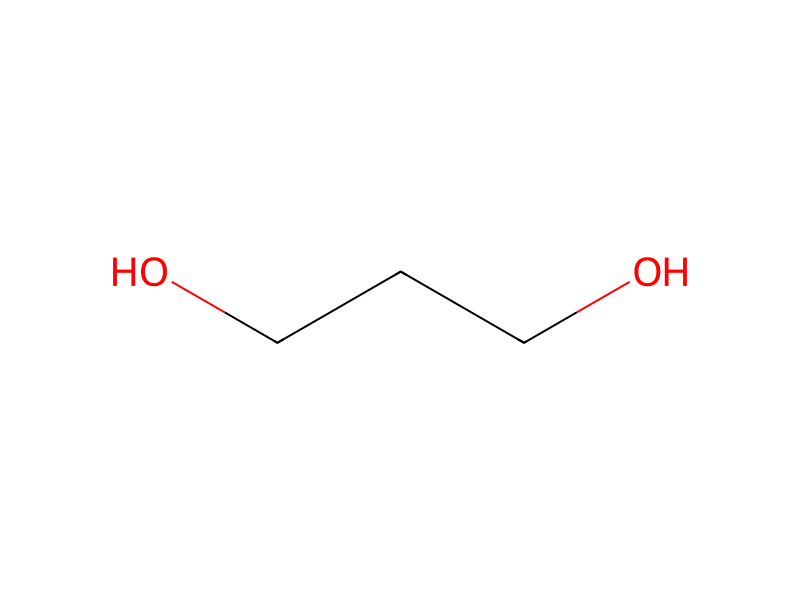


Reaktionsbedingungen
- Temperatur
- 105 °C
Versuchsvorschrift
A mixture of 3.81 g of 1,3-dihydroxyacetone dimer (available from Aldrich Chemical Co., Milwaukee, Wis.) and 308 mg of Amberlyst-15 ion-exchange resin (Aldrich Chemical Co., Milwaukee, Wis.) in 10 mL of 1,3-propanediol was stirred for four hours at a temperature of about 105° C. (external oil bath temperature) and protected from atmospheric moisture. After cooling the mixture to room temperature, it was filtered through a plug of glass wool into a separatory funnel containing 50 mL of 10% aqueous sodium chloride; and the product was isolated by extraction with dichloromethane (2×15 mL portions). The combined dichloromethane extracts were washed with saturated brine (30 mL), then dried over anhydrous sodium sulfate and filtered. Removal of dichloromethane by evaporation at reduced pressure, followed by evaporative distillation (bath temperature: 72°-91° C., 2.5 mm) afforded 2.92 g (53% yield) of the desired product, greater than 98% pure as shown by gas chromatographic analysis. The title compound, 2-acetyl-1,3-dioxane, has been previously prepared in a similar manner by S. K. Gupta, J. Org. Chem., 41, 2642 (1976).
Aufarbeitung
- temperatureAfter cooling the mixture to room temperature
- filtrationit was filtered through a plug of glass wool into a separatory funnel
- additioncontaining 50 mL of 10% aqueous sodium chloride
- customand the product was isolated by extraction with dichloromethane (2×15 mL portions)
- washThe combined dichloromethane extracts were washed with saturated brine (30 mL)
- dry with materialdried over anhydrous sodium sulfate
- filtrationfiltered
- customRemoval of dichloromethane
- customby evaporation at reduced pressure
- distillationfollowed by evaporative distillation (bath temperature: 72°-91° C., 2.5 mm)
Quellen und Nachweise
- ORD-Eintrag
- ord-269b851b735d4a8eb3b74c01b1c7a45f
- Quelldatensatz
- uspto-grants-1992_04
- Patentnummer
- US05107030
Verknüpfte Notizen
Wird geladen…