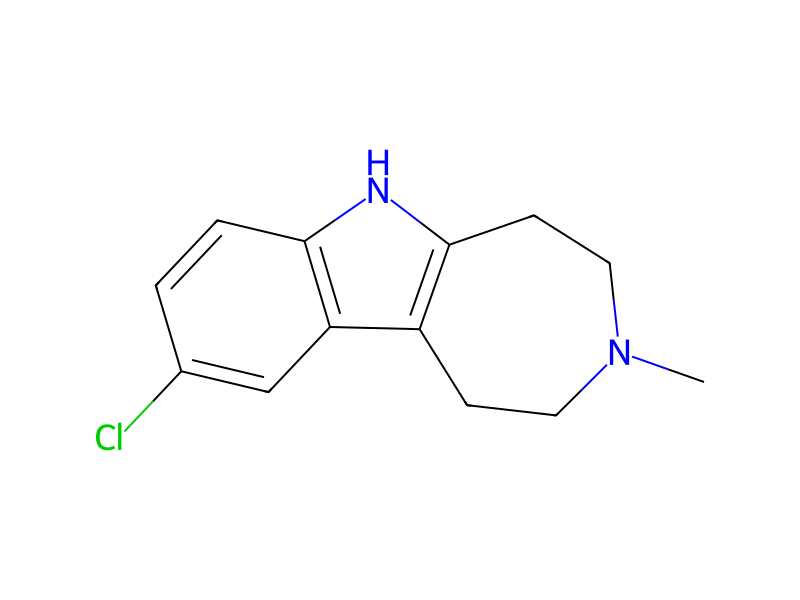
[Cl:1][C:2]1[CH:10]=[CH:9][C:8]2[NH:7][C:6]3[CH2:11][CH2:12][N:13]([CH3:16])[CH2:14][CH2:15][C:5]=3[C:4]=2[CH:3]=1.CN(C=O)C.[O-]P([O-])([O-])=O.[K+].[K+].[K+].Br[CH:31]=[C:32]([C:34]1[CH:39]=[CH:38][C:37]([O:40][CH3:41])=[CH:36][CH:35]=1)[CH3:33]>>[Cl:1][C:2]1[CH:10]=[CH:9][C:8]2[N:7](/[CH:31]=[C:32](/[C:34]3[CH:35]=[CH:36][C:37]([O:40][CH3:41])=[CH:38][CH:39]=3)\[CH3:33])[C:6]3[CH2:11][CH2:12][N:13]([CH3:16])[CH2:14][CH2:15][C:5]=3[C:4]=2[CH:3]=19-Chloro-3-methyl-1,2,3,4,5,6-hexahydroazepino[4,5-b]indole (43 mg, 0.184 mmol) was dissolved in DMF (4 mL) Copper (I) iodide (4 mg, 0.0184 mmol) L-proline (4.2 mg, 0.037 mmol) and K3PO4 (78 mg, 0.37 mmol) were added and the reaction mixture was stirred for 10 min. at RT. 1-(1-Bromoprop-1-en-2-yl)-4-methoxybenzene (50 mg, 0.22 mmol) was added dropwise and the reaction mixture was purged with nitrogen. The reaction mixture was heated at 80° C. for overnight (prolonged heating in some cases was required). The DMF was evaporated under reduced pressure, the residue was diluted with water and the solid was filtered. The solid material was purified by silica gel chromatography (100-200 mesh). 1H NMR (DMSO-d6, Oxalate salt) δ (ppm): 7.60 (m, 3H), 7.10 (m, 2H), 6.98 (m, 3H), 3.80 (s, 3H), 3.60 (m, 4H), 3.10 (m, 4H), 2.82 (s, 3H), 1.80 (s, 3H).