StartseiteMCPWorkbenchSkills
StartseiteWorkbenchBenachrichtigungenMein Bereich
llms.txt · MCP-AnleitungDatenschutz · Nutzungsbedingungen · Supportv1.8.0
  1. Startseite
  2. /Reaktion

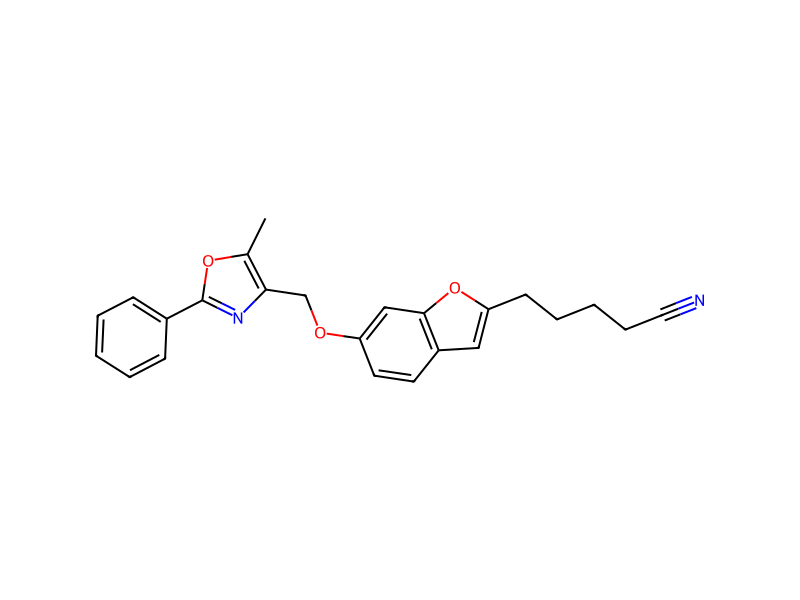
Hydrochloric Acid → 2-(4-Cyanobutyl)-6-(5-methyl-2-phenyl-4-oxazolylmethoxy)benzofuran

HRID 1052
Notizen
Druckvorschau

Reaktionsgleichung

Reaktionsgleichung von HRID 1052
[H-].[Na+].[Br-].[C:4]([CH2:6][CH2:7][CH2:8][P+](C1C=CC=CC=1)(C1C=CC=CC=1)C1C=CC=CC=1)#[N:5].[CH3:28][C:29]1[O:33][C:32]([C:34]2[CH:39]=[CH:38][CH:37]=[CH:36][CH:35]=2)=[N:31][C:30]=1[CH2:40][O:41][C:42]1[CH:52]=[CH:51][C:45]2[CH:46]=[C:47]([CH:49]=O)[O:48][C:44]=2[CH:43]=1.Cl>CN(C)C=O.O1CCCC1.[C].[Pd]>[C:4]([CH2:6][CH2:7][CH2:8][CH2:49][C:47]1[O:48][C:44]2[CH:43]=[C:42]([O:41][CH2:40][C:30]3[N:31]=[C:32]([C:34]4[CH:35]=[CH:36][CH:37]=[CH:38][CH:39]=4)[O:33][C:29]=3[CH3:28])[CH:52]=[CH:51][C:45]=2[CH:46]=1)#[N:5]
KomponentenVersuchsvorschriftAufarbeitungQuellen und NachweiseNotizen zur Reaktion

Komponenten

8

Edukt 4

HCID 313Hydrochloric AcidHCID 24758Sodium hydrideHCID 3036619(3-Cyanopropyl)triphenylphosphonium bromideHCID 196943726-(5-Methyl-2-phenyl-4-oxazolylmethoxy)-2-benzofurancarbaldehyde

Produkt 1

HCID 196943862-(4-Cyanobutyl)-6-(5-methyl-2-phenyl-4-oxazolylmethoxy)benzofuranAusbeute 60 %

Reagenzien, Katalysatoren, Lösungsmittel

3
HCID 178418390HCID 178418390, VerbindungKatalysatorHCID 6228DimethylformamideLösungsmittelHCID 8028TetrahydrofuranLösungsmittel

Versuchsvorschrift

Sodium hydride (60%, oily, 0.20 g) was gradually added to a solution of 3-cyanopropyltriphenylphosphonium bromide (2.07 g) in N,N-dimethylformamide (30 ml) at room temperature, followed by stirring for 1 hour. 6-(5-Methyl-2-phenyl-4-oxazolylmethoxy)benzofuran-2-carboaldehyde (1.40 g) was added, followed by stirring at 70° to 80° C. for 2 hours. The reaction mixture was poured over ice water and neutralized with 2N hydrochloric acid, followed by extraction with ethyl acetate (200 ml). After the ethyl acetate layer was washed with water and dried (MgSO4), the solvent was distilled off; the residue was subjected to silica gel column chromatography. From the fraction eluted with ethyl acetate-hexane (1:2, v/v), an oily substance was obtained, which was dissolved in tetrahydrofuran (40 ml). To this solution, palladium-carbon (5%, 0.70 g) was added, followed by catalytic reduction at room temperature and under an atmospheric pressure of 1 atm. The catalyst was filtered off, the filtrate was concentrated; the residue was subjected to silica gel column chromatography. From the fraction eluted with ethyl acetate-hexane (1:3, v/v), crystals of 2-(4-cyanobutyl)-6-(5-methyl-2-phenyl-4-oxazolylmethoxy)benzofuran (0.97 g, 60%) were obtained, which was then recrystallized from diethyl ether-hexane to yield colorless prisms having a melting point of 87° to 88° C.


Aufarbeitung

  1. stirringby stirring at 70° to 80° C. for 2 hours
  2. extractionfollowed by extraction with ethyl acetate (200 ml)
  3. washAfter the ethyl acetate layer was washed with water
  4. dry with materialdried (MgSO4)
  5. distillationthe solvent was distilled off
  6. washFrom the fraction eluted with ethyl acetate-hexane (1:2
  7. customv/v), an oily substance was obtained
  8. customfollowed by catalytic reduction at room temperature and under an atmospheric pressure of 1 atm
  9. filtrationThe catalyst was filtered off
  10. concentrationthe filtrate was concentrated
  11. washFrom the fraction eluted with ethyl acetate-hexane (1:3

Quellen und Nachweise

ORD-Eintrag
ord-647fc8886f5443968e4362c127da55fe
Quelldatensatz
uspto-grants-1998_03
DOI
10.6084/m9.figshare.5104873.v1
Patentnummer
US05723479

Notizen zur Reaktion

Wird geladen…

Auf dieser SeiteKomponentenVersuchsvorschriftAufarbeitungQuellen und NachweiseNotizen zur Reaktion