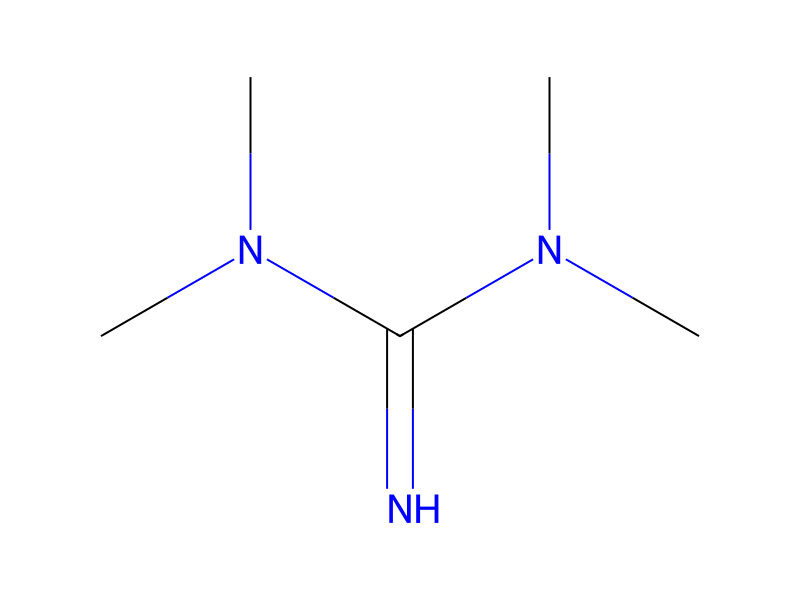
1,1,3,3-Tetramethylguanidine → HCID 178499694, Verbindung
Reaktionsgleichung

CN(C)C(N(C)C)=N.[CH3:9][O:10][C:11](=[O:40])[CH:12](P(OC)(OC)=O)[NH:13][C:14](=[O:33])[C:15]1[CH:20]=[CH:19][C:18]([C:21]([NH:23][CH2:24][C:25]2[CH:30]=[CH:29][CH:28]=[C:27]([OH:31])[CH:26]=2)=[O:22])=[CH:17][C:16]=1[Br:32].CC(C)(OC([N:47]1[C:51]2[CH:52]=[CH:53][C:54]([CH:56]=O)=[CH:55][C:50]=2[N:49]=[N:48]1)=O)C>O1CCCC1>[CH3:9][O:10][C:11](=[O:40])/[C:12](/[NH:13][C:14](=[O:33])[C:15]1[CH:20]=[CH:19][C:18]([C:21]([NH:23][CH2:24][C:25]2[CH:30]=[CH:29][CH:28]=[C:27]([OH:31])[CH:26]=2)=[O:22])=[CH:17][C:16]=1[Br:32])=[CH:56]/[C:54]1[CH:53]=[CH:52][C:51]2[NH:47][N:48]=[N:49][C:50]=2[CH:55]=1Komponenten
Edukt 3


Produkt 1

Reagenzien, Katalysatoren, Lösungsmittel 1

Versuchsvorschrift
1,1,3,3-Tetramethylguanidine (0.5 mL, 3.97 mmol) was added to a solution of rac.-N-[2-bromo-4-[[(3-hydroxybenzyl)amino]carbonyl]benzoyl]-2-(dimethoxyphosphinyl)glycine methyl ester (Example 130; 1.00 g, 1.89 mmol) in tetraliydrofuran (3 mL) at −20° C. After 10 min, a solution of 1-(1,1-dimethylethoxycarbonyl)-1H-benzotriazole-5-carboxaldehyde (Example 40; 467 mg, 1.89 mmol) in tetrahydrofuran (3 mL) was added. The solution was stirred at room temperature for 1 h, then the solvent was evaporated and the residue was dissolved in a mixture of trifluoroacetic acid/dichloromethane (1:1; 4 mL). After the solution was stirred at room temperature for 2 h, the solvent was evaporated and the residue co-evaporated with toluene (2×5 mL) to remove residual trifluoroacetic acid. Ethyl acetate (20 mL) was added and the solution was washed with 5% sodium bicarbonate solution (20 mL). After the aqueous layer was back extracted with ethyl acetate, the combined organic layers were dried (MgSO4), filtered and evaporated to dryness. The residual material was chromatographed over silica gel (5-10% methanol/dichloromethane) to give (Z)-3-(1H-benzotriazol-5-yl)-2-[[2-bromo-4-[[(3-hydroxybenzyl)amino]carbonyl]benzoyl]amino]propenoic acid methyl ester (690 mg, 66% yield) as a colorless solid.
Aufarbeitung
- customthe solvent was evaporated
- dissolutionthe residue was dissolved in a mixture of trifluoroacetic acid/dichloromethane (1:1; 4 mL)
- stirringAfter the solution was stirred at room temperature for 2 h
- customthe solvent was evaporated
- customthe residue co-evaporated with toluene (2×5 mL) to remove residual trifluoroacetic acid
- additionEthyl acetate (20 mL) was added
- washthe solution was washed with 5% sodium bicarbonate solution (20 mL)
- extractionAfter the aqueous layer was back extracted with ethyl acetate
- dry with materialthe combined organic layers were dried (MgSO4)
- filtrationfiltered
- customevaporated to dryness
- customThe residual material was chromatographed over silica gel (5-10% methanol/dichloromethane)
Quellen und Nachweise
- ORD-Eintrag
- ord-66b32d6544bd4099b373151a324df2db
- Quelldatensatz
- uspto-grants-2003_02
- Patentnummer
- US06515124B2
Notizen zur Reaktion
Wird geladen…