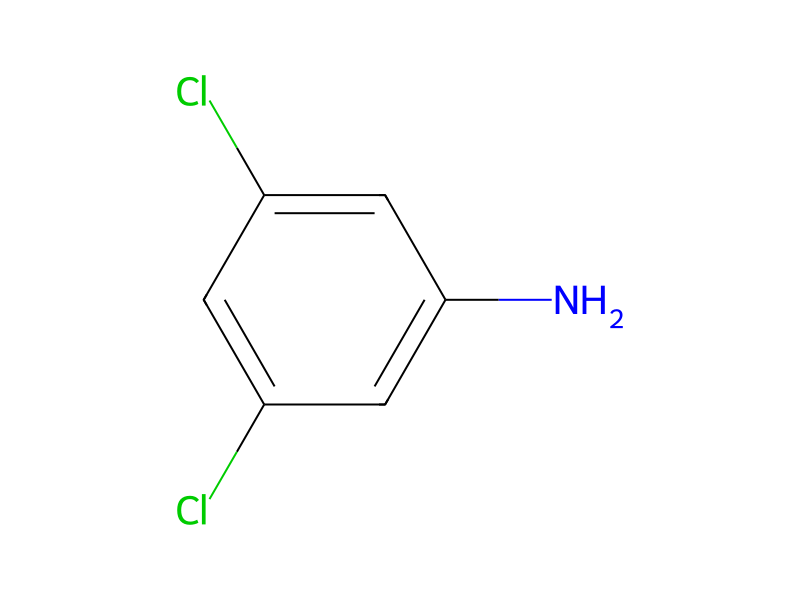
3,5-Dichloroaniline → HCID 12213510, Verbindung
Reaktionsgleichung

ClC1C(Cl)=NC2C(C=1)=CC=CC=2.[NH2:13][C:14]1[CH:19]=[CH:18][CH:17]=[CH:16][CH:15]=1.C(C([O-])=O)#CC([O-])=O.ClC1C=C(C=C(Cl)C=1)N.[C:37]([C:43]([O:45][CH3:46])=[O:44])#[C:38][C:39]([O:41][CH3:42])=[O:40]>>[NH:13](/[C:38](=[CH:37]\[C:43]([O:45][CH3:46])=[O:44])/[C:39]([O:41][CH3:42])=[O:40])[C:14]1[CH:19]=[CH:18][CH:17]=[CH:16][CH:15]=1Komponenten


Versuchsvorschrift
The dichloroquinoline (represented by 4) may be synthesized as described by Heindel, N. D., et al., “CYCLIZATION OF ANILINE-ACETYLENE DICARBOXYLATE ADDUCTS: A MODIFIED CONRAD-LIMPACH METHOD FOR THE SYNTHESIS OF POTENTIAL ANTIMALARIALS,” J. Med. Chem. 11 1218–1221 (1968). 3,5-Dichloroaniline, (1) a dihaloaniline, is refluxed with dimethyl acetylenedicarboxylate to produce substituted diester (3) in approximately 80% yield. Upon heating in diphenyl ether, the fumarate ester under goes cyclization to the quinoline carboxylate (4). The ester (4) can be readily aminated to the tosylamine (5) as described by Harrison, B. L., et al., “4-[(CARBOXYMETHYL)OXYL]-AND 4-[(CARBOXYMETHYL)AMINO]-5,7-DICHLOROQUINOLINE-2-CARBOXYLIC ACID: NEW ANTAGONISTS OF THE STRYCHNINE-INSENSITIVE GLYCINE BINDING SITE ON THE N-METHYL-D-ASPARTATE RECEPTOR COMPLEX,” J. Med. Chem. 33 3130–3132 (1990). The tosylamine (5) was acylated with diphenylcarbamoyl chloride (6), followed by hydrolysis, to form the diphenyl urea derivative (7).
Quellen und Nachweise
- ORD-Eintrag
- ord-979a98b74de0443c8c28fd8f8e97ae8b
- Quelldatensatz
- uspto-grants-2005_11
- Patentnummer
- US06962930B1
Notizen zur Reaktion
Wird geladen…