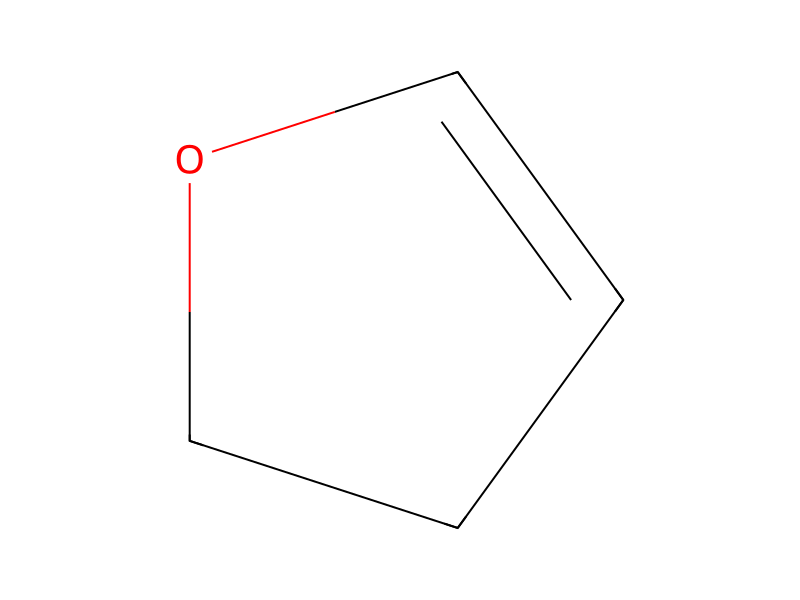
2,3-Dihydrofuran → HCID 12509180, Verbindung
HRID 1065521
Reaktionsgleichung

[O:1]=[C:2]1[NH:7][C:6](=[O:8])[C:5]([C:9]([O:11][CH3:12])=[O:10])=[CH:4][NH:3]1.[O:13]1[CH:17]=[CH:16][CH2:15][CH2:14]1>N1C=CC=CC=1>[O:13]1[CH2:14][CH2:15][CH2:16][CH:17]1[N:3]1[CH:4]=[C:5]([C:9]([O:11][CH3:12])=[O:10])[C:6](=[O:8])[N:7]([CH:14]2[CH2:15][CH2:16][CH2:17][O:13]2)[C:2]1=[O:1]Komponenten
4
Edukt 2

Produkt 1

Reagenzien, Katalysatoren, Lösungsmittel 1

Versuchsvorschrift
In 14 ml. of pyridine are dissolved 3.4 g. (20.0 mmoles) of methyl 1,2,3,4-tetrahydro-2,4-dioxopyrimidine-5-carboxylate and 4.9 g. (70.0 mmoles) of 2,3-dihydrofuran and the solution is heated in a closed reaction vessel at 140° C. for 6 hours. The reaction mixture is then concentrated to dryness under reduced pressure and the residue is dissolved in 30 ml. of chloroform and applied to a column of 68 g. of silica gel. Elution is carried out with 250 ml. of chloroform and the eluate is concentrated to dryness under reduced pressure to give 0.8 g. (yield 12.9%) of methyl 1,3-bis(2-tetrahydrofuryl)-1,2,3,4-tetrahydro-2,4-dioxopyrimidine-5-carboxylate.