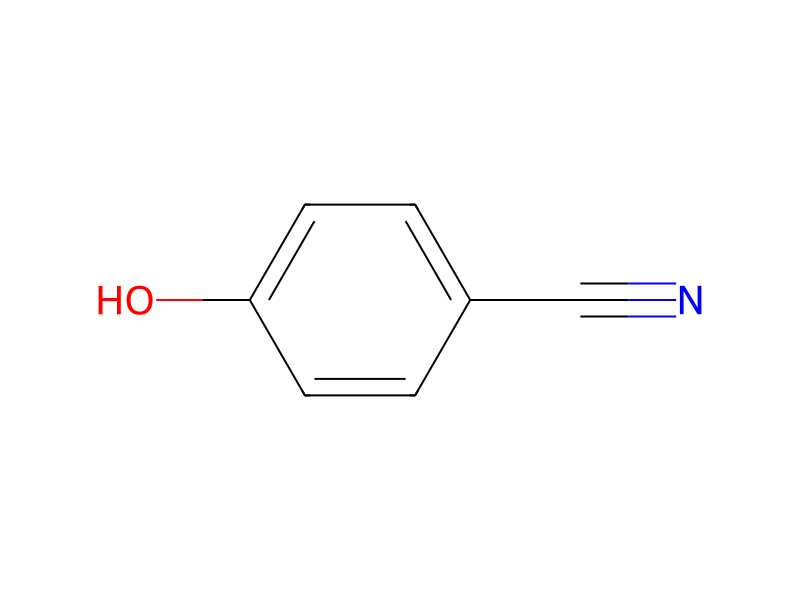
Trichlorofluoromethane → 4-Cyanophenol
HRID 1075421
Reaktionsgleichung

[C:1]([C:3]1[CH:8]=[CH:7][C:6]([OH:9])=[C:5](F)[CH:4]=1)#[N:2].C(C1C=C(F)C(O)=C(F)C=1)#N.C(Cl)(Cl)(Cl)F>>[C:1]([C:3]1[CH:8]=[CH:7][C:6]([OH:9])=[CH:5][CH:4]=1)#[N:2]Komponenten
4


Versuchsvorschrift
A stirred reaction vessel charged with 4-cyanophenol (11.9 g, 0.1 mol) and 96% formic acid (200 cm3) was purged with nitrogen and cooled to 10° C. Fluorine (0.2 mol), diluted with nitrogen to 10%, was passed through the cooled, stirred solution over a period of about 6 hours. The vessel was purged with nitrogen and allowed to warm to ambient temperature. The reaction mixture was poured into water and extracted with diethyl ether. The extracts were dried and the solvent was removed by distillation to leave a tan solid (12.4 g). Short path distillation of the crude product (3.9 g) at reduced pressure gave an off white solid (3.4 g) which was shown to comprise three main compounds by nmr and GC analysis. The mixture was shown to contain 4-cyano-2-fluorophenol (δF -134.7 ppm[d6 -Me2CO]) and 4-cyano-2,6-difluorophenol (δF -131.0 ppm[d6 -Me2CO]) in yields of 64% and 10%, respectively, with a conversion of 84%. (NB The chemical shifts in this and all other examples were relative to CFCl3.)