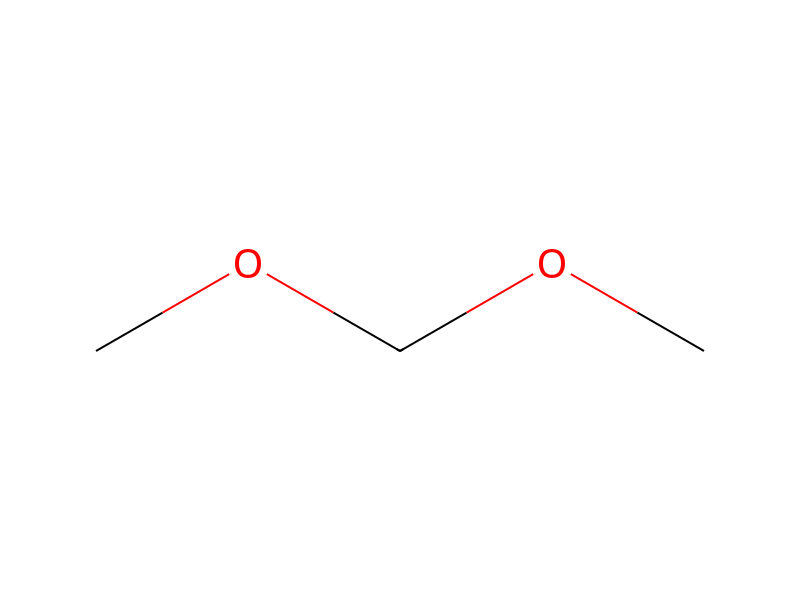
Into a 500-mL round bottom flask equipped with a soxlet and a condensor were placed 2,4-dibromophenol (32.0 g, 0.13 mole), dimethoxymethane (200 mL, 2.26 mole), p-toluenesulfonic acid monohydrate (2.24 g, 12.0 mmol) and CH2Cl2 (200 mL). The soxlet extractor was filled with 3 A and 4 A molecular sieves. The reaction mixture was heated to reflux for 24 h after which time the soxlet extractor was filled with freshly activated sieves. The reaction mixture was heated to reflux for another 24 h. After this period of time, Et3N (10 mL) was added. The reaction mixture was stirred for 5 mn, and concentrated to dryness. The residue was dissolved in CH2Cl2 (400 mL) and the resulting solution was washed with 5% NaOH (400 mL), H2O (400 mL), dried over Na2SO4, and concentrated in vacuo. The crude product was purified by flash chromatography (hexanes/EtOAc; 6:1) to yield 2,4-Dibromo-1-methoxymethoxybenzene [9](32.9 g, 88%) as a light yellow oil; 1H NMR (CDCl3, 300 MHz) δ7.67 [s, ArH(3)], 7.33 [d, J=8.7 Hz, ArH(5)], 7.02 [d, J=8.7 Hz, ArH(6)], 5.21 [s, OCH2OCH3 ], and 3.49 [s, OCH3 ]; LRMS (EI) m/z 298 (M+, 3), 296 (M+, 5), 294 (M+, 3), and 45 (100)