Reaktionsgleichung

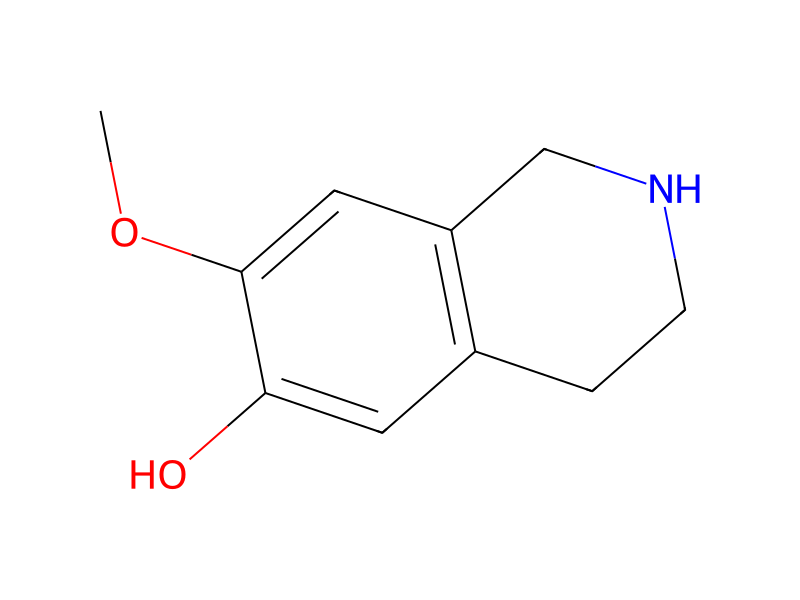
[OH:1][C:2]1[CH:3]=[C:4]2[C:9](=[CH:10][C:11]=1[O:12]C)[CH2:8][NH:7][CH2:6][CH2:5]2.[Si:14](Cl)([C:17]([CH3:20])([CH3:19])[CH3:18])([CH3:16])[CH3:15].N1C=CC=C[CH:23]=1>>[CH3:18][C:17]([Si:14]([CH3:16])([CH3:15])[O:12][C:11]1[CH:10]=[C:9]2[C:4]([CH2:5][CH2:6][NH:7][CH2:8]2)=[CH:3][C:2]=1[O:1][CH3:23])([CH3:20])[CH3:19]Komponenten
4



Versuchsvorschrift
To a solution of 19.2 g of 6-hydroxy-7-methoxy-1,2,3,4-tetrahydroisoquinoline in 425 mL of pyridine is added 48.4 g of t-butyl-dimethylsilylchloride and 0.5 g of 4-N,N-dimethylaminopyridine. The solution is heated to reflux for 3.5 hours and the volatiles removed at 70° C. by distillation. The residue is partitioned between aqueous potassium bicarbonate and ethyl acetate. The organic layer is washed with water, dried (magnesium sulfate) and the volatiles removed in vacuo. The residue is suspended in diethyl ether, filtered and washed with hexane. The filtrate is evaporated and the residue distilled via Kugelrohr at 150 mm and 120°-130° C. to afford 26.2 g of the desired product as a colorless oil.
Aufarbeitung
- temperatureThe solution is heated
- temperatureto reflux for 3.5 hours
- customthe volatiles removed at 70° C. by distillation
- customThe residue is partitioned between aqueous potassium bicarbonate and ethyl acetate
- washThe organic layer is washed with water
- dry with materialdried (magnesium sulfate)
- customthe volatiles removed in vacuo
- filtrationfiltered
- washwashed with hexane
- customThe filtrate is evaporated
- distillationthe residue distilled via Kugelrohr at 150 mm and 120°-130° C.
Quellen und Nachweise
- ORD-Eintrag
- ord-c635290f2f514f71939fc5929559abd1
- Quelldatensatz
- uspto-grants-1996_08
- Patentnummer
- US05550149
Verknüpfte Notizen
Wird geladen…