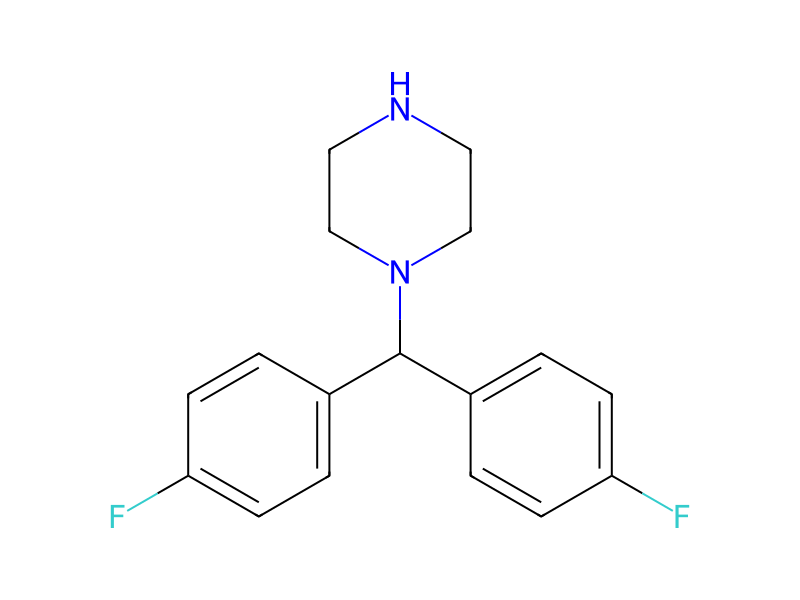
[F:1][C:2]1[CH:7]=[CH:6][C:5]([CH:8]([C:15]2[CH:20]=[CH:19][C:18]([F:21])=[CH:17][CH:16]=2)[N:9]2[CH2:14][CH2:13][NH:12][CH2:11][CH2:10]2)=[CH:4][CH:3]=1.[C:22]1([NH:32][C:33](=[O:36])[CH2:34]Cl)[C:31]2[C:26](=[CH:27][CH:28]=[CH:29][CH:30]=2)[CH:25]=[CH:24][CH:23]=1.C(=O)([O-])[O-].[K+].[K+]>O1CCCC1.CN(C)C=O.C(OCC)(=O)C>[F:21][C:18]1[CH:19]=[CH:20][C:15]([CH:8]([C:5]2[CH:4]=[CH:3][C:2]([F:1])=[CH:7][CH:6]=2)[N:9]2[CH2:10][CH2:11][N:12]([CH2:34][C:33](=[O:36])[NH:32][C:22]3[C:31]4[C:26](=[CH:27][CH:28]=[CH:29][CH:30]=4)[CH:25]=[CH:24][CH:23]=3)[CH2:13][CH2:14]2)=[CH:16][CH:17]=1A mixture of 290 mg of 1-[bis(4-fluorophenyl)methyl]piperazine and 400 mg of N-(1-naphthyl)chloroacetamide was dissolved in 10 ml of a 1:1 by volume mixture of tetrahydrofuran and N,N-dimethylformamide. 1.2 g of anhydrous potassium carbonate were then added to the solution, after which the reaction mixture was stirred for 15 hours at 25° C. and then diluted with ethyl acetate. The organic layer was washed three times with water and then dried over anhydrous magnesium sulfate. The solvent was evaporated off under reduced pressure. The residue was subjected to silica gel thin layer chromatography using a 1:1 by volume mixture of cyclohexane and ethyl acetate as the developing solvent, to afford 430 mg of 1-[bis(4-fluorophenyl)methyl]4-(1-naphthylcarbamoylmethyl)piperazine, melting at 173° C.