Reaktionsgleichung

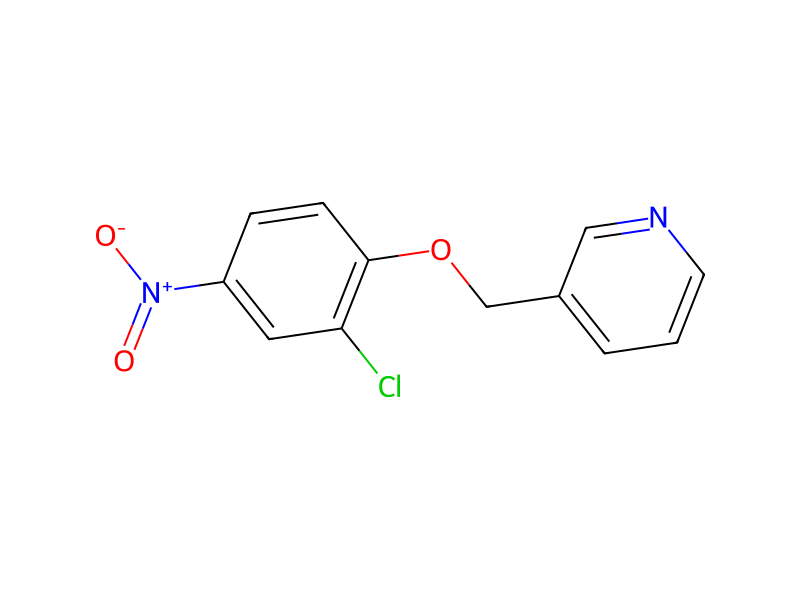
Br[CH2:2][C:3]1[CH:4]=[N:5][CH:6]=[CH:7][CH:8]=1.ClC1C=CC(CBr)=NC=1.[Cl:18][C:19]1[CH:24]=[C:23]([N+:25]([O-:27])=[O:26])[CH:22]=[CH:21][C:20]=1[OH:28]>>[Cl:18][C:19]1[CH:24]=[C:23]([N+:25]([O-:27])=[O:26])[CH:22]=[CH:21][C:20]=1[O:28][CH2:2][C:3]1[CH:4]=[N:5][CH:6]=[CH:7][CH:8]=1Komponenten
4


Versuchsvorschrift
In like manner, each of 3-bromomethylpyridine and 5-chloro-2-bromomethylpyridine is reacted with 2-chloro-4-nitrophenol to give 3-(2-chloro-4-nitrophenoxy)methylpyridine and 5-chloro-2-(2-4-nitrophenoxy)methylpyridine, respectively, each of which is reduced. The resulting 3-(2-chloro-4-aminophenoxy)methylpyridine and 5-chloro-2-(2-chloro-4-aminophenoxy)methylpyridine is each reacted with 3,4,5,6-tetrahydrophthalic anhydride to yield, respectively, N-3-chloro-4-(3-pyridylmethoxy)phenyl-3,4,5,6-tetrahydrophthalimide and N-3-chloro-4-[2-(5-chloropyridyl)methoxy]phenyl-3,4,5,6-tetrahydrophthalmide.
Quellen und Nachweise
- ORD-Eintrag
- ord-cd16385667e441d6b19b35031ba2a912
- Quelldatensatz
- uspto-grants-1982_06
- Patentnummer
- US04332944
Verknüpfte Notizen
Wird geladen…