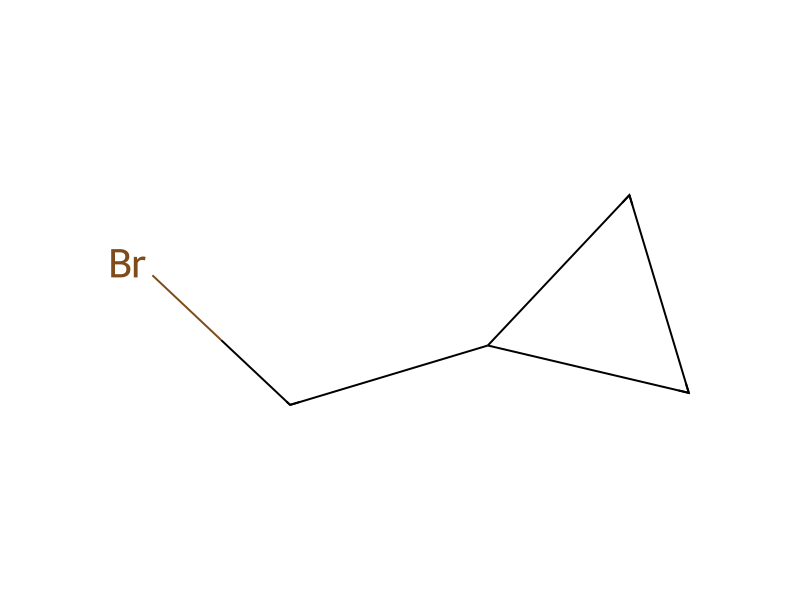
[Br:1][C:2]1[CH:3]=[C:4]([CH2:10][C:11]([O:13][CH2:14][CH3:15])=[O:12])[CH:5]=[C:6]([Cl:9])[C:7]=1[OH:8].C([O-])([O-])=O.[K+].[K+].[CH:22]1([CH2:25]Br)[CH2:24][CH2:23]1>CS(C)=O>[Br:1][C:2]1[CH:3]=[C:4]([CH2:10][C:11]([O:13][CH2:14][CH3:15])=[O:12])[CH:5]=[C:6]([Cl:9])[C:7]=1[O:8][CH2:25][CH:22]1[CH2:24][CH2:23]1To a stirred solution of ethyl 2-(3-bromo-5-chloro-4-hydroxyphenyl)acetate (4 g, 0.011 mol) and K2CO3 (2.8 g, 0.02 mol) in 100 ml of DMSO was slowly added cyclopropyl methylbromide (1.46 ml, 0.017 mol) at room temperature. Upon completion of the addition, the reaction mixture was heated at 60° C. for 4 h. Upon completion of the reaction, the mixture was poured onto water and extracted with EtOAc (×2). The combined organic layers were washed with water, dried over Na2SO4, filtered and concentrated in vacuo to give ethyl 2-(3-bromo-5-chloro-4-(cyclopropylmethoxy)phenyl)acetate in 72% yield. (93.4 g). 1HNMR (CDCl3): 7.38 (bs, 1H); 7.28 (s, 1H); 4.16 (q, 2H); 3.87 (d, 2H); 3.58 (s, 2H); 1.38 (m, 1H); 1.28 (t, 3H); 0.63 (m, 2H); 0.38 (m, 2H).
Wird geladen…