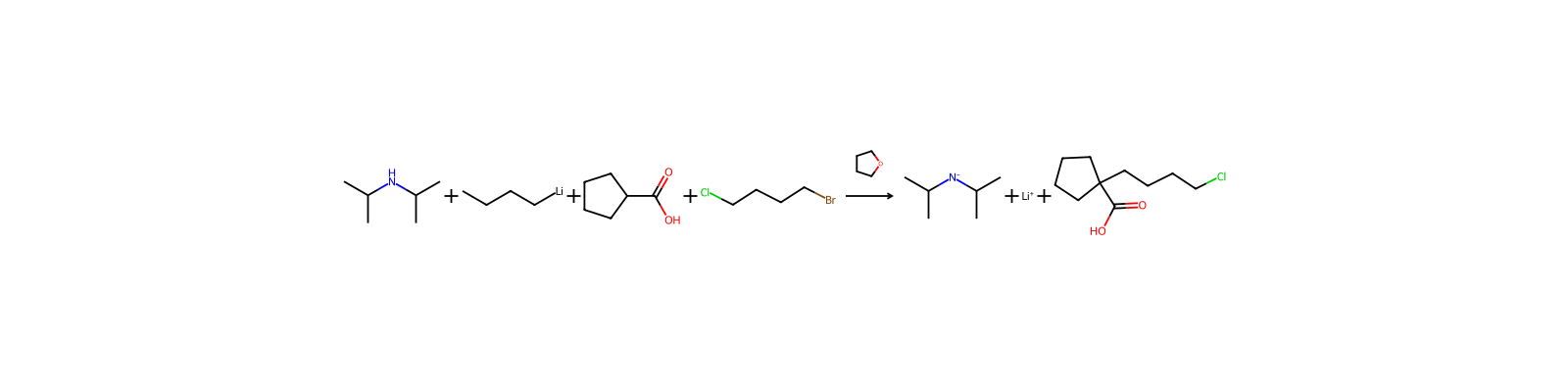
Beteiligte Stoffe
| Rolle | Name | HCID | Einwaage |
|---|
| Edukt | Diisopropylamine | HCID 7912 | — |
| Edukt | Cyclopentanecarboxylic acid | HCID 18840 | — |
| Edukt | 1-Bromo-4-chlorobutane | HCID 81364 | — |
| Edukt | Butyllithium | HCID 178418339 | — |
| Lösungsmittel | Tetrahydrofuran | HCID 8028 | — |
| Produkt | Lithium diisopropylamide | HCID 2724682 | — |
| Produkt | 1-(4-Chlorobutyl)cyclopentanecarboxylic acid | HCID 22633539 | — |
Reaktionsschritte
A solution of lithium diisopropylamide was prepared under nitrogen from diisopropylamine (31.0 ml., 220 mmol.) and n-butyl lithium (1.5M in hexane, 88.0 ml., 220 mmol.) in tetrahydrofuran (80 ml.), maintaining the temperature between -3° C. -1° C. After stirring 15 minutes, cyclopentanecarboxylic acid (11.4 g., 100 mmol.) in tetrahydrofuran (10 ml.) was added at 0° C.-3° C. over 25 minutes. After an additional 15 minutes at 0° C., the bath was removed and the reaction stirred 15 minutes more, causing the temperature to rise to 11° C. The milky white solution was cooled to -74° C. and 1-bromo-4-chlorobutane (23 ml., 200 mmol.) in tetrahydrofuran was added quickly, the temperature rising to -66° C. After 16 hours, the reaction was allowed to warm to room temperature in situ. The reaction was quenched with methanol (10 ml.) and concentrated in vacuo. The residue was partitioned between water (200 ml.) and ethyl ether (200 ml.). The aqueous layer was acidified to pH 1 with 12M hydrochloric acid and extracted with methylene chloride (3×150 ml.), dried (magnesium sulfate), filtered and evaporated to give 20.0 g. of the title product as a yellow oil.
Herkunft & Nachweise
| DOI | 10.6084/m9.figshare.5104873.v1 |
|---|
| Patentnummer | US05723457 |
|---|
| Quelldatensatz | uspto-grants-1998_03 |
|---|
| ORD ID | ord-6701048b9aed462d813326f7541d1d53 |
|---|
| Quellennotiz | uspto-grants-1998_03 |
|---|