Reaktionsgleichung
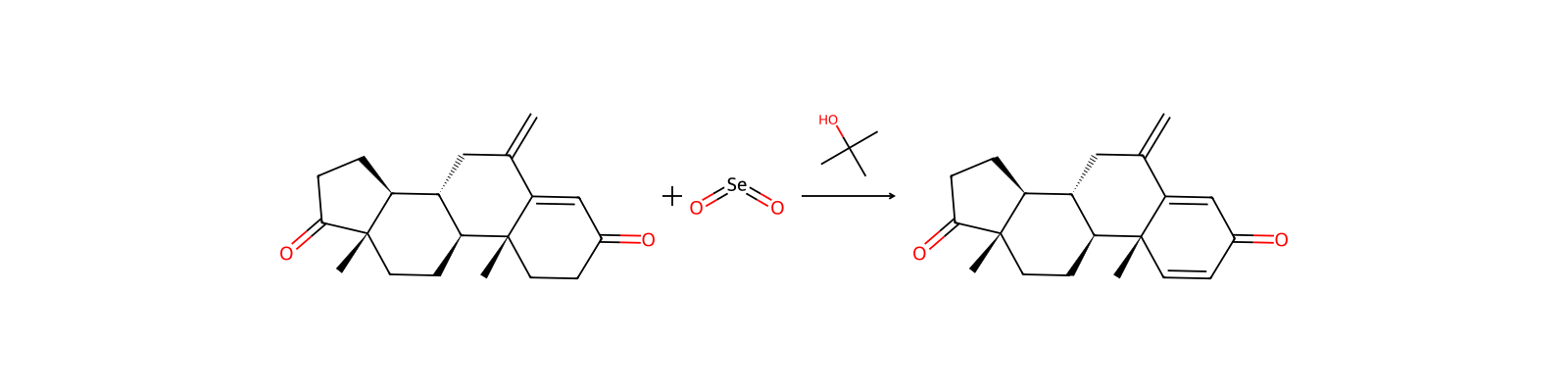
[CH2:1]=[C:2]1[C:19]2[C@:14]([CH3:21])([CH2:15][CH2:16][C:17](=[O:20])[CH:18]=2)[C@@H:13]2[C@H:4]([C@H:5]3[C@@:9]([CH2:11][CH2:12]2)([CH3:10])[C:8](=[O:22])[CH2:7][CH2:6]3)[CH2:3]1.[Se](=O)=O>C(O)(C)(C)C>[CH2:1]=[C:2]1[C:19]2[C@:14]([CH3:21])([CH:15]=[CH:16][C:17](=[O:20])[CH:18]=2)[C@@H:13]2[C@H:4]([C@H:5]3[C@@:9]([CH2:11][CH2:12]2)([CH3:10])[C:8](=[O:22])[CH2:7][CH2:6]3)[CH2:3]1Komponenten
4
Edukt 2


Produkt 1

Reagenzien, Katalysatoren, Lösungsmittel 1

Versuchsvorschrift
A mixture of 6-methylenandrost-4-ene-3,17-dione (0.50 g), selenium dioxide (0.50 g) and t-butylalcohol (200 ml) was heated to reflux under nitrogen for about 30 hours. The cooled solution was filtered and then evaporated to dryness under reduced pressure. The residue was taken up in ethyl acetate (100 ml), treated with charcoal and washed consecutively with water, ammonium sulfide solution, cold 17% ammonium hydroxide, cold dilute hydrochloric acid, water, dried with sodium sulfate and finally evaporated to dryness. The crude product was chromatographed as described in example 1 to yield 0.20 g of pure 6-methylenandrosta-1,4-diene-3,17-dione, m.p. 188°-191° C.
Aufarbeitung
- temperaturewas heated
- temperatureto reflux under nitrogen for about 30 hours
- filtrationThe cooled solution was filtered
- customevaporated to dryness under reduced pressure
- additiontreated with charcoal
- washwashed consecutively with water, ammonium sulfide solution, cold 17% ammonium hydroxide, cold dilute hydrochloric acid, water
- dry with materialdried with sodium sulfate
- customfinally evaporated to dryness
- customThe crude product was chromatographed
Quellen und Nachweise
- ORD-Eintrag
- ord-90ef8924fd2e4f759fb0ef37bff637d9
- Quelldatensatz
- uspto-grants-1990_02
- Patentnummer
- US04904650
Verknüpfte Notizen
Wird geladen…