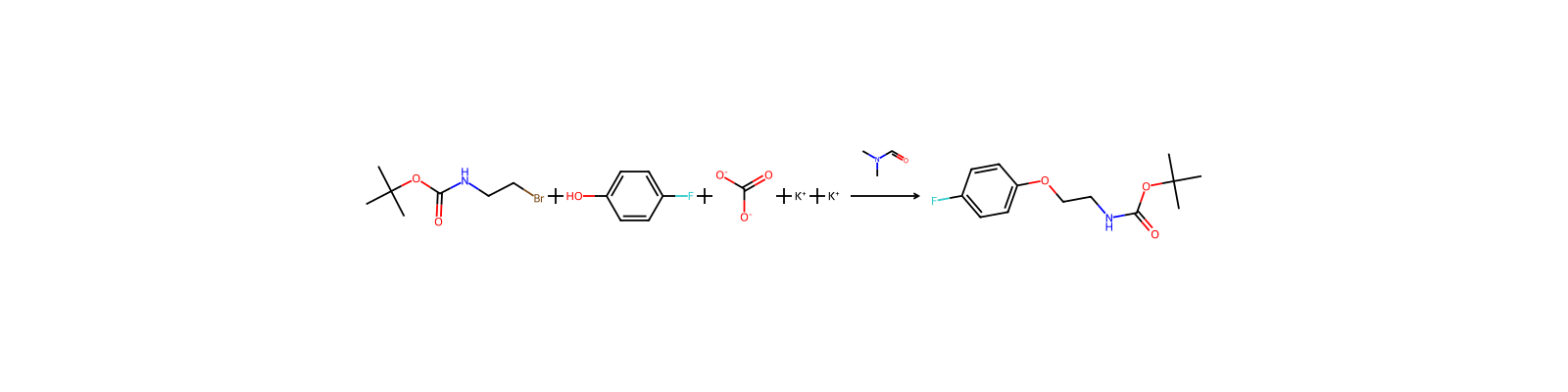
Br[CH2:2][CH2:3][NH:4][C:5](=[O:11])[O:6][C:7]([CH3:10])([CH3:9])[CH3:8].[F:12][C:13]1[CH:18]=[CH:17][C:16]([OH:19])=[CH:15][CH:14]=1.C(=O)([O-])[O-].[K+].[K+]>CN(C=O)C>[F:12][C:13]1[CH:18]=[CH:17][C:16]([O:19][CH2:2][CH2:3][NH:4][C:5](=[O:11])[O:6][C:7]([CH3:10])([CH3:9])[CH3:8])=[CH:15][CH:14]=1To the crude product (700 mg) of t-butyl 2-bromoethylcarbamate obtained in Step 1 were added 4-fluorophenol (875 mg), potassium carbonate (1.08 g) and DMF (7 ml), and the mixture was stirred overnight at 90° C. The solvent was evaporated, and the mixture was diluted with ethyl acetate. After washing with water, the organic layer was dried over anhydrous sodium sulfate, and the solvent was evaporated. The obtained crude product was purified by silica gel chromatography (ethyl acetate-hexane) to give t-butyl 2-(4-fluorophenoxy)ethylcarbamate (390 mg).
Wird geladen…