Reaktionsgleichung

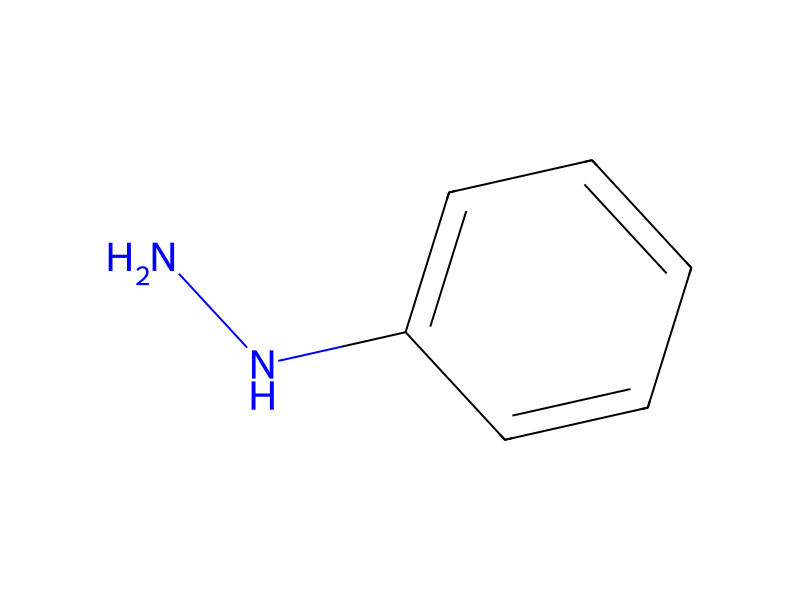
[C:1]1([NH:7][NH2:8])[CH:6]=[CH:5][CH:4]=[CH:3][CH:2]=1.C(N(CC)CC)C.[S:16]([C:20]1[CH:21]=[C:22]([CH:26]=[CH:27][C:28]=1[Cl:29])[C:23](Cl)=[O:24])(=[O:19])(=[O:18])[NH2:17]>COCCOC>[C:1]1([NH:7][NH:8][C:23](=[O:24])[C:22]2[CH:26]=[CH:27][C:28]([Cl:29])=[C:20]([S:16](=[O:18])(=[O:19])[NH2:17])[CH:21]=2)[CH:6]=[CH:5][CH:4]=[CH:3][CH:2]=1Komponenten
Edukt 3


Produkt 1

Reagenzien, Katalysatoren, Lösungsmittel 1

Versuchsvorschrift
In a 1 liter round bottom flask were placed phenyl hydrazine (54.1 g, 0.5 mol), triethylamine (50.5 g, 0.5 mol), and 150 ml of 1,2 dimethoxyethane. Then the mixture was cooled to ice-bath temperature and with good stirring and over 10 minutes a solution of 3-sulfamoyl-4-chlorobenzoyl chloride 97.1% (61 g, 0.24 mol) in 150 ml 1,2 dimethoxyethane was added dropwise. The reaction was permitted to reach ambient temperature. After standing for 6 days the solvent was evaporated under vacuum and the residue taken up in 500 ml of ethyl acetate. The organic phase was washed twice with 2N H2SO4, with water and finally with 1 molar sodium bicarbonate solution. The ethyl acetate phase was separated and dried with magnesium sulfate, clarified and concentrated to crystallization. 35 g of product mp 189°-190° C. were obtained.
Aufarbeitung
- customIn a 1 liter round bottom flask were placed
- temperatureThen the mixture was cooled to ice-bath temperature
- additionwas added dropwise
- customto reach ambient temperature
- customthe solvent was evaporated under vacuum
- washThe organic phase was washed twice with 2N H2SO4, with water and finally with 1 molar sodium bicarbonate solution
- customThe ethyl acetate phase was separated
- dry with materialdried with magnesium sulfate
- concentrationconcentrated to crystallization
Quellen und Nachweise
- ORD-Eintrag
- ord-7357454cce0446c4b47ae203adce1400
- Quelldatensatz
- uspto-grants-1981_03
- Patentnummer
- US04258059
Verknüpfte Notizen
Wird geladen…