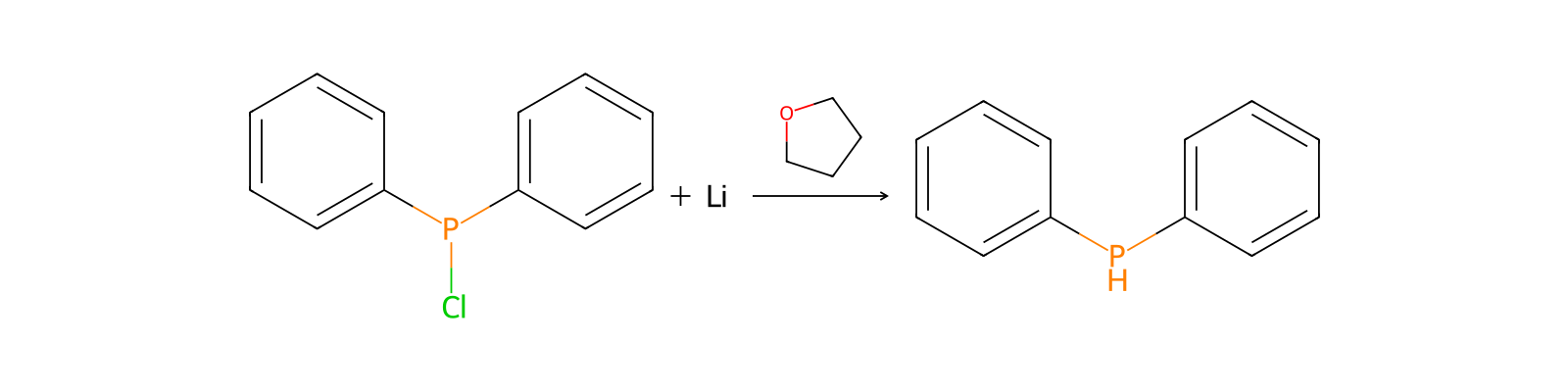
Beteiligte Stoffe
| Rolle | Name | HCID | Einwaage |
|---|
| Edukt | Chlorodiphenylphosphine | HCID 66180 | — |
| Edukt | Lithium | HCID 3028194 | — |
| Lösungsmittel | Tetrahydrofuran | HCID 8028 | — |
| Produkt | Diphenylphosphine | HCID 70017 | — |
Reaktionsschritte
A THF solution (150 ml) containing chlorodiphenylphosphine (60 g, 0.34 mole) was added dropwise from a dropping flask, and under nitrogen atmosphere to a stirred THF (75 ml) suspension of lithium metal (5 g, 0.7 moles) in a 500 ml round bottom flask. Formation of lithiodiphenylphosphide was indicated by the appearance of a bright red color. After stirring 18 hours, unreacted lithium was removed and the solution was added slowly to a rapidly stirred THF slurry of the brominated resin beads (32 g, 35 percent Br, 131.3 mmol Br). This slurry was allowed to stir two days under nitrogen (longer if high percent Br content resin used). The slurry was then hydrolyzed by adding it to two liters of nitrogen-saturated acetone/water (3:1) and stirring for one hour. The beads were then filtered and washed by stirring successively in one liter each of the following nitrogen-saturated solvents: water (2 hours), acetone (2 hours), benzene/methanol (9:1) (18-24 hours), and methanol (4-5 hours). The beads were then vacuum dried (80° C., 0.05 torr) for 24 hours, and analyzed for 6.44 percent P which corresponds to 35.0 percent of the polystyryl rings substituted with the diphenylphosphide moiety.
Herkunft & Nachweise
| DOI | 10.6084/m9.figshare.5104873.v1 |
|---|
| Patentnummer | US04258206 |
|---|
| Quelldatensatz | uspto-grants-1981_03 |
|---|
| ORD ID | ord-74a4e650899e4eea8e3cf265b74afb8c |
|---|
| Quellennotiz | uspto-grants-1981_03 |
|---|