StartseiteMCPWorkbenchSkills
StartseiteWorkbenchBenachrichtigungenMein Bereich
llms.txt · MCP-AnleitungDatenschutz · Nutzungsbedingungen · Supportv1.8.3
  1. Startseite
  2. /Reaktion

Isopropyl iodide → 3-Isopropyl-7H-pyrrolo[2,3-d]pyrimidin-4(3H)-one

HRID 1291236
Drucken

Reaktionsgleichung

Reaktionsgleichung von HRID 1291236
[N:1]1[C:6]2[NH:7][CH:8]=[CH:9][C:5]=2[C:4](=[O:10])[NH:3][CH:2]=1.C(=O)([O-])[O-].[K+].[K+].[CH:17](I)([CH3:19])[CH3:18]>CN(C=O)C>[CH:17]([N:3]1[C:4](=[O:10])[C:5]2[CH:9]=[CH:8][NH:7][C:6]=2[N:1]=[CH:2]1)([CH3:19])[CH3:18]
KomponentenReaktionsbedingungenVersuchsvorschriftAufarbeitungQuellen und NachweiseNotizen zur Reaktion

Komponenten

5

Edukt 3

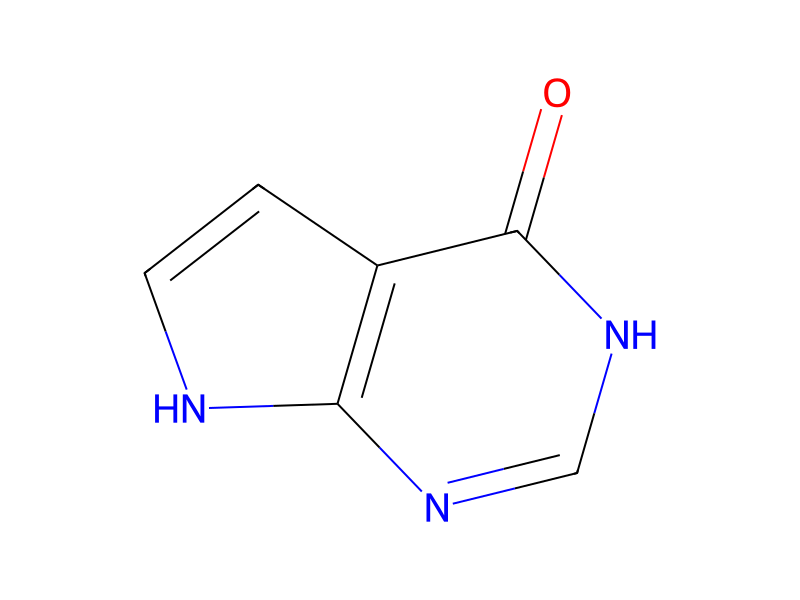
HCID 6362Isopropyl iodideHCID 11430Potassium CarbonateHCID 1354086897-Deazahypoxanthine

Produkt 1

HCID 189190403-Isopropyl-7H-pyrrolo[2,3-d]pyrimidin-4(3H)-one

Reagenzien, Katalysatoren, Lösungsmittel 1

HCID 6228DimethylformamideLösungsmittel

Reaktionsbedingungen

Temperatur
55 °C

Versuchsvorschrift

Under argon gas, 7H-pyrrolo[2,3-d]pyrimidin-4(3H)-one (1.0 g) was dissolved in DMF (35 ml) with warming. Then, anhydrous potassium carbonate (1.02 g) and isopropyl iodide (1.1 ml) were added and the mixture was stirred at 55° C. for 13 hours. The insoluble matter was filtered off and the solvent was distilled off under reduced pressure. The residue was purified by flash column chromatography (silica gel; hexane: ethyl acetate=4:1→1:1) to provide the title compound (110 mg). 1 H-NMR (CDCl3) δ: 1.48(6H,d,J=7.OHz), 5.31(1H,m), 6.74(1H,dd,J=2.2&3.4Hz), 6.96(1H,dd,J=2.2&3.4Hz), 7.95(1H,s), 9.20(1H,brs).

Aufarbeitung

  1. temperaturewith warming
  2. filtrationThe insoluble matter was filtered off
  3. distillationthe solvent was distilled off under reduced pressure
  4. customThe residue was purified by flash column chromatography (silica gel; hexane: ethyl acetate=4:1→1:1)

Quellen und Nachweise

ORD-Eintrag
ord-8f2a1c06a491442d8d9ac05223c6c2ad
Quelldatensatz
uspto-grants-1998_05
DOI
10.6084/m9.figshare.5104873.v1
Patentnummer
US05753664

Notizen zur Reaktion

Auf dieser SeiteKomponentenReaktionsbedingungenVersuchsvorschriftAufarbeitungQuellen und NachweiseNotizen zur Reaktion