Reaktionsgleichung

Br[C:2]1[CH:7]=[CH:6][C:5]([C:8]2[CH:13]=[CH:12][C:11]([N:14]3[CH2:18][CH2:17][C@@H:16]4[CH2:19][N:20]([CH3:22])[CH2:21][C@H:15]34)=[CH:10][CH:9]=2)=[CH:4][CH:3]=1.[N:23]1[NH:24][C:25](=[O:29])[CH:26]=[CH:27][CH:28]=1.C(=O)([O-])[O-].[K+].[K+]>N1C2C(=CC=CC=2)C=CC=1.CCCCCC.[Cu]>[CH3:22][N:20]1[CH2:19][C@@H:16]2[C@@H:15]([N:14]([C:11]3[CH:12]=[CH:13][C:8]([C:5]4[CH:6]=[CH:7][C:2]([N:24]5[C:25](=[O:29])[CH:26]=[CH:27][CH:28]=[N:23]5)=[CH:3][CH:4]=4)=[CH:9][CH:10]=3)[CH2:18][CH2:17]2)[CH2:21]1Komponenten
Edukt 3

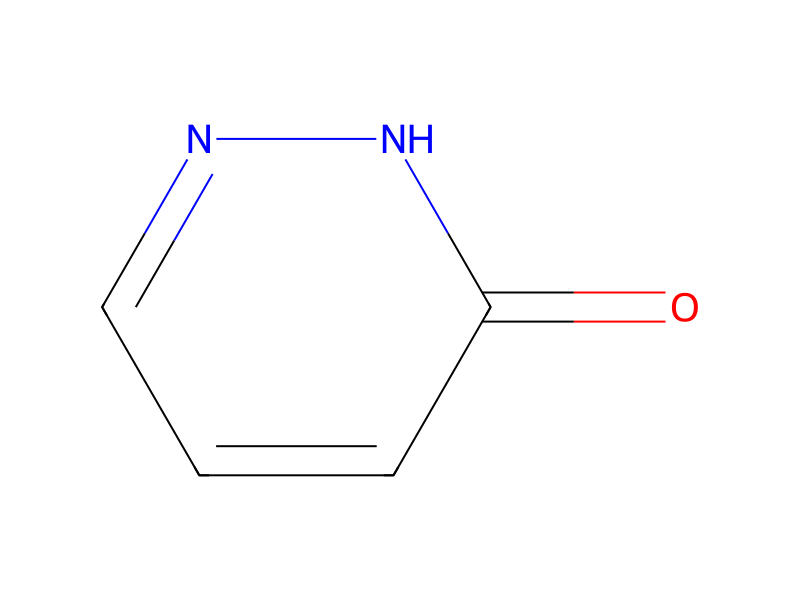

Produkt 1

Reagenzien, Katalysatoren, Lösungsmittel 3



Reaktionsbedingungen
- Temperatur
- 150 °C
Versuchsvorschrift
The product of Example 41A (4.54 g, 12.6 mmole), 3(2H)-pyridazinone (2.41 g, 25.2 mmole), copper powder (1.60 g, 25.2 mmole) and potassium carbonate (5.21 g, 37.7 mmole) were dissolved in 63 ml of quinoline and heated at 150° C. under N2 for 48 hours. The mixture was cooled to room temperature, diluted with hexane (15 ml) and filtered through CELITE®. The filtrate was concentrated under reduced pressure and the residue was purified by chromatography (eluting first with diethyl ether, followed by dichloromethane, then elution with a mixture of 5% methanol in dichloromethane) to provide the title compound. 1H NMR (300 MHz, CDCl3) δ ppm 7.91 (dd, J=3.73, 1.70 Hz, 1H) 7.61-7.65 (m, 4H) 7.51(d, J=8.48 Hz, 2H) 7.25 (dd, dd, J=9.40, 4.07 Hz, 1H) 7.07 (dd, J=9.49, 1.70 Hz, 1H) 6.64 (d, J=8.81 Hz, 2H) 4.19-4.27 (m, 1H) 3.54-3.64 (m, 1H) 3.28-3.38 (m, 1H) 3.00-3.11 (m, 1H) 2.56-2.85 (m, 4H) 2.40 (s, 3H) 2.10-2.29 (m, 1H) 1.89-2.05 (m, J=6.78 Hz, 1H); MS (M+H)+=373. The solid (3aR,6aR)-2-[4′-(5-methyl-hexahydro-pyrrolo[3,4-b]pyrrol-1-yl)-biphenyl-4-yl]-2H-pyridazin-3-one obtained showed a melting range of 204-207° C. (dec.). To a solution of (3aR,6aR)-2-[4′-(5-methyl-hexahydro-pyrrolo[3,4-b]pyrrol-1-yl)-biphenyl-4-yl]-2H-pyridazin-3-one in methanol was added D-(−)-tartaric acid; a solid formed which was collected by filtration and dried to give a solid of m.p. 218-221° C. In like manner, a methanolic solution of (3aR,6aR)-2-[4′-(5-methyl-hexahydro-pyrrolo[3,4-b]pyrrol-1-yl)-biphenyl-4-yl]-2H-pyridazin-3-when treated with L-(+)-tartaric acid, followed by concentration of the solution and addition of diethyl ether, gave a solid of map 206-209° C. A methanolic solution of (3aR,6aR)-2-[4′-(5-methyl-hexahydro-pyrrolo[3,4-b]pyrrol-1-yl)-biphenyl-4-yl]-2H-pyridazin-3—when treated with phosphoric acid, followed by concentration of the solution, gave a solid of m.p. 224-229° C. A methanolic solution of (3aR,6aR)-2-[4′-(5-methyl-hexahydro-pyrrolo[3,4-b]pyrrol-1-yl)-biphenyl-4-yl]-2H-pyridazin-3—when treated with salicylic acid, followed by concentration of the solution and addition of diethyl ether and hexane, gave a solid of m p. 115-118° C. A methanolic solution of (3aR,6aR)-2-[4′-(5-methyl-hexahydro-pyrrolo[3,4-b]pyrrol-1-yl)-biphenyl-4-yl]-2H-pyridazin-3—when treated with ascorbic acid, followed by concentration of the solution and addition of diethyl ether and hexane, gave a solid of m.p. 163-167° C. A methanolic solution of (3aR,6aR)-2-[4′-(5-methyl-hexahydro-pyrrolo[3,4-b]pyrrol-1-yl)-biphenyl-4-yl]-2H-pyridazin-3—when treated with sulfuric acid, followed by concentration of the solution and addition of diethyl ether, gave a solid of m.p. 232-235° C.
Aufarbeitung
- temperatureThe mixture was cooled to room temperature
- filtrationfiltered through CELITE®
- concentrationThe filtrate was concentrated under reduced pressure
- customthe residue was purified by chromatography (
- washeluting first with diethyl ether
- washelution
- additionwith a mixture of 5% methanol in dichloromethane)
Quellen und Nachweise
- ORD-Eintrag
- ord-c2d237df271148789358f564549bc866
- Quelldatensatz
- uspto-grants-2010_06
- Patentnummer
- US07728031B2
Verknüpfte Notizen
Wird geladen…