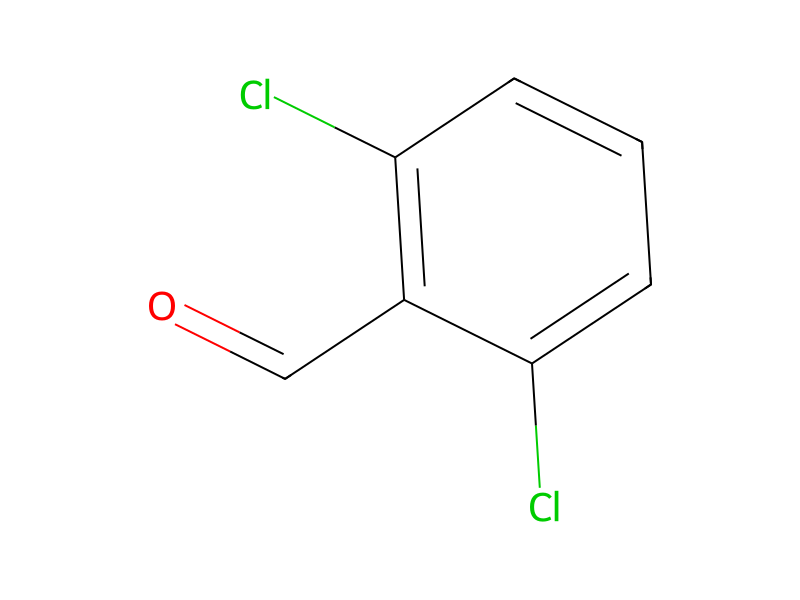
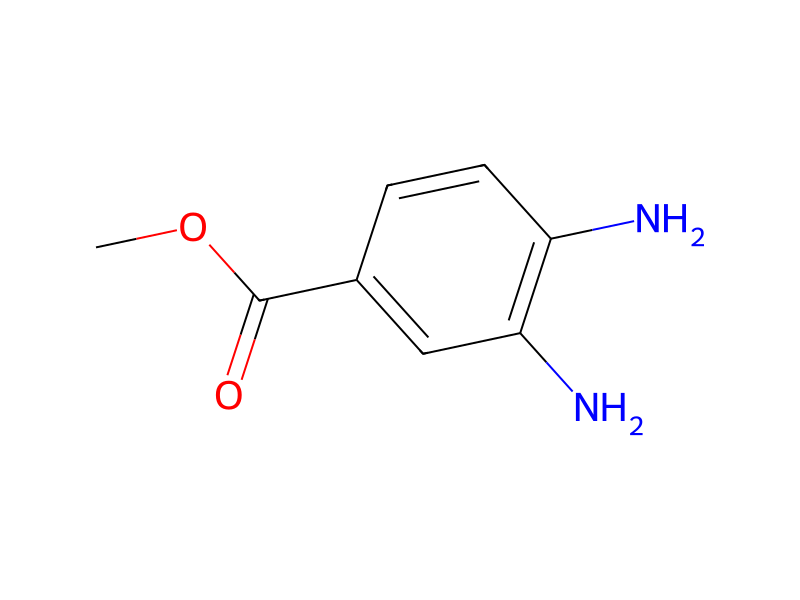
[Cl:1][C:2]1[CH:9]=[CH:8][CH:7]=[C:6]([Cl:10])[C:3]=1[CH:4]=O.[CH3:11][O:12][C:13](=[O:22])[C:14]1[CH:19]=[CH:18][C:17]([NH2:20])=[C:16]([NH2:21])[CH:15]=1>CS(C)=O.CCOC(C)=O>[CH3:11][O:12][C:13]([C:14]1[CH:19]=[CH:18][C:17]2[N:20]=[C:4]([C:3]3[C:2]([Cl:1])=[CH:9][CH:8]=[CH:7][C:6]=3[Cl:10])[NH:21][C:16]=2[CH:15]=1)=[O:22]Slowly add a solution of FeCl3 (1.46 g, 9.02 mmol) in DMSO (10 mL) to a stirring solution of 2,6-dichloro-benzaldehyde (5.27 g, 30.1 mmol) and 3,4-diamino-benzoic acid methyl ester (5.00 g, 30.1 mmol) in DMSO (90 mL). Allow the reaction to stir open to the air for 17 hr. Add additional FeCl3 (0.73 g, 4.51 mmol). Stir for an additional 24 hr. Dilute with EtOAc (600 mL) and extract with water (3×50 mL). Dry the organic phase over Na2SO4 and evaporate the solvent. Triturate the residue with DCM to afford the desired product as a light tan solid: 1H NMR (400 MHz, MeOD) δ ppm 3.96 (s, 3H) 7.55-7.63 (m, 3H) 7.71 (d, J=8.21 Hz, 1H) 8.04 (dd, J=8.53, 1.58 Hz, 1H) 8.37 (br. s., 1H); (M+H)+ 320.9.
Wird geladen…