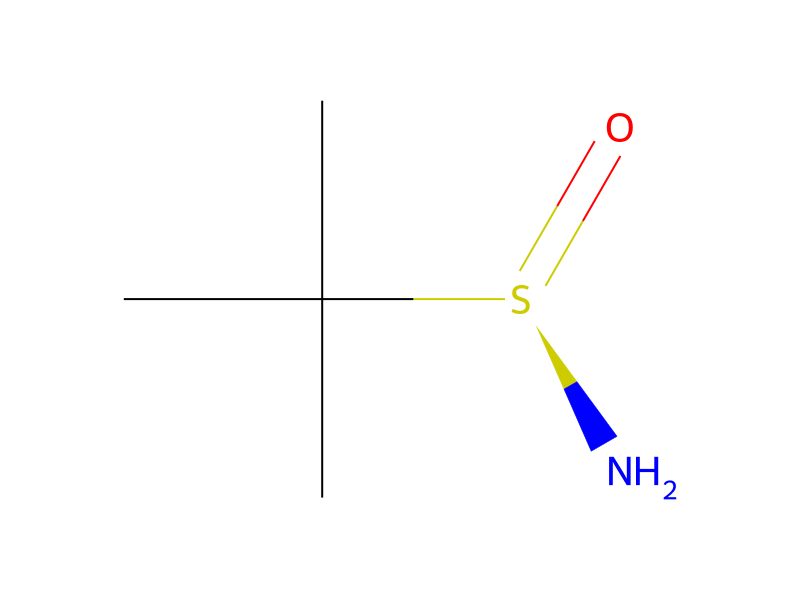
[Br:1][C:2]1[CH:6]=[C:5]([CH:7]=O)[O:4][N:3]=1.[CH3:9][C:10]([S@:13]([NH2:15])=[O:14])([CH3:12])[CH3:11]>C(Cl)Cl.CC(C)[O-].[Ti+4].CC(C)[O-].CC(C)[O-].CC(C)[O-]>[Br:1][C:2]1[CH:6]=[C:5](/[CH:7]=[N:15]/[S:13]([C:10]([CH3:12])([CH3:11])[CH3:9])=[O:14])[O:4][N:3]=1To a solution of 3-bromo-isoxazole-5-carbaldehyde (182 mg, 1.03 mmol) and (R)-(+)-2-methyl-2-propanesulfinamide (150 mg, 121 mmol) in CH2Cl2 (2 mL) was added titanium (IV) isopropoxide (0.667 mL, 2.28 mmol) and the mixture was warmed at reflux. After 22 hours, the solvent was concentrated in vacuo and the remaining solution was diluted with EtOAc (33 mL) and saturated aqueous NaCl (6 mL) was added. The resultant heterogeneous mixture was stir at room temperature. After 30 minutes, the mixture was filtered through a pad of diatomaceous earth. The EtOAc layer was dried over Na2SO4, filtered and concentrated in vacuo. The crude material was purified by silica gel chromatography eluting with a gradient of 0-100% EtOAc in heptane to afford 2-methyl-propane-2-sulfinic acid 1-(3-bromo-isoxazol-5-yl)-meth-(E)-ylideneamide.