StartseiteMCPWorkbenchSkills
StartseiteWorkbenchBenachrichtigungenMein Bereich
llms.txt · MCP-AnleitungDatenschutz · Nutzungsbedingungen · Supportv1.8.3
  1. Startseite
  2. /Reaktion

Hydrochloric Acid → HCID 178448898, Verbindung

HRID 1366542
Drucken

Reaktionsgleichung

Reaktionsgleichung von HRID 1366542
CC(OC([N:8](C(OC(C)(C)C)=O)[N:9]([C:17]1[C:22]([F:23])=[C:21]([NH:24][CH2:25][C:26]([CH3:34])([N:28]2[CH2:33][CH2:32][O:31][CH2:30][CH2:29]2)[CH3:27])[N:20]=[C:19]([Cl:35])[N:18]=1)C(OC(C)(C)C)=O)=O)(C)C.Cl>CO.O1CCOCC1>[Cl:35][C:19]1[NH:20][C:21]([NH:24][CH2:25][C:26]([CH3:34])([N:28]2[CH2:33][CH2:32][O:31][CH2:30][CH2:29]2)[CH3:27])=[C:22]([F:23])[C:17](=[N:9][NH2:8])[N:18]=1
KomponentenVersuchsvorschriftAufarbeitungQuellen und NachweiseNotizen zur Reaktion

Komponenten

5

Edukt 2

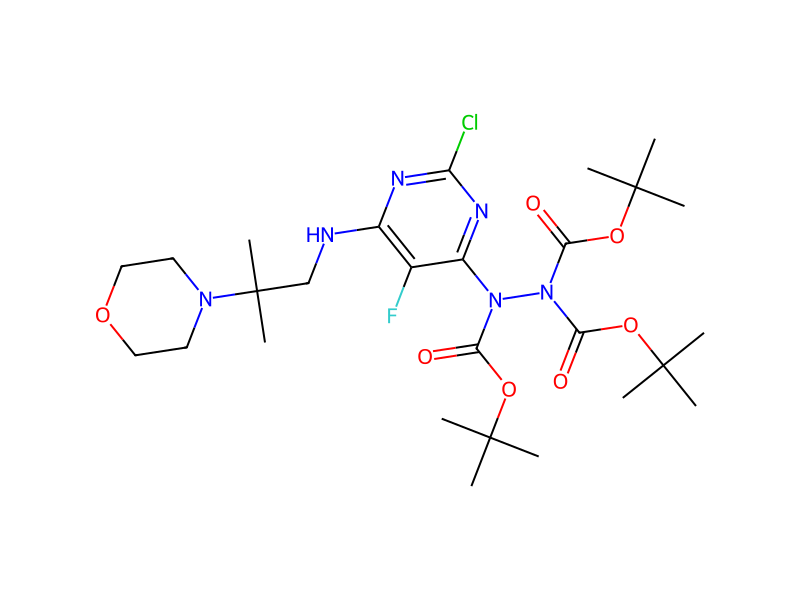
HCID 313Hydrochloric AcidHCID 86636980Tris(1,1-dimethylethyl) 2-(2-chloro-5-fluoro-6-{[2-methyl-2-(4-morpholinyl)propyl]amino}-4-pyrimidinyl)-1,1,2-hydrazinetricarboxylate

Produkt 1

HCID 178448898HCID 178448898, VerbindungAusbeute 83,1 %

Reagenzien, Katalysatoren, Lösungsmittel 2

HCID 887MethanolLösungsmittel
HCID 31275
1,4-Dioxane
Lösungsmittel

Versuchsvorschrift

To a suspension of tris(1,1-dimethylethyl)2-(2-chloro-5-fluoro-6-{[2-methyl-2-(4-morpholinyl)propyl]amino}-4-pyrimidinyl)-1,1,2-hydrazinetricarboxylate (0.578 g, 0.94 mmol) in MeOH (8 mL) was added 4M HCl in 1,4-dioxane (8 mL), and the resulting mixture was stirred at room temperature overnight. The solvent was removed in vacuo, and the crude residue was treated with an aqueous K2CO3 extractive workup to provide 2-chloro-5-fluoro-6-{[2-methyl-2-(4-morpholinyl)propyl]amino}-4(1H)-pyrimidinone hydrazone as a brown oil (0.249 g). LCMS: (M+H)+=319.2.

Aufarbeitung

  1. customThe solvent was removed in vacuo
  2. additionthe crude residue was treated with an aqueous K2CO3 extractive workup

Quellen und Nachweise

ORD-Eintrag
ord-8108465012a749ea848552982a4231f8
Quelldatensatz
uspto-grants-2011_02
DOI
10.6084/m9.figshare.5104873.v1
Patentnummer
US07893056B2

Notizen zur Reaktion

Auf dieser SeiteKomponentenVersuchsvorschriftAufarbeitungQuellen und NachweiseNotizen zur Reaktion