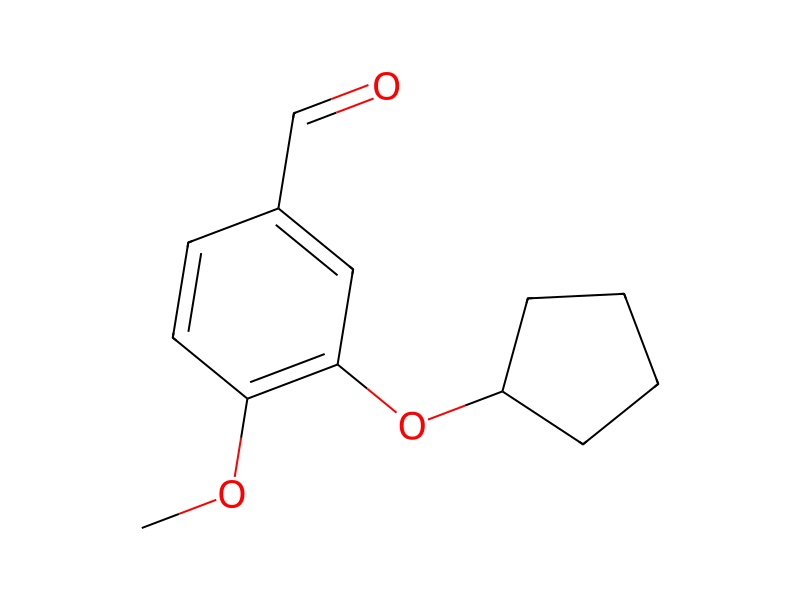
[Br-].[Cl:2][C:3]1[CH:28]=[CH:27][CH:26]=[C:25]([Cl:29])[C:4]=1[CH2:5][P+](C1C=CC=CC=1)(C1C=CC=CC=1)C1C=CC=CC=1.CC(C)([O-])C.[K+].[CH:36]1([O:41][C:42]2[CH:43]=[C:44]([CH:47]=[CH:48][C:49]=2[O:50][CH3:51])[CH:45]=O)[CH2:40][CH2:39][CH2:38][CH2:37]1>O1CCCC1>[CH:36]1([O:41][C:42]2[CH:43]=[C:44](/[CH:45]=[CH:5]/[C:4]3[C:25]([Cl:29])=[CH:26][CH:27]=[CH:28][C:3]=3[Cl:2])[CH:47]=[CH:48][C:49]=2[O:50][CH3:51])[CH2:37][CH2:38][CH2:39][CH2:40]1A stirred suspension of 2,6-dichlorobenzyltriphenylphosphonium bromide (2.5 g) in dry tetrahydrofuran (30 mL) is treated dropwise with a solution of potassium t-butoxide (0.56 g) in dry tetrahydrofuran (32 mL) at 0° C. After stirring at this temperature for 1 hour, it is treated with a solution of 3-cyclopentyloxy-4-methoxybenzaldehyde (1.1 g) in dry tetrahydrofuran (15 mL). The reaction mixture is stirred from 0° C. to 5° C. for 1 hour and 30 minutes, and then allowed to warm to room temperature. After stirring overnight, the mixture is concentrated and the resulting residue is treated with ethyl acetate (200 mL). The resulting organic solution is filtered. The filtrate is concentrated and the resulting residue is subjected to flash chromatography, eluting with dichloromethane, to give trans-1-(3-cyclopentyloxy-4-methoxyphenyl)-2-(2,6-dichlorophenyl)ethene (1.16 g), m.p. 47-49° C. [Elemental analysis: C,66.4; H,5.6; Cl,19.4%, calculated: C,66.1; H,5.55; Cl,19.5%].