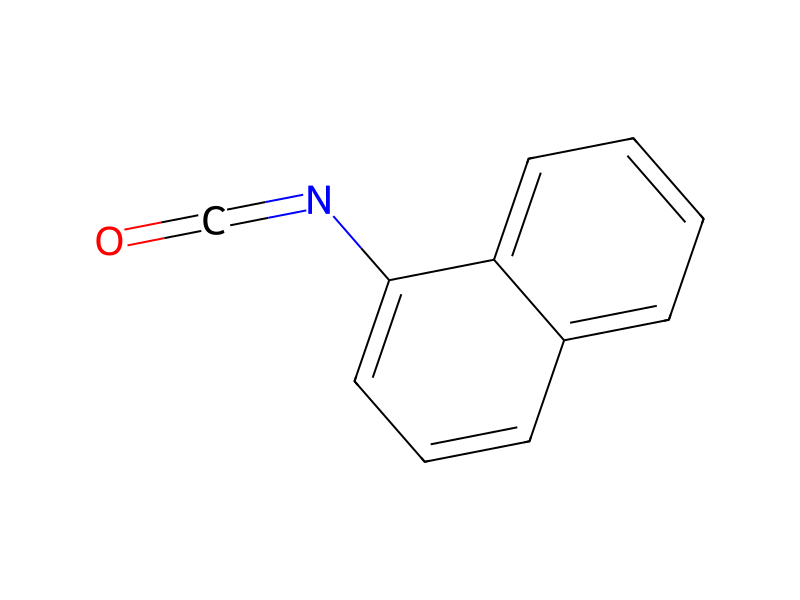
alpha-Naphthyl isocyanate → N-(2-Hydroxy-4-nitrophenyl)-N′-1-naphthalenylurea
Reaktionsgleichung

[OH:1][C:2]1[CH:8]=[C:7]([N+:9]([O-:11])=[O:10])[CH:6]=[CH:5][C:3]=1[NH2:4].[C:12]1([N:22]=[C:23]=[O:24])[C:21]2[C:16](=[CH:17][CH:18]=[CH:19][CH:20]=2)[CH:15]=[CH:14][CH:13]=1>>[OH:1][C:2]1[CH:8]=[C:7]([N+:9]([O-:11])=[O:10])[CH:6]=[CH:5][C:3]=1[NH:4][C:23]([NH:22][C:12]1[C:21]2[C:16](=[CH:17][CH:18]=[CH:19][CH:20]=2)[CH:15]=[CH:14][CH:13]=1)=[O:24]Komponenten
3


Versuchsvorschrift
N-(2-Hydroxy-4-nitrophenyl)-N′-(1-naphthyl)urea was prepared from 2-hydroxy 4-nitro aniline (500 mg, 3.24 mmol) and 1-naphthyl isocyanate (3.24 mmol) according to the procedure in General Method B. The product precipitated from methylene chloride and filtered. The resulting solid was titruated with 1:3 triethyl amine:methylene chloride. The filterate was concentrated in vacuo. The resulting residue was dissolved in methylene chloride and treated with 1N HCl in water. The desired product precipitated from solution and was collected by filtration (0.11 g, 10%). EI-MS m/z 324 (M+H)+
Aufarbeitung
- customThe product precipitated from methylene chloride
- filtrationfiltered
- concentrationThe filterate was concentrated in vacuo
- dissolutionThe resulting residue was dissolved in methylene chloride
- additiontreated with 1N HCl in water
- customThe desired product precipitated from solution
- filtrationwas collected by filtration (0.11 g, 10%)
Quellen und Nachweise
- ORD-Eintrag
- ord-8a14fd56e72b4c87b8a6079fa2f7f55f
- Quelldatensatz
- uspto-grants-2001_07
- Patentnummer
- US06262113B1
Notizen zur Reaktion
Wird geladen…